Ibiza has two reputations, and only one of them is loud. The other comes down to a date: in 1999 UNESCO added the island to the World Heritage List — not for its clubs, but for its walled old town and for the underwater meadows that give its water that clarity. In between there are whitewashed villages, a nature park covering more than 2,700 hectares of land, and coves you reach on foot. And in 2026 an administrative decision made that Ibiza far easier to enjoy than the other one: the island now caps how many vehicles may drive on it in summer. Here is how to plan the trip.
💶 Transparency: this article contains partner links. If you book through one of them we earn a commission, at no extra cost to you. It changes nothing in our recommendations, and the free or official option is named before the link every time one exists.
What the 2026 vehicle cap changes before you even leave
Let us start with the one thing that can spoil a trip before it begins. Since 2026, Ibiza limits the number of vehicles allowed to circulate on the island during the summer, and the measure is here to stay: the Consell d’Eivissa approved it for the 2026 and 2027 seasons.
The figures, as voted. The period runs from 1 June to 30 September. The ceiling is 17,668 vehicles per day, which is 2,500 fewer than in 2025. That quota is split: 14,000 places for hire cars (2,000 fewer than last year), 3,548 for tourists arriving with their own vehicle, and 120 for Formentera residents. Unauthorised entry can be fined up to 10,000 euros.
What that means in practice, case by case.
- You hire a car on the island, from a local agency: there is nothing for you to apply for and no fee to pay. The quota is handled by the rental company, not by you.
- You bring your own car on the ferry: this is where the paperwork lives. Authorisation is requested through Ibiza Circular, the Consell’s official platform, and the charge is one euro per day of stay within the regulated period.
- Exempt are vehicles whose holder is tax-resident in Ibiza, official and public-service vehicles, goods transport, and agricultural or construction machinery.
The details can be adjusted from one season to the next — the quota is set by a plenary agreement of the Consell, and we would rather send you to the official portal than promise you a calendar we do not control. The direction, though, is unmistakable: Ibiza is discouraging the car you bring and has changed nothing about the car you hire on arrival.
And here is the point nobody spells out: this constraint pushes you towards exactly the trip the rest of this article describes. Fewer cars means fewer people in the same places at the same hours.
Dalt Vila: the World Heritage is here, not in the clubs
In 1999 UNESCO inscribed a site called “Ibiza, Biodiversity and Culture”. The name says everything: the listing covers both the historical imprint left by Phoenicians, Carthaginians and Renaissance engineers and a marine ecosystem — the Posidonia seagrass meadows carpeting the seabed between Ibiza and Formentera, which filter the water enough to give it that clarity.
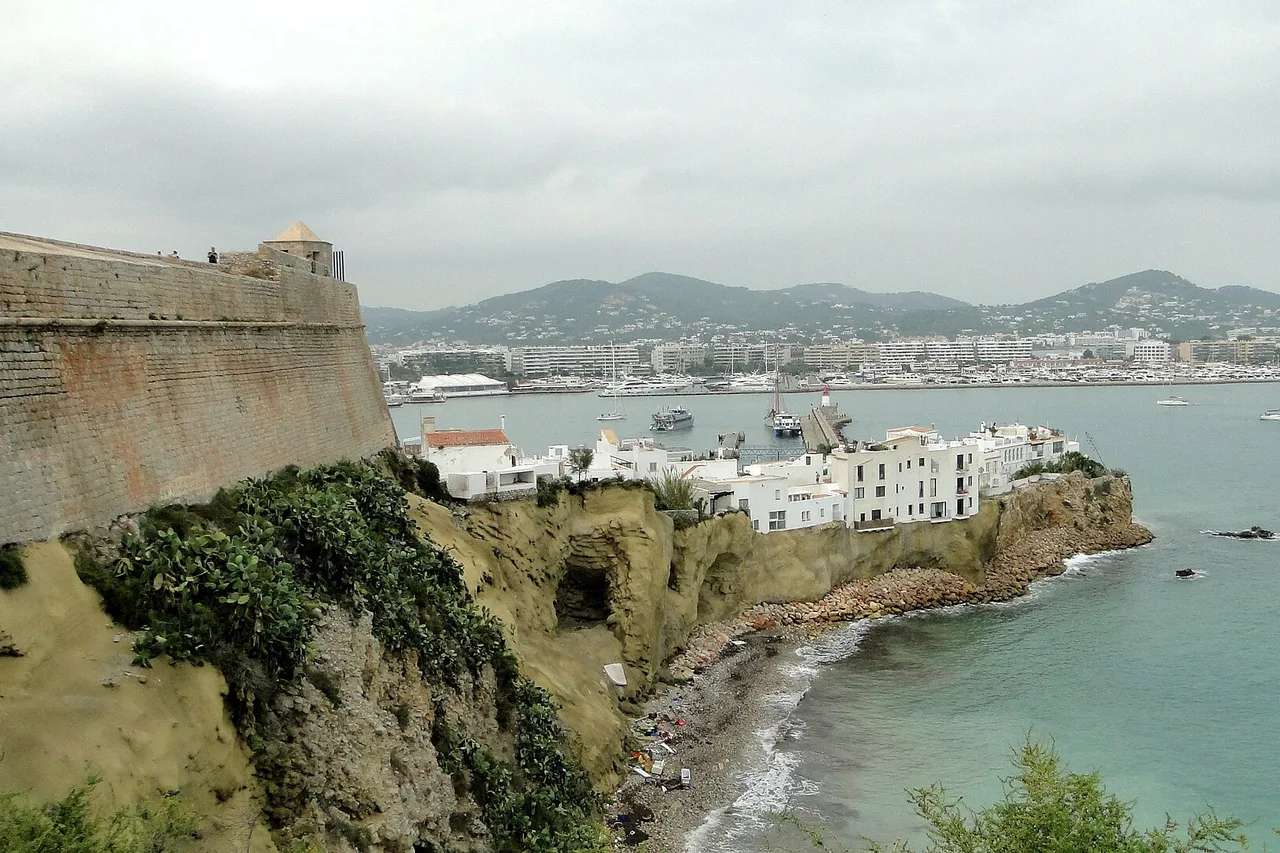
The visible half is Dalt Vila, the upper town of Eivissa, enclosed in a 16th-century bastioned wall. It is routinely described as the best-preserved coastal fortress in the Mediterranean, and you see why on the way up: the curtain walls are intact, the bastions are walkable, and the view from the ramparts takes in the harbour, the sea and Formentera on the horizon.
Two pieces of advice, both free. Go up early in the morning or late in the afternoon: the lanes are steep and cobbled, and there is no shade at all in the middle of the day. And walk the circuit along the ramparts rather than through the lanes: it is the emptier route, the more spectacular one, and it is free to enter.
The cathedral and the castle crown the summit. Below, the Sa Penya quarter and the old harbour make up the picture you take home from the island — the one you see from the walls, and which has nothing to do with what the word “Ibiza” usually summons.
The inland villages, and the market that opens even in February
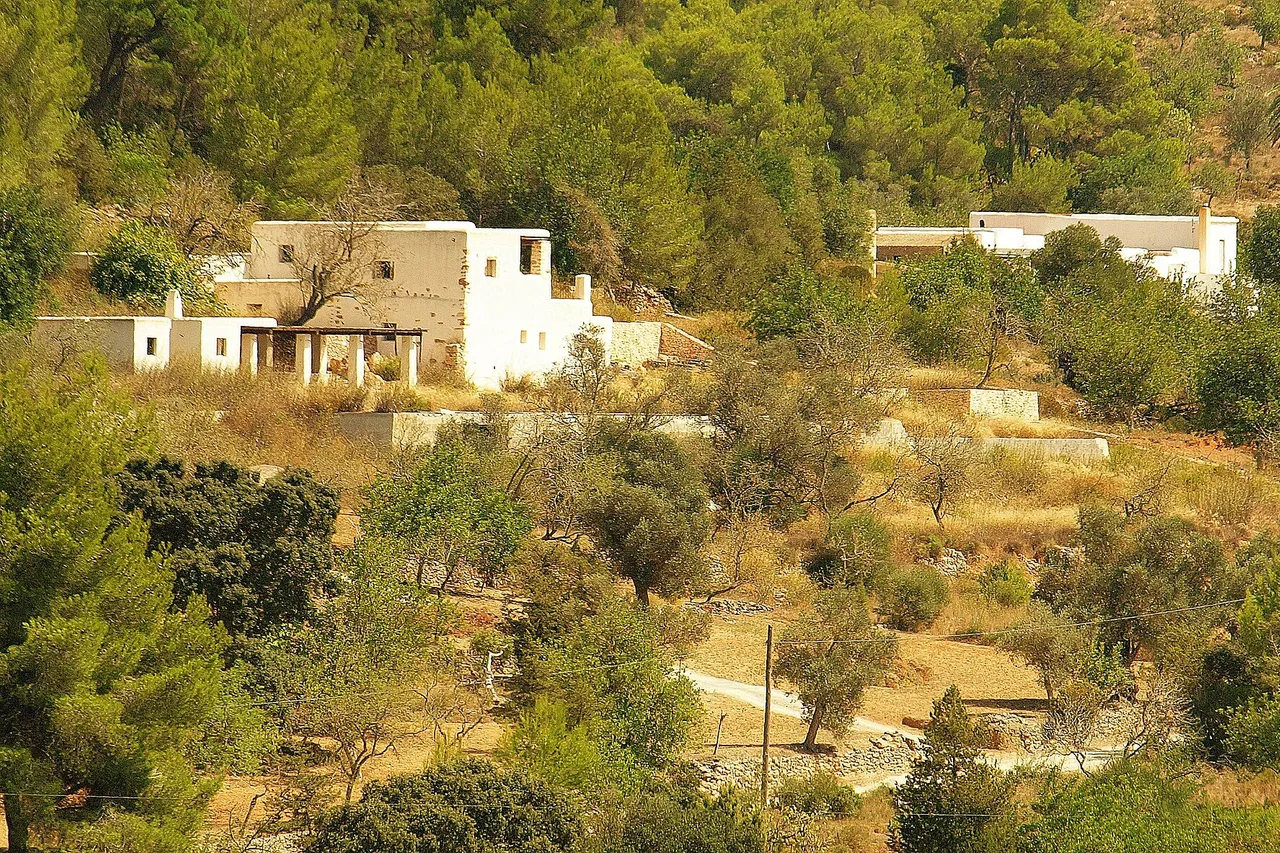
Inland Ibiza is farming country. You drive past dry-stone terraces, almond and carob trees, low whitewashed houses, and every so often a fortified church in the middle of a square. It is thirty minutes from the coast, and almost nobody goes.
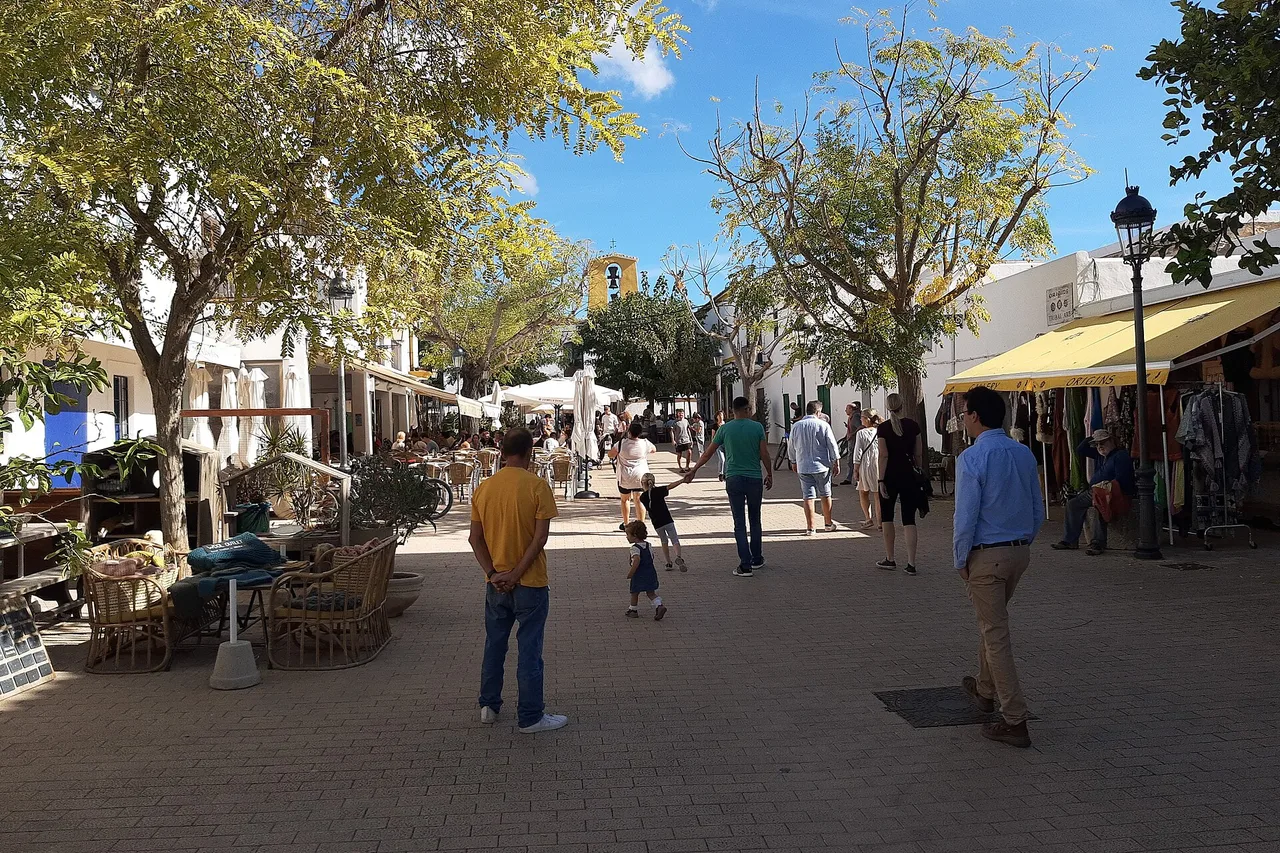
Santa Gertrudis de Fruitera is the easiest place to start: a pedestrian square, terraces, galleries and a typical white church. It is also the liveliest of the inland villages — meaning there are people on the square, not in the street at four in the morning.
Santa Agnès de Corona is the exact opposite: a hamlet, a church, and around it the Pla de Corona, a plateau planted with almond trees. In January and February the almond trees are in blossom there, and the plain becomes an outing for islanders. It is the only spectacle Ibiza offers in midwinter, and it costs nothing.
Sant Carles de Peralta, in the north-east, is home to Las Dalias, the island’s historic market — held there since 1985. Contrary to what most people assume, this is not a summer market: it opens on Saturdays almost all year. Here is its calendar as the organiser publishes it.
| Period | Days | Hours |
|---|---|---|
| January | closed | — |
| February – March | Saturday and Sunday | 10am–5.30pm (Sat) · 11am–5.30pm (Sun) |
| April – May | Saturday and Sunday | 10am–8pm (Sat) · 11am–8pm (Sun) |
| June and September | Saturday, plus night market Sunday to Tuesday | 10am–8pm · 7–11.30pm at night |
| July – August | Saturday, plus night market Sunday to Tuesday | 10am–10pm · 7pm–midnight at night |
| October | Saturday and Sunday | 10am–7pm (Sat) · 11am–6pm (Sun) |
| November | Saturday and Sunday | 10am–5pm |
| December | Christmas market, Saturday and Sunday | 10am–5pm (Sat) · 11am–5pm (Sun) |
The other big market, Punta Arabí at Es Canar, is larger and runs on Wednesdays from April to October: that is the one to aim for if you come in high season and want the fairground version. Out of season, Las Dalias remains the more interesting of the two — which is precisely the subject of this article.
Ses Salines: a nature park, salt and flamingos
The south of the island is taken up by the Ses Salines nature park of Eivissa and Formentera. It has been protected for a long time: a nature reserve since 1995, a nature park since 2001, and one of the elements included in the 1999 UNESCO listing. Its surface is considerable for such a small island: roughly 2,752 hectares on land and 14,028 hectares at sea.
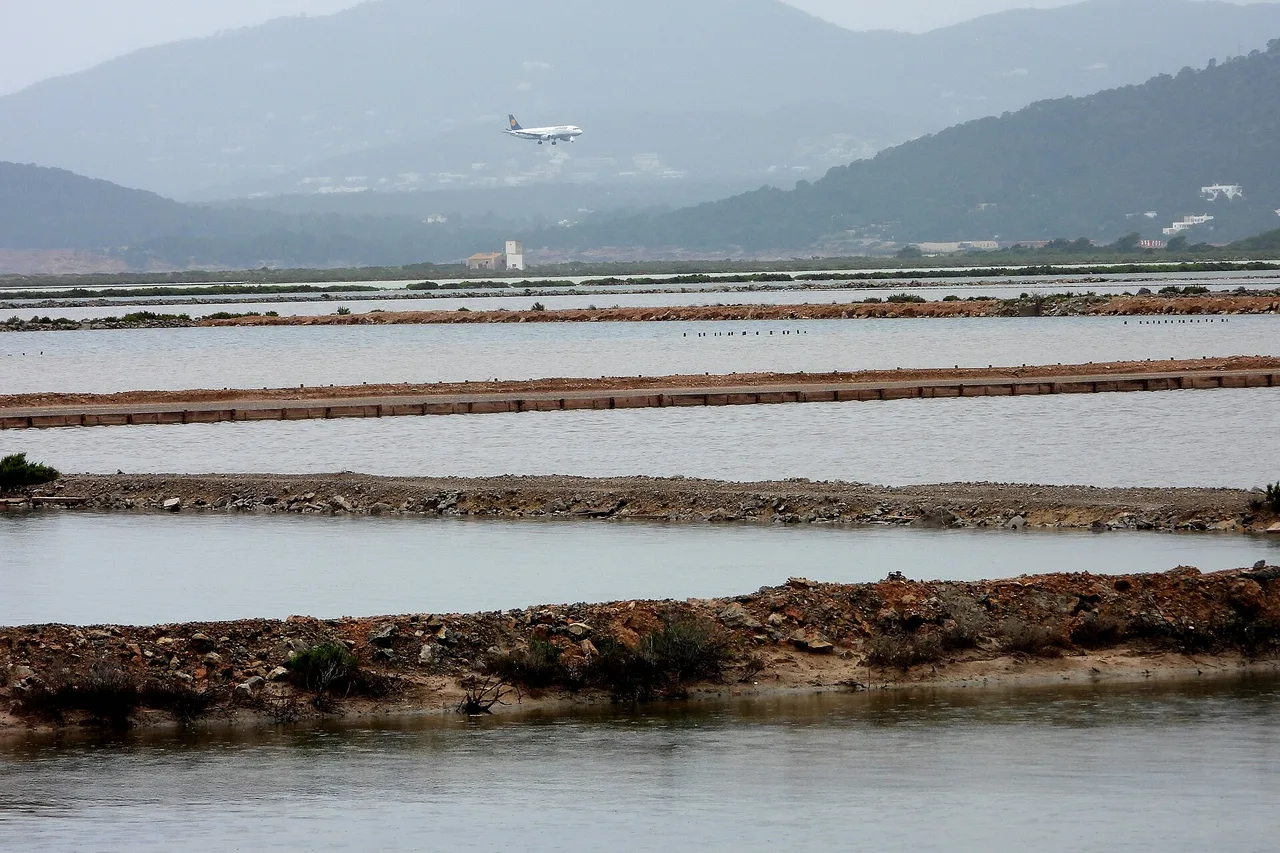
Three things here exist nowhere else on Ibiza. The salt pans themselves — evaporation basins still in production, lined up at water level. The birds: the site is a migration stopover, and flamingos use it regularly, above all in spring and autumn. And the dunes and salt habitats fringing the lagoons, now rare in the western Mediterranean.
The park is walked or cycled, from Sant Jordi or from the beach car parks. Two rules, and they are not decorative: stay on the marked paths — the dune system is fragile and protected — and do not approach the birds; watching is done from a distance. There is also something comic about it: the park sits under the airport approach, and the aircraft pass low over the basins.
A word on Posidonia, since it earns the island half its listing. These underwater meadows are not seaweed but a flowering plant; they shelter wildlife, hold the seabed together and, when washed up in winter, form those brown banks that protect the sand from erosion. When you see them on a beach, do not think it is dirty: it is healthy.
The coves of the west and north, and when to go
The beaches that built the island’s party reputation are in the south and immediately west of Sant Antoni. The ones described here are elsewhere, and they are nothing like each other.
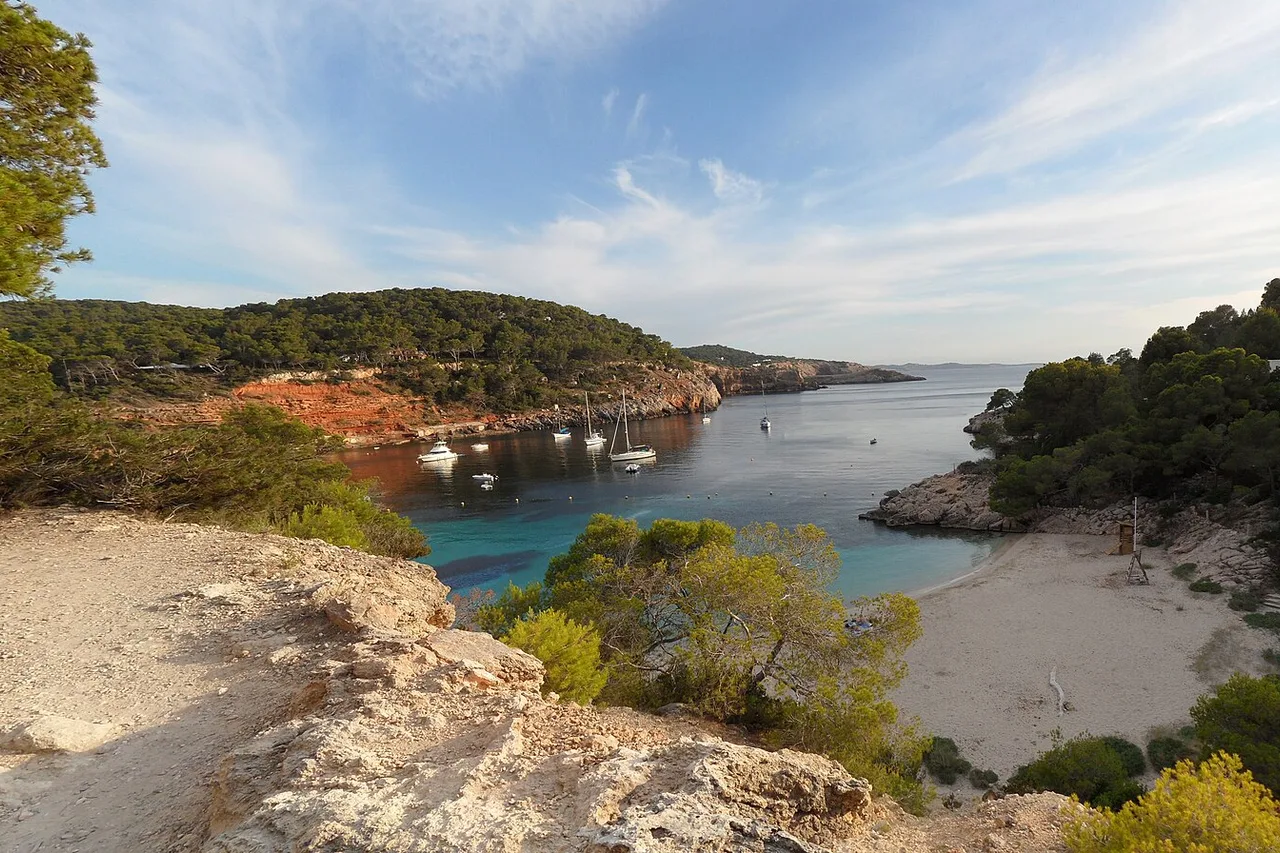
Cala Salada and Cala Saladeta, north of Sant Antoni, form a twin cove cut into a pine wood, with very pale turquoise water. Saladeta, the smaller of the two, is reached from Salada by a short but uneven path over the rocks — which is exactly what protects it. Parking is limited and regulated in high season: arrive early, or come out of season.
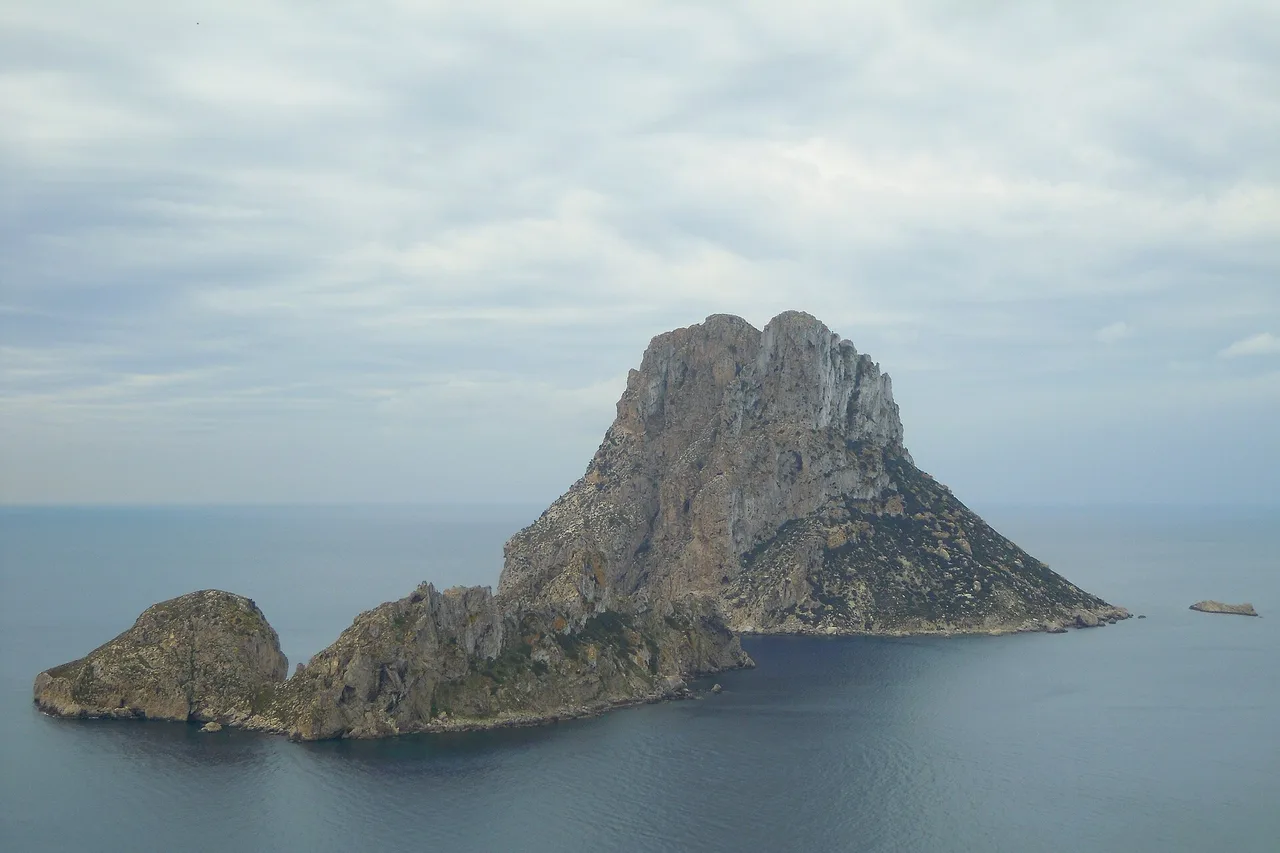
Cala d’Hort, in the south-west, is the beach from which you see Es Vedrà whole. This limestone islet, 382 metres high, rises out of the sea a short way offshore; together with Es Vedranell (123 metres) and the Illots de Ponent it has formed a nature reserve since 2002. It is the island’s most photographed sunset, and it costs nothing.
Benirràs, in the north, has kept its tradition of drumming at sunset around the Es Cap Bernat rock. It is a party, but it is not the Ibiza party: it ends when the sun goes down.
And the month matters more than the place. Everything above reads differently by season: in July and August these coves are full and parking is the real obstacle; in May, June, September and October they are the same coves without the queue, with sea still warm in September. In January and February the island belongs to the almond trees and the walkers — but many seafront restaurants are shut, and you have to accept that.
Getting around: hire on the island, or do not drive at all
Ibiza measures about forty kilometres at its longest, and its highest point, Sa Talaia, does not exceed 475 metres. Nothing is far. But the interior and the north cannot be reached without a vehicle: that is where the villages and the cove trailheads are.
Let us come back to the quota from the first section, because it settles the question. Hiring on the island exempts you entirely from the application and the one euro a day; bringing your own car by ferry puts you inside the scheme, and the private quota is the tightest of the three — 3,548 places against 14,000 for hire cars. For a one- or two-week stay, hiring locally is both simpler and less bureaucratic.
Comparing local car-hire agencies in Ibiza gives a realistic picture of the terms before you commit: local firms cover the airport and the port of Eivissa, often ask for lighter deposits than the big chains, and publish their season prices well in advance. One honest caveat: in July and August the constraint is no longer price but availability — 14,000 vehicles a day is a ceiling, not a promise. Book early.
And if you do not want to drive at all? It works, provided you choose your base. Staying in Eivissa or Santa Eulària puts the old town, the salt pans and some of the beaches within bus and taxi reach; the north will stay out of reach. For the arrival, booking an airport transfer in advance avoids the summer-evening taxi queue and is shared between passengers — the airport is a quarter of an hour from town, but three quarters of an hour from the northern villages.
One last piece of advice, and it costs nothing: do not stay where you do not want to sleep. West Sant Antoni and Platja d’en Bossa are the two poles of the nightlife. Santa Gertrudis, Sant Joan de Labritja, Sant Carles or Santa Eulària give you the same island, twenty minutes’ drive away, without the bass.
In short
The three things to remember:
① The island has been UNESCO-listed since 1999 — Dalt Vila and the Posidonia meadows. Free to enter, free of charge, and the opposite of what the word “Ibiza” evokes.
② The interior exists and can be visited all year — Santa Gertrudis, Santa Agnès and its almond blossom in January and February, Las Dalias on Saturdays (closed in January only).
③ The south is a nature park — Ses Salines, roughly 2,752 hectares on land and 14,028 at sea, protected since 1995, with its salt basins and its flamingos.
The 2026 arithmetic: from 1 June to 30 September, Ibiza caps circulation at 17,668 vehicles a day. Hiring on the island requires no application at all; bringing your own car requires authorisation through Ibiza Circular and one euro a day, within a quota of just 3,548 places.
The best time: May, June, September and October give you the same coves without the queue. January and February give you almond blossom and an empty island — but many seafront addresses are shut.