The two islands almost touch — eleven kilometres of strait, twenty-five minutes by ferry — and they look alike from the plane: basalt, very little green, a great deal of sky. On the ground they are opposites. Lanzarote is a designed island: the artist César Manrique imposed an aesthetic on an entire territory, and UNESCO listed the whole of it — villages and hotels included — as a biosphere reserve on 7 October 1993. Fuerteventura is an empty one: twice its neighbour’s surface, 35,000 fewer inhabitants, and beaches where you can walk for an hour without meeting anyone. So the choice is not made on the weather, which is almost identical, but on what you are going there to do.
Two figures explain everything else: twice the surface, two and a half times fewer people
Start with what no photograph shows. Fuerteventura covers 1,659.74 km² and had 131,502 inhabitants in April 2026. Lanzarote covers 845.94 km² with 166,878 inhabitants (2025). In other words, the larger of the two islands is also the emptier one, and the gap is not small — roughly 79 inhabitants per square kilometre on Fuerteventura against 197 on Lanzarote, two and a half times the density on the island half the size.
Tourism follows the same slope. According to the ISTAC monthly figures for 2025, Lanzarote consistently takes 17 to 18% of the tourists arriving in the Canaries and Fuerteventura 14 to 15% — Lanzarote remains the third most visited island in the archipelago, behind Tenerife and Gran Canaria. Add the two effects together: on Fuerteventura, fewer people are spread over twice the space.
That produces a very concrete difference in a holiday day. On Lanzarote, everything is under three quarters of an hour away: you can fit two sites and a beach between breakfast and an early drink. On Fuerteventura the distances are real — it takes over two hours to drive from Corralejo in the north to Morro Jable in the far south — and the reward is a beach where you may well be alone.
Lanzarote: the only Canary Island that was designed
This is the trait no other island in the archipelago shares. In the 1960s and 1970s the painter and architect César Manrique, born in Arrecife, persuaded the local authorities to treat tourism development as an aesthetic project rather than a property operation. Rules from that period are still applied: no advertising hoardings along the roads, low white buildings, green shutters inland and blue ones on the coast.
What remains above all is a series of public places that are themselves works: the Jameos del Agua and the Cueva de los Verdes, set inside the lava tube of the Corona volcano; the Mirador del Río, cut into the cliff facing La Graciosa; the Jardín de Cactus, laid out in a former lapilli quarry. UNESCO recognised this singularity on 7 October 1993 by listing the entire island as a biosphere reserve — the first time an inhabited territory, with its villages and its tourist infrastructure, was listed in its entirety rather than an untouched natural area.
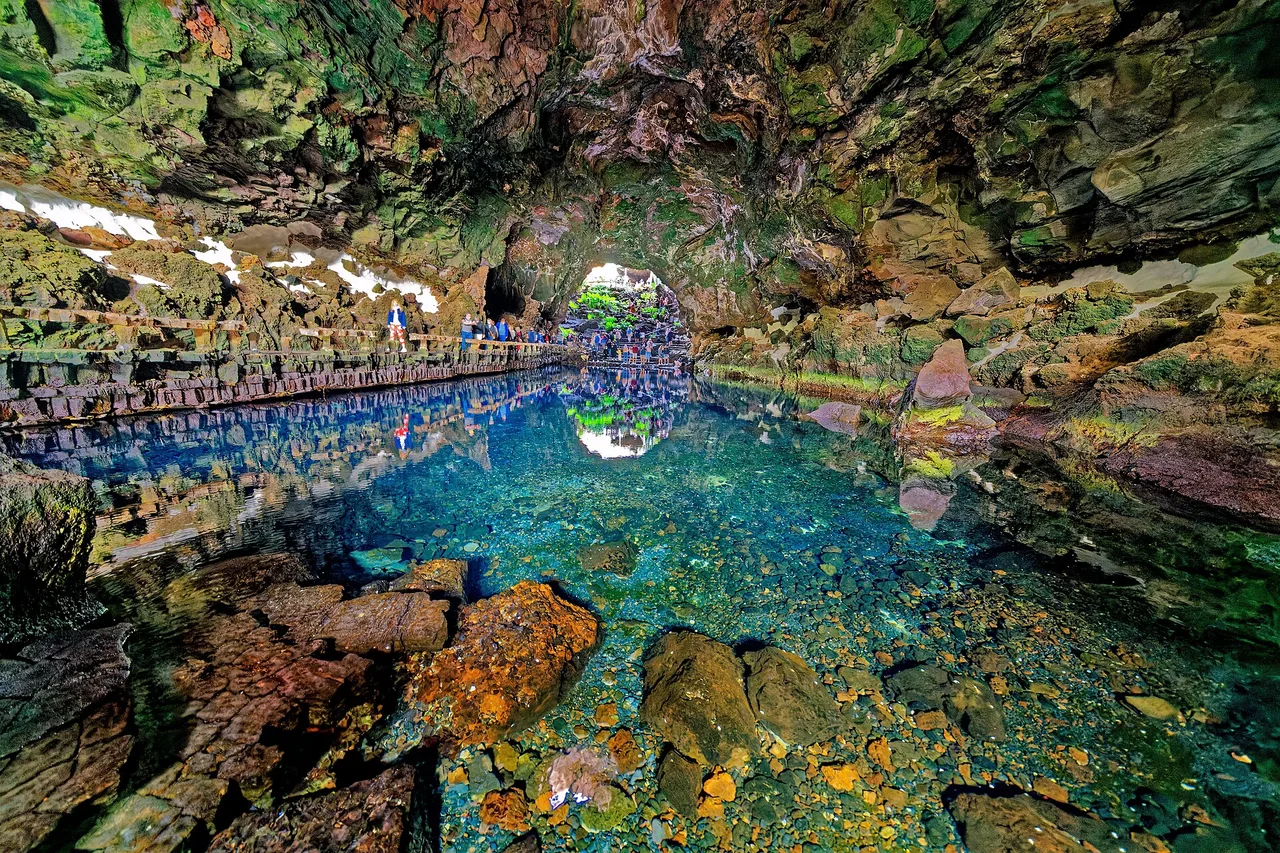
The practical consequence fits in one sentence: on Lanzarote there are things to visit. It is an island for a programme, where you fill your days with a list of named places. If you are the kind of traveller for whom a week on a beach is a week wasted, this is your island.
Timanfaya: what the visitor figure does not tell you
Timanfaya National Park is Lanzarote’s heaviest argument, and it deserves its reputation. The landscape comes from an eruption that lasted six years, from 1730 to 1736: the rock is so recent that it has not had time to cover itself with soil, and geothermal heat still comes within a few metres of the surface.
One detail is worth knowing beforehand, because it changes how the figures read. The Mancha Blanca visitor centre received a little over 262,000 people in 2024, while the Cabildo of Lanzarote counts 1,492,435 visitors for the park as a whole over the same year. These are not two versions of one number: they are two different counters, one on a building, the other on a territory. The practical conclusion matters more: people come here by the million, and you do not walk freely — the heart of the park is visited by coach, on the Ruta de los Volcanes, to protect ground that does not repair itself.

Fuerteventura: fourteen kilometres of beach, and nobody on it
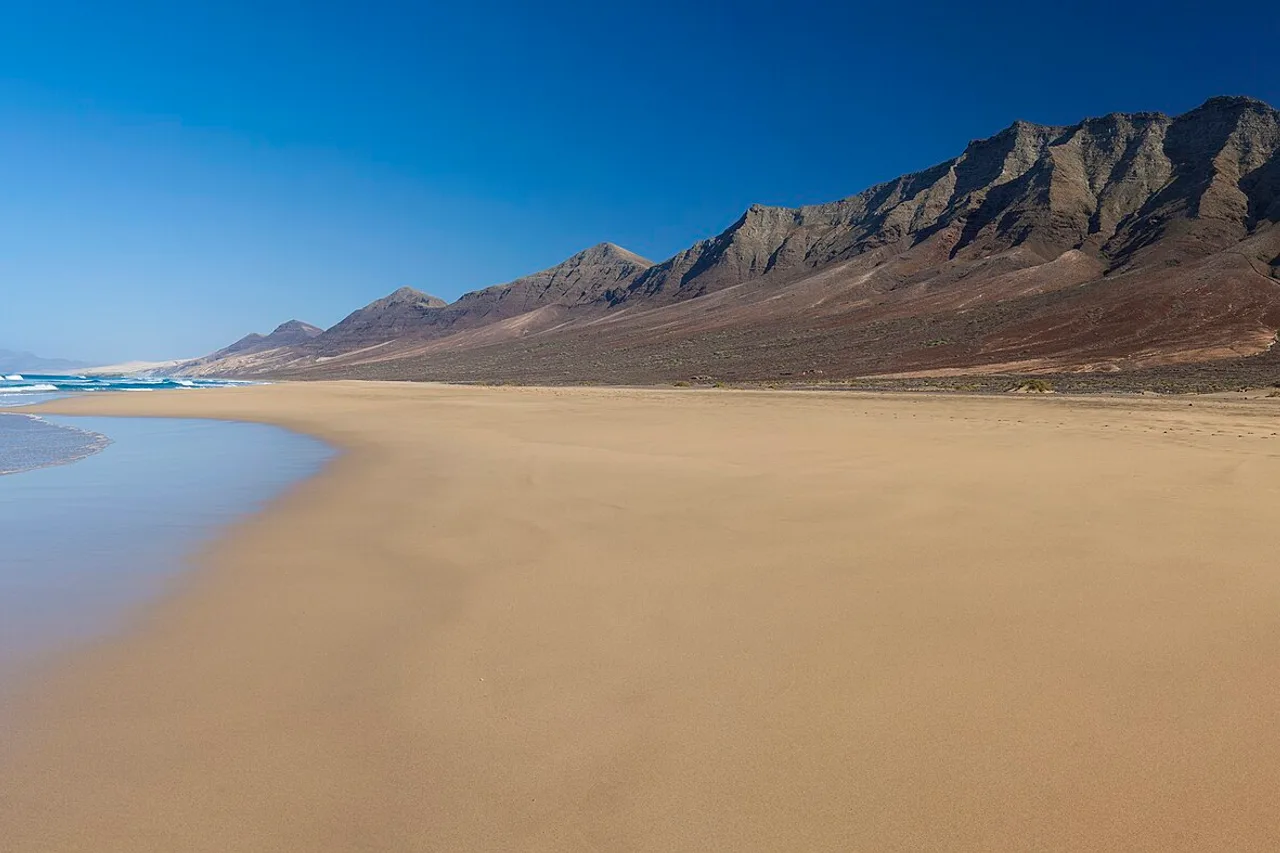
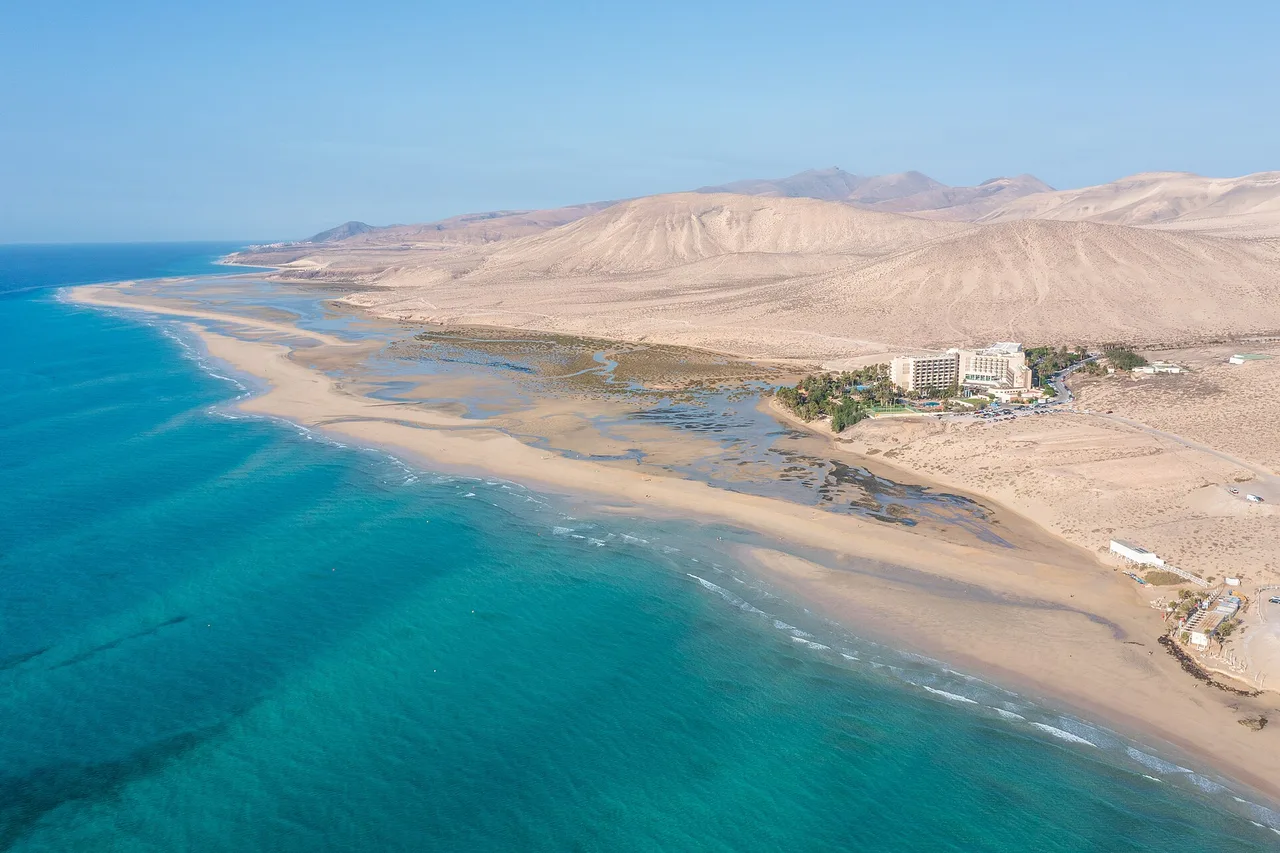
At the far south of Fuerteventura, behind the Jandía massif, Cofete beach runs for more than fourteen kilometres. You reach it by a dirt track, there is neither a kiosk nor a lifeguard, the currents are serious — and that is precisely why it has stayed what it is. It is the best summary of the island: Fuerteventura does not offer you a programme, it offers you space.
The relief backs up that impression. The high point, Pico de la Zarza, reaches 807 metres in the Jandía massif, against about 670 metres for Peñas del Chache, the summit of the Famara massif on Lanzarote. Neither is high enough to block the trade winds and build a genuine wet side, as Tenerife or La Palma do: both islands stay dry and bright from end to end.
UNESCO listed Fuerteventura as a biosphere reserve on 27 May 2009, sixteen years after its neighbour, and the reserve’s record says the essential thing: 353,500.6 hectares, of which 53.14% is marine. Here it is not the architecture that is protected, it is first of all the sea. In the north, the Corralejo dunes natural park covers 2,668.7 hectares of pale sand set against the ocean, facing the islet of Lobos and, behind it, Lanzarote.

The wind: the same trade wind, two opposite uses
Both islands get the same north-easterly trade wind, which strengthens markedly from May to September. But they do different things with it. On Playa de Sotavento, on the Jandía peninsula, the probability of 25 to 30 knots over that period is 75 to 95%: this is what made Fuerteventura a world capital of windsurfing and kitesurfing, and what brings a competition circuit back every summer.
Lanzarote has its equivalent, in another discipline: Famara, the long beach at the foot of the cliff of the same name, is a recognised surf spot, with currents that make it a poor choice for swimming. So both islands have wind — the question is whether you are coming to find it or to escape it.
Because there is a downside, rarely written down: in July and August a beach fully open to the north-east can be distinctly uncomfortable, sand in the eyes included, when the hotel photograph promised the opposite. The remedy is the same on both islands: pick a sheltered cove, or change coast. On Lanzarote the Papagayo beaches in the south are the best protected; on Fuerteventura the south-east face of Jandía around Costa Calma is gentler than the northern tip.
The weather does not decide it: thirteen millimetres of rain apart per year
This is the bad news for anyone hoping for a simple tiebreaker. According to the 1981-2010 climate normals of AEMET, the Spanish meteorological agency, Fuerteventura airport receives 98 mm of rain a year and Lanzarote airport 111 mm. Thirteen millimetres apart — which, over a week’s holiday, is strictly nothing.
The thermometer does no better. Both airports show the same annual mean, 21.1 °C, and a mean January maximum of 20.6 °C on Fuerteventura against 20.7 °C on Lanzarote. It needs saying plainly, because many articles imply otherwise: between these two islands, the weather is not a selection criterion. It is one between the east and the west of the archipelago, or between the north and the south of a single island — not here.
La Geria or the kilometres: the test that really decides
What remains is what you will do with your days, and that is where it is settled. Lanzarote has an agricultural landscape that exists nowhere else: La Geria, where every vine is planted at the bottom of a hollow dug several metres into the lapilli, sheltered from the wind by a crescent-shaped dry-stone wall. Thousands of these craters cover the slope, and you can taste the malvasía at the producers. It is a place you visit, photograph and talk about afterwards.
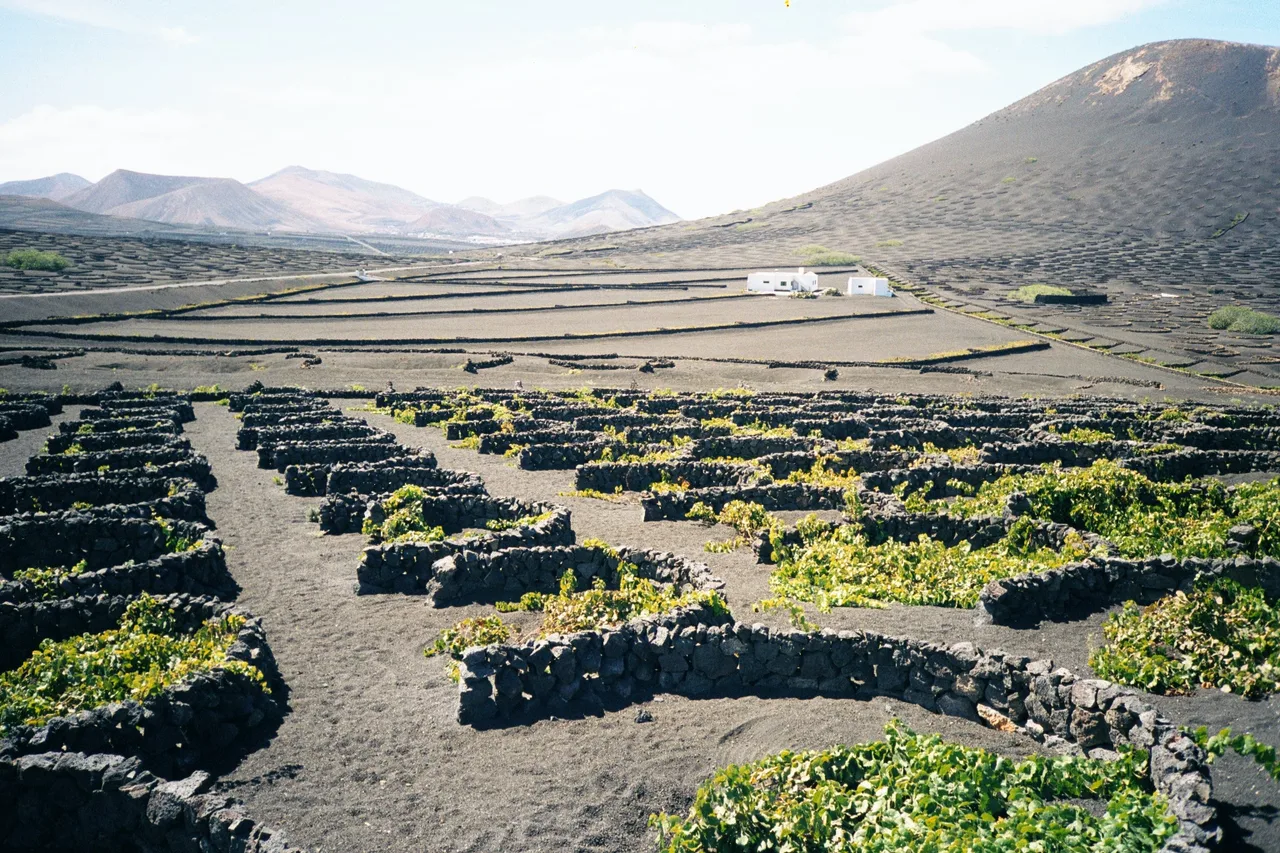
Fuerteventura has nothing comparable to show, and does not try. Its heritage is quieter — Betancuria, the old capital set in an inland valley, the windmills, the goat herds and the majorero cheese that comes from them. You come for the emptiness, not for the list.
Hence a very simple test, and honestly a more reliable one than any beach comparison. Write down what you want to see. If it fits into eight named places, take Lanzarote. If it fits into one sentence — “an empty beach” — take Fuerteventura.
The car, the transfer, and the ferry that makes the choice less final
The vehicle question is not the same on the two islands. On Fuerteventura a car is essential: the distances are real, buses link the main resorts but not the beaches that make the island worth the trip. On Lanzarote it is very useful without being strictly compulsory if you stay in Playa Blanca or Puerto del Carmen and accept an organised excursion for Timanfaya.
Good to knowIn high season, cars get booked up fast and prices rise as the dates approach. Comparing local rental companies before you go lets you lock in the car and the rate in the Canaries, with deposit and insurance shown upfront.
Rent a car in the CanariesLocal rental companies on LocalrentOne point to check before booking, because it catches many people out: a good number of rental companies forbid taking their vehicle on the inter-island ferry, or require written permission. If your plan is to do both islands with the same car, read the contract before you pay for the crossing. Comparing the local Canary rental agencies lets you see those conditions before committing — local agencies in the archipelago are often cheaper than the big networks, with lighter deposits.
Full guide: Car hire in the Canary Islands: prices, deposit, ferries
If you land at night, or if you have decided against a car, a transfer booked in advance avoids the taxi queue outside the airport, on Fuerteventura as on Lanzarote. Conversely, for Timanfaya and the Manrique centres, buy at the official Cabildo desks: there is nothing to gain from a reseller.
Finally, the good news: you do not have to choose. The Corralejo – Playa Blanca ferry takes about 25 minutes on the fast boat, and four companies run the route — Fred. Olsen Express, Naviera Armas, Balearia and Líneas Marítimas Romero — with several departures a day in each direction. We have no ferry operator in our portfolio: book direct with the company, that is where the price is best. A day trip to Timanfaya from Corralejo is perfectly feasible; so is a week split in two, if you accept moving hotel in the middle.
| You are coming for… | The island | Why | What you have to accept |
|---|---|---|---|
| Sightseeing, having a programme | Lanzarote | Timanfaya, the Manrique centres, La Geria: a list that fills five days | More people, and a ticket to pay at every stop |
| An empty beach, for hours | Fuerteventura | Cofete, Jandía, Sotavento: fourteen kilometres of sand without a single building | Driving time, and sometimes no facilities at all |
| Windsurfing or kitesurfing | Fuerteventura | 75 to 95% probability of 25-30 knots at Sotavento from May to September | The wind does not stop on the days you want to sunbathe |
| Surfing | Lanzarote | Famara and the north-west coast, at the foot of the cliff | Strong currents, and a beach poorly suited to swimming |
| A holiday without a car | Lanzarote | The southern resorts are compact and well served | Giving up the corners no bus reaches |
| A quiet family holiday | Both | Playa Blanca and Papagayo on Lanzarote, Corralejo on Fuerteventura | Check how exposed to the wind your chosen beach is |
| A first time in the Canaries | Lanzarote | Denser, more varied, easier to fill in a week | It is not the wildest island in the archipelago |
The most useful reading of that table fits in a line. Lanzarote is visited, Fuerteventura is crossed. Both are beautiful, both have the same climate, and neither is “better” than the other: they simply answer two holiday wishes that have nothing in common.
If a single piece of advice were needed for a first stay in this part of the archipelago: take a week on Lanzarote and book one ferry day for the Corralejo dunes. You will know, on the way home, which of the two islands is really calling you — and the question will not come up again.
Top-rated activities in the Canaries, bookable online: