Every guide ranks Santorini’s villages by the view. It is the wrong criterion, because it hides the one that decides each of your days: the island has a single transport hub, and it is Fira. Every bus route starts and ends there. Between two points that are not Fira, you need two buses and two tickets — and Kamari and Perissa, which can see each other from the sand, have no direct link at all. Here is the full calculation, village by village, and the two other things the advertised price does not tell you.
The Fira rule: the island has a single hub
Here is the fact that should open every Santorini accommodation guide, and opens none of them. The island’s bus network has one single point of passage: Fira bus station. All 11 destinations served — Oia, the south-eastern beaches, Akrotiri, the airport, the port — start there and return there. Cross-island links barely exist.
The consequence is mechanical. To get from a point A to a point B where neither is Fira, you need two buses and you have to buy a second ticket. This is not a low-season exception or a timetable flaw: it is the shape of the network itself.
Full guide: Santorini Excursions: What to Book and What It Costs
| The journey | Buses needed | How |
|---|---|---|
| Fira → a south-east beach | 1 | direct route |
| Oia → a south-east beach | 2 | change at Fira, second ticket |
| Kamari → Perissa | 2 | change at Fira, second ticket |
| Perissa → Oia | 2 | change at Fira, second ticket |
Look at the third row, because it catches everyone out: Kamari and Perissa have no bus between them. The two beaches are neighbours as the crow flies, but Mesa Vouno — the mountain that drops into the sea — separates them, and the road goes around. There is a direct crossing over the top, via the Ancient Thera site: it is a steep hike, not a shortcut to dinner.
Let us translate that rule into a real week. Over six days out, two of them spent in Fira itself:
| Where you sleep | Tickets over the week | Ticket cost |
|---|---|---|
| In Fira | 12 | 21.60 € – 38.40 € |
| Anywhere else on the island | 20 | 36.00 € – 64.00 € |
| What “anywhere else” costs | + 8 | + 14.40 € – 25.60 € |
The money gap is modest — the price of two coffees. That is not where the question is settled. It is 8 extra rides, so 8 more waits, often in the same spot, with timetables that shift with the season. That is the true price of sleeping away from the hub: not euros, but half-hours.
📌 A word on timetables, because it holds for the whole island: the service is frequent from April to October and reduced in winter, but the boards move with the season, school days and ferry traffic. The board at Fira bus station is the authority, and nothing else. And bring change: rides cost 1.80 € to 3.20 €, cash only.
Arrival: the one moment your chosen village does not help
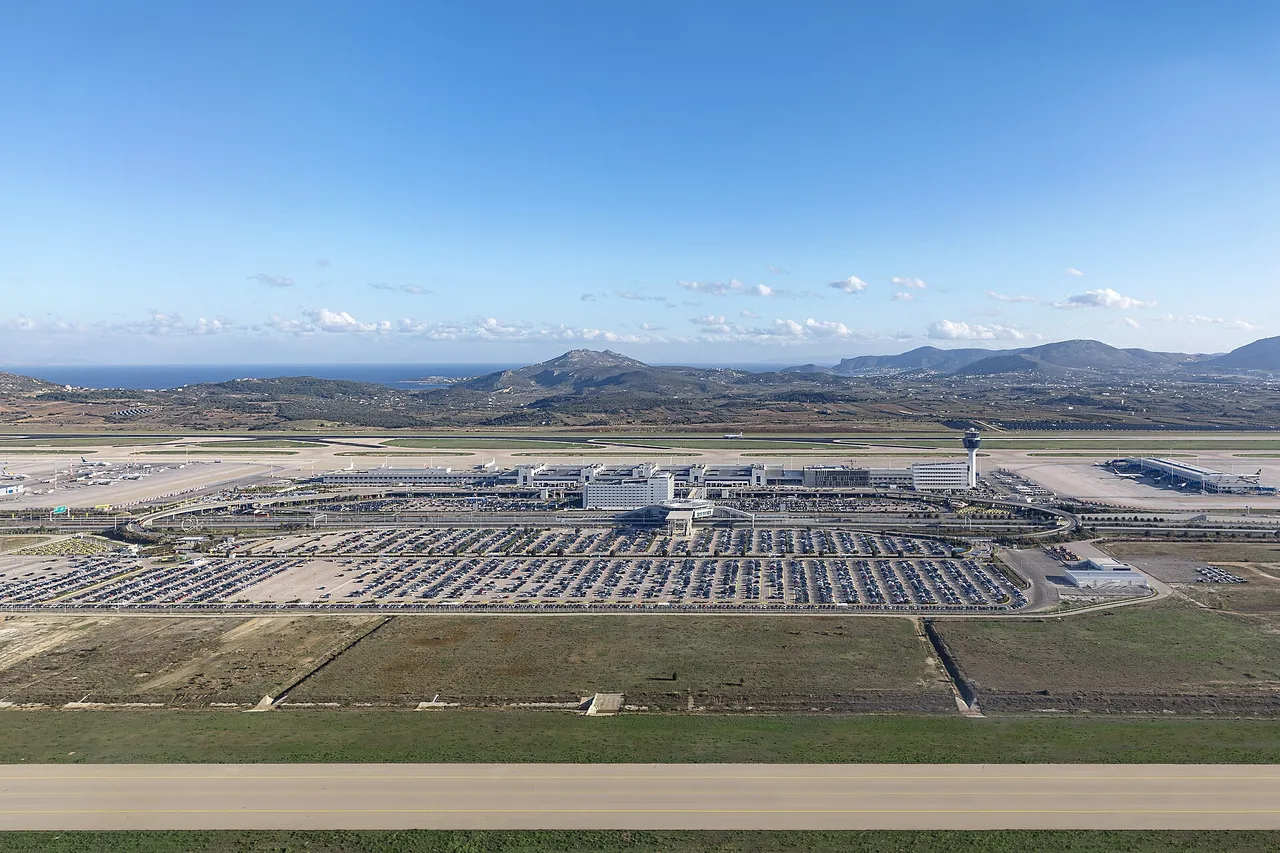
Whatever your village, the first hour on the island happens in the same place and the same way. Santorini has very few taxis, and the rank at Athinios port is notoriously chaotic every time a ferry lands: there is no guarantee one will be waiting, and if you are not among the first off the boat, the wait can be long.
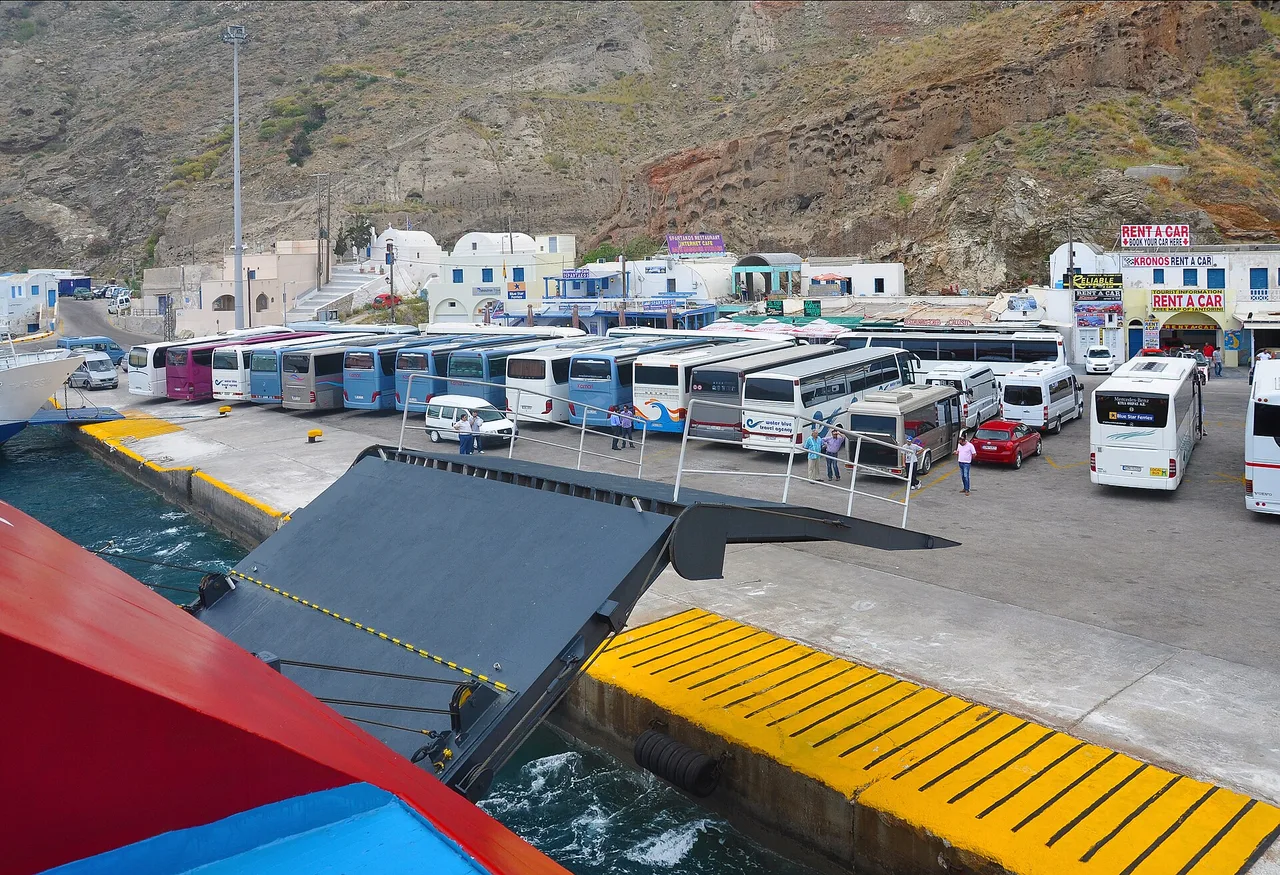
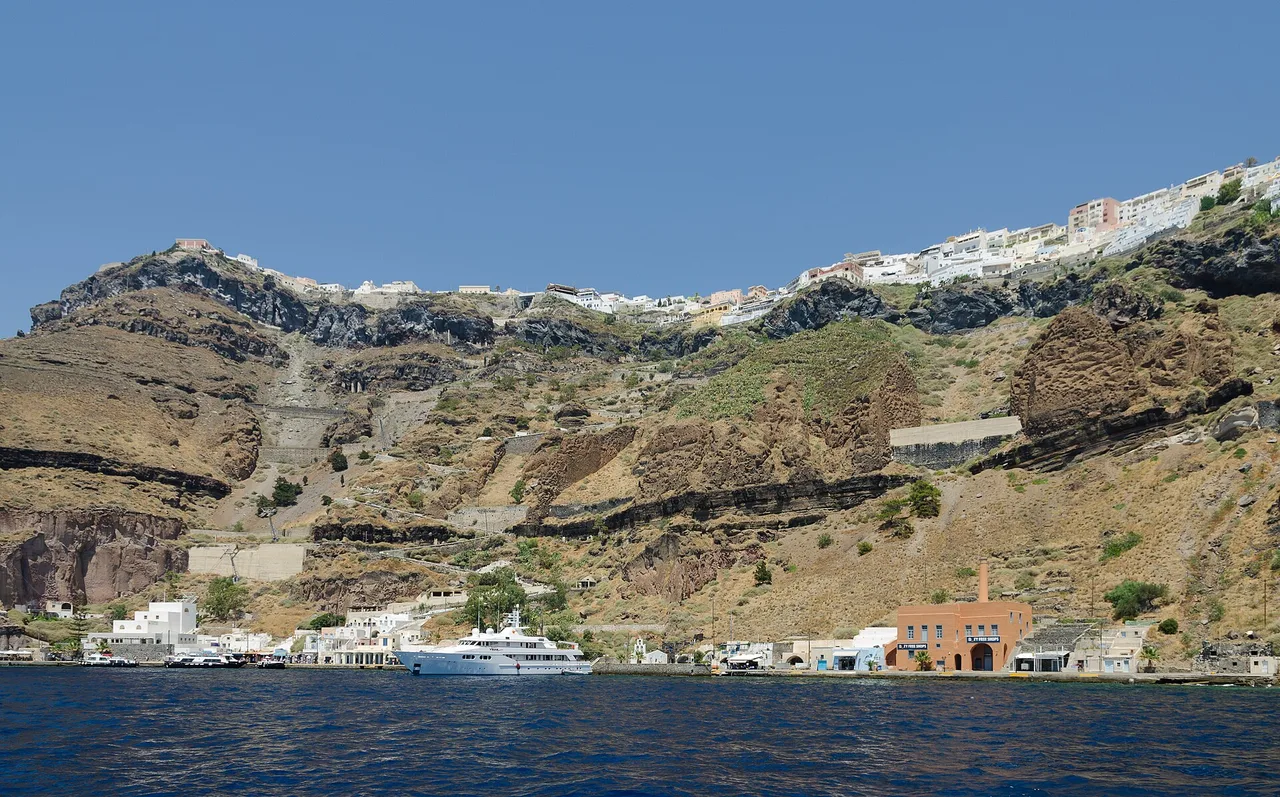
Add the setting: the port sits at the foot of a cliff, the road climbing out of it is a series of hairpins, and everybody disembarks at once. This is the one stretch of the trip where your choice of village changes nothing at all — and also the one where planning ahead changes everything. A transfer booked in advance, from the port or the airport to your village does not make the drive faster; it removes the only part that depends on you, namely finding a vehicle among three hundred people looking for one.
⚠️ An honest caveat: if you arrive by plane at a quiet hour and you are staying in Fira, a bus does the job perfectly well. The reasoning above holds for ferry arrivals, night arrivals, and villages where the last stretch is awkward — which is precisely the subject of the next section.
The last stretch is on foot, and it has steps
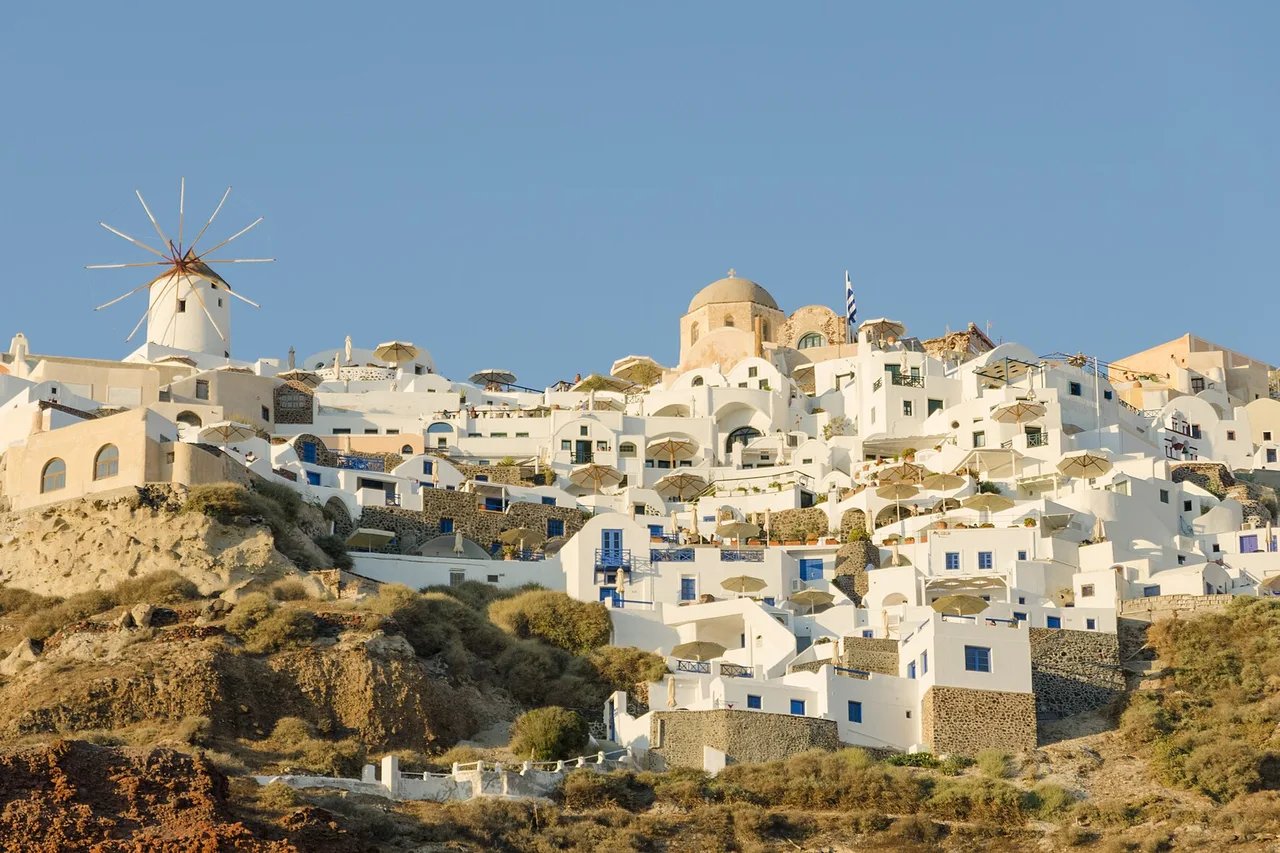
The second fact the photographs never show: on the caldera, you do not park outside your hotel. Oia’s main lane is pedestrian, and the caldera side of Imerovigli is not a street but a path — narrow, stepped, with entrances cut into the cliff. The vehicle drops you at a car park, and the rest is on foot.
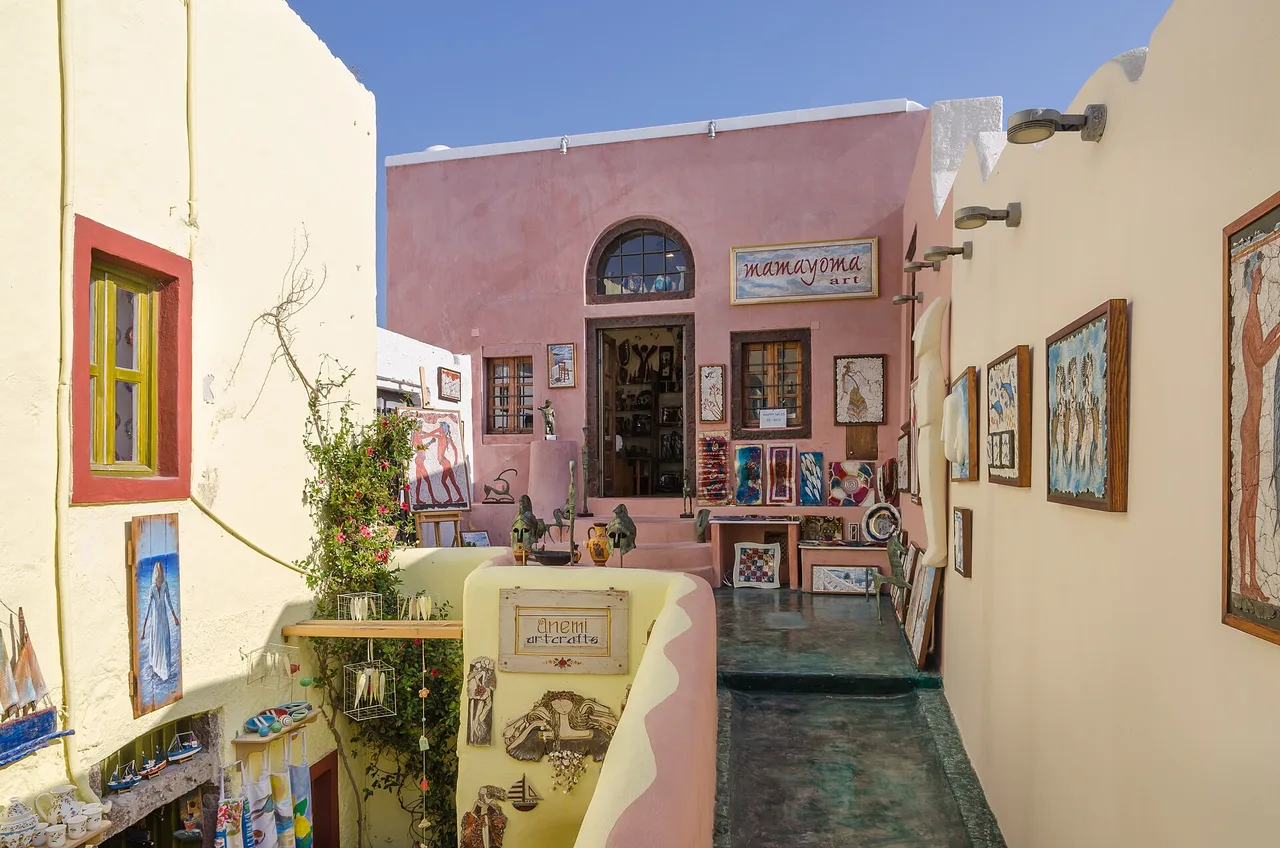
It is beautiful and it is not a flaw: these villages are pedestrian because they are built into a cliff, and that is exactly what you came for. But with two suitcases, at thirty degrees, after a ferry, the same lane becomes a different exercise. Most caldera hotels have porters — the solution exists, it is simply invisible until you ask for it.
Hence the only genuinely useful move, and it happens before you leave: email your hotel and ask two things — where the transfer should drop you, and whether someone can take the bags. Two lines of email that remove the worst quarter of an hour of the trip.
The same problem returns on the last day, worse, because there is no longer a room to leave anything in: checkout is around eleven and the flight or the boat leaves in the evening. That is five to eight hours with luggage, in a stepped village. A luggage store, in Fira or near the port costs the price of a lunch and makes that last day usable instead of endured.
The four families of villages, and who each one suits
Once the hub rule is understood, the choice becomes readable. Santorini does not have fifteen options: it has four families, and each is bought with a known drawback.
① The lively caldera — Fira and Firostefani. This is the best choice for a first visit, and the reasoning is the one from section 1: you sleep on the hub. You will also find the most shops, restaurants and evening life here, and the best value on the caldera. Firostefani is Fira’s immediate extension, ten minutes on foot: markedly quieter, with the same view and almost the same convenience. The drawback: Fira is the island’s busiest village during the day.
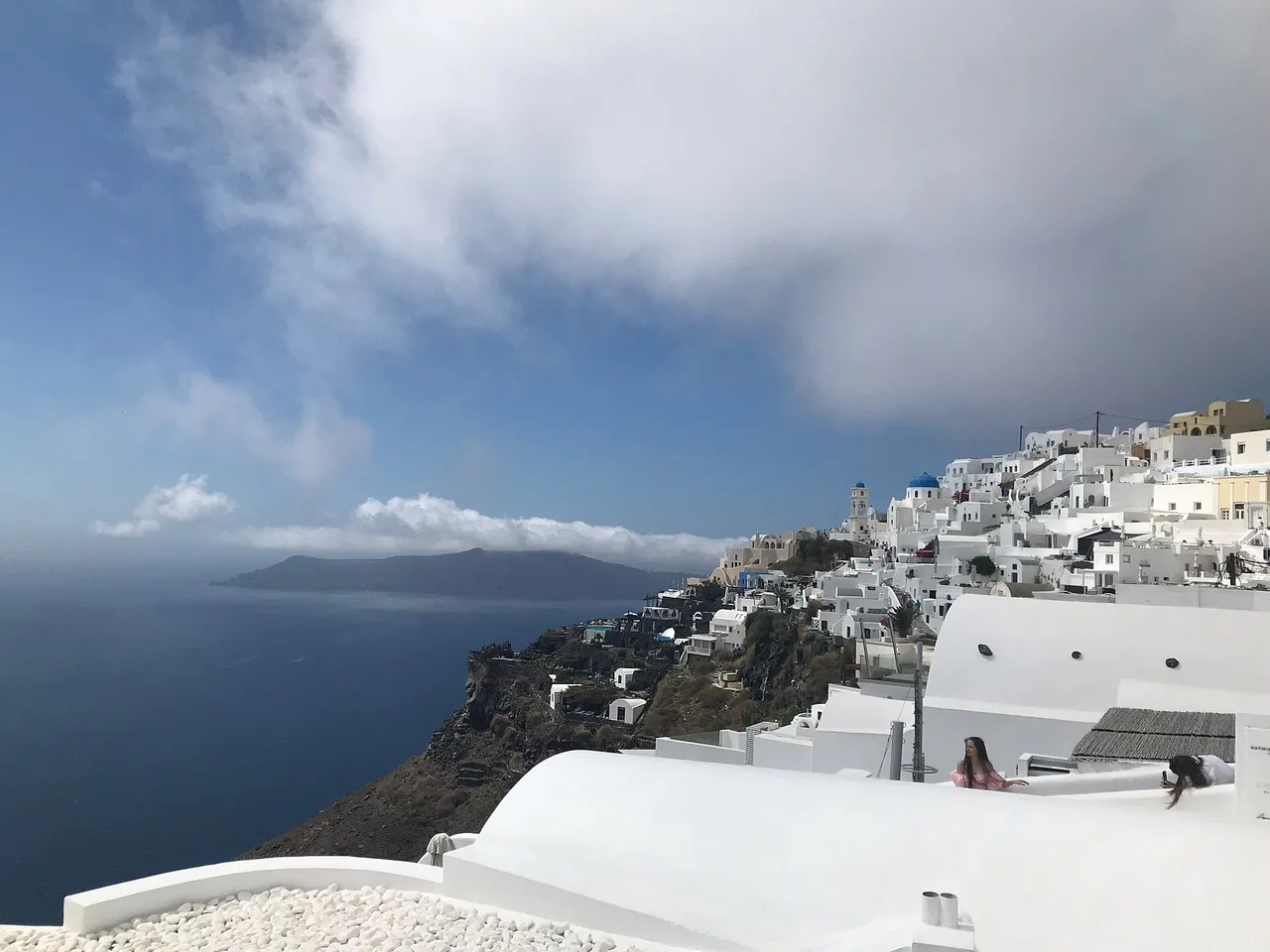
② The quiet caldera — Imerovigli and Oia. Imerovigli is the calm village on the cliff, with some of the finest sunset views. Oia is the most photographed of them all, and the most oriented towards cave hotels and serious kitchens. The drawback: the last stretch from section 3, and a change at Fira for any journey that is not going to Fira.
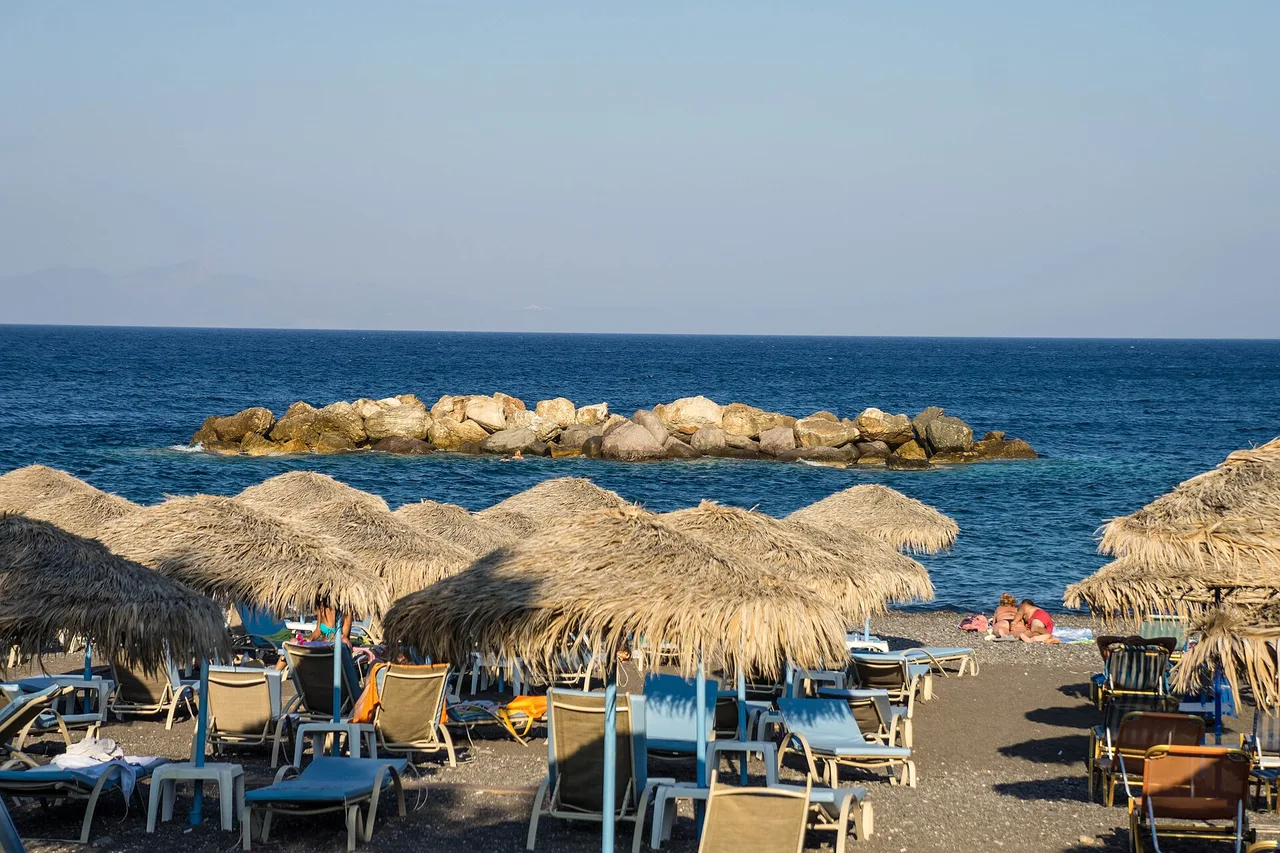
③ The beaches — Kamari, Perissa and Perivolos. Black sand, lower room rates than the caldera, and a genuine seaside-resort life. Between the two: the sand at Perissa and Perivolos is finer and easier underfoot, Kamari’s is pebblier; on the other hand Kamari is more compact — beach, restaurants, shops and hotels grouped together — and closer to the airport and to Fira. Perissa and Perivolos are longer, more spread out, more laid-back as you move south. The drawback: you are at the end of a branch, two buses from everything that is not Fira — including the other beach.
④ Inland — Pyrgos, Megalochori and the central villages. This is the least known option and, for some travellers, the truest: villages that live all year round, without the pressure of the caldera, at the prices that go with it. The drawback: this is the family that depends most on a car, for exactly the reason in section 1.
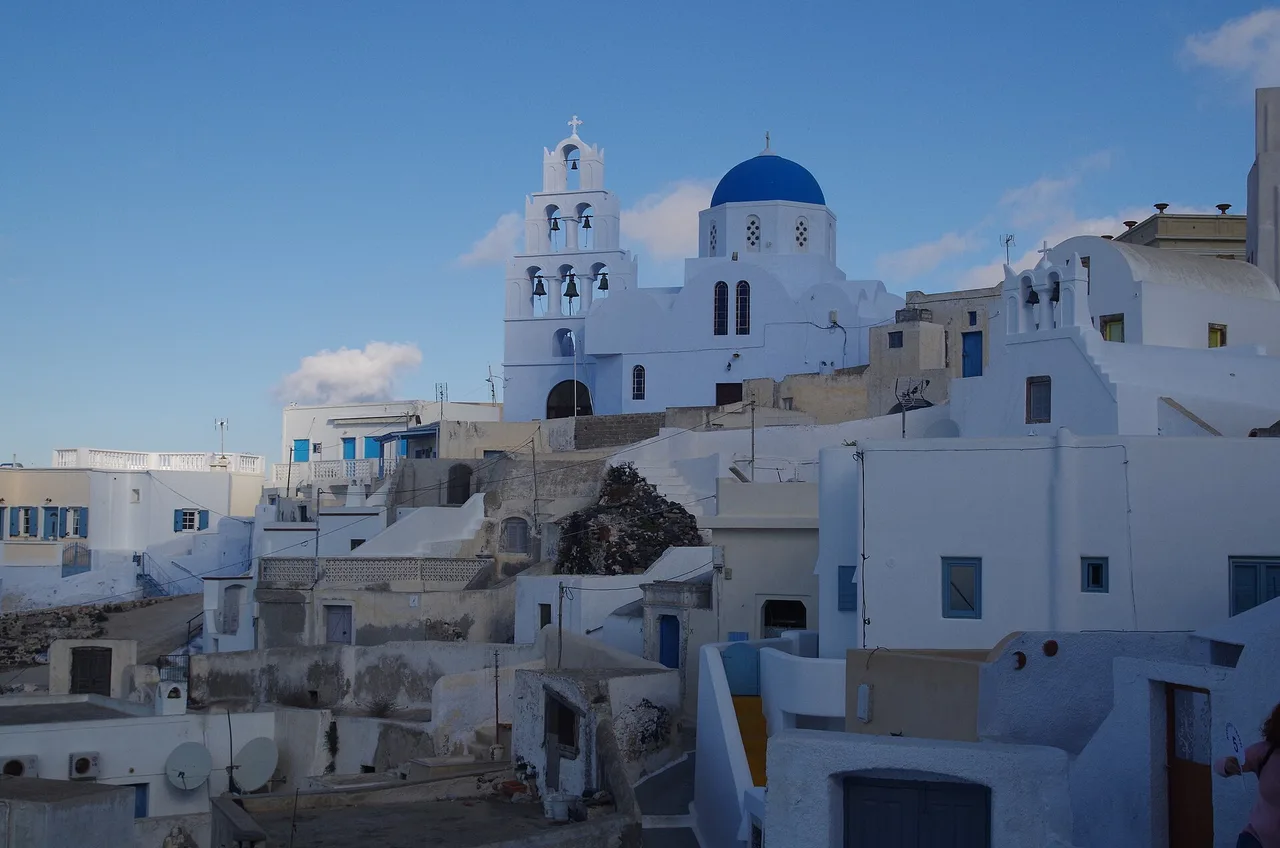
The advertised price is not the price paid
A third thing the comparison sites do not show, and it is paid in cash at reception: the Greek climate resilience fee. It has existed since 1 January 2024, it is charged per room per night — never per person, and it is almost never included in the advertised price.
| The category | Per night | Over 7 nights |
|---|---|---|
| Apartment, 1 or 2 stars | 2 € | 14 € |
| 3 stars | 4 € | 28 € |
| 4 stars | 10 € | 70 € |
| 5 stars | 15 € | 105 € |
Over seven nights, that runs from 14 € for an apartment to 105 € for a five-star. It is not a sum that changes a decision — it is a sum that changes a comparison, because it weighs entirely differently by category. Two rooms that look identically priced no longer are once the fee is added, if one is rated four stars and the other is not.
📌 From November to March the rates fall very low — fifty cents a night for a one- to two-star. The fee is therefore an April-to-October subject, and a footnote the rest of the year.
When a car changes everything — and when it is useless
This is the most frequent question, and it has no general answer: it depends solely on where you sleep.
On the caldera, rent nothing. Fira, Firostefani, Imerovigli and Oia are linked to each other, the island is small and dense, parking is difficult, and the buses are more than enough. A car there would be an object to park, not a tool.
Elsewhere the rule inverts — and it is the section 1 table that says so. From the south-eastern beaches or the inland villages, half your outings need two buses, two tickets and two waits. A car or a scooter, even for just two or three days removes the single-hub constraint in one move: you no longer go through Fira, you go there only when you want to. Book ahead in July and August — an island’s fleet is finite, and it empties.
Full guide: Car Rental in Greece: Prices, Deposit and Ferries
⚠️ And if you are still hesitating, take the problem from the other end: how many days do you expect to spend outside your village? Two or three, on the caldera: the buses are enough. Five or six, from a beach: the wheels pay for themselves in time saved, before money even enters the conversation.
The five mistakes that spoil the stay
1. Choosing your village from a sunset photograph. The view is real and you will enjoy it for an hour a day. The network decides the other twenty-three.
2. Assuming Kamari and Perissa are interchangeable because they are neighbours. They are not: there is no bus between them, and the direct crossing is a mountain hike.
3. Arriving by ferry with no transfer booked. It is the first hour of the trip, and the hour when the island offers the fewest solutions.
4. Not warning the hotel you are coming. The porter almost always exists; he is not guessed at. Two lines of email, and the last stretch stops being a problem.
5. Comparing two places on the advertised price alone. The climate fee is paid on top, per room per night, and it varies sevenfold by category. Over a week, it is enough to reverse a ranking.
📌 And if you take away one thing: in Santorini, the village is not chosen on the view, it is chosen on the network. The rest — the caldera, the blue domes, the evening light — you will have anyway, from any one of them.