
Between Hanoi and Saigon lie 1,726 kilometres of track and 32 hours 45 of train. Crossing Vietnam overland in two weeks means spending nearly 10% of the trip in a compartment. This route therefore takes two domestic flights and gives the time back to the places: Hanoi, a night in Lan Ha Bay, Ninh Binh, Hue, the Hai Van Pass, Hoi An, Saigon and the Mekong Delta. 13 nights, all doable independently.
The route at a glance
Vietnam is a long, narrow country. Covering it north to south in two weeks is not about seeing everything, it is about knowing which stretches to skip. Our itinerary has eight stops and 13 nights. It starts in Hanoi and ends in Saigon, which has the most return flights to Europe.
| Day | Stop | Night in |
|---|---|---|
| 1–2 | Arrive in Hanoi, Old Quarter, Temple of Literature, West Lake | Hanoi (2) |
| 3 | Transfer to Lan Ha Bay, cruise and kayaking | on board (1) |
| 4–5 | Ninh Binh: Trang An, Hang Mua, cycling through the rice fields | Ninh Binh (2) |
| 6–7 | Fly Hanoi → Hue, Imperial City, royal tombs | Hue (2) |
| 8–10 | Hai Van Pass to Hoi An, old town, An Bang beach, cycling | Hoi An (3) |
| 11 | Fly Da Nang → Saigon, District 1 | Saigon (1) |
| 12 | Mekong Delta, floating market the next morning at dawn | Can Tho (1) |
| 13–14 | Back to Saigon, last evening, departure | Saigon (1) |
The number that matters: 7 changes of bed in 13 nights. You cannot do fewer in two weeks and still see the north, the centre and the south. That is why the route keeps one anchor: three nights in Hoi An, right in the middle of the trip.
Why two domestic flights rather than the train
The Reunification Express links Hanoi and Saigon over 1,726 km. The fastest train, the SE1, leaves Hanoi at 21:45 in 2026 and reaches Saigon two mornings later at 06:30: 32 hours 45 minutes. Over two weeks, that is nearly 10% of your whole trip spent in a compartment.
Two flights of about an hour each replace it: Hanoi → Hue and Da Nang → Saigon. In between you travel by road, exactly where the scenery deserves it: the Hai Van Pass between Hue and Hoi An. Still, count each flight day as half a day lost: hotel, transfer, airport, transfer, hotel.
And why north to south rather than the reverse? Both work. North to south has two advantages: you start with the busiest part (Hanoi, the cruise, Ninh Binh) and finish in the south, where it is almost always warm. But the route runs just as well backwards.
Days 1–2: Hanoi

Hanoi is the city where you arrive and understand nothing at first: scooters, pavement kitchens, vendors in conical hats. Give it two nights. Stay in the Old Quarter or right by Hoan Kiem Lake, so that everything important is on foot.
A good first day: a walk round Hoan Kiem Lake in the morning while locals do tai chi, then the Temple of Literature, the country's first university. The afternoon in the Old Quarter's lanes, the evening a bowl of pho on a plastic stool. Day two: West Lake and the Ho Chi Minh Mausoleum, which only opens in the morning.
From Noi Bai airport to the Old Quarter allow about 45 minutes. After a long-haul flight, a driver booked in advance, waiting with a name board in the hall, saves the haggling and the detours.
Days 3–5: Lan Ha Bay and Ninh Binh
Famous Ha Long Bay is just over two hours from Hanoi, 155 to 170 km on the expressway. For one night on board, though, we recommend its southern extension, Lan Ha Bay, near Cat Ba Island: the same limestone karsts, far fewer boats. Cruises are booked as packages, with transfer from Hanoi, kayaking and dinner on board. Ask when booking whether the return transfer can drop you straight in Ninh Binh: it saves going back through Hanoi.

Ninh Binh, 90 to 95 km south of Hanoi, is "Ha Long Bay on land": rice fields between karst peaks. Two nights, because the best happens early in the morning. The Trang An boat trip costs 300,000 dong since 1 January 2026, about €10 (it was 250,000): two to three hours through caves and past temples, with a woman rowing at the back. Then the 500 steps of Hang Mua for the view over the valley, ideally at sunset. Spend day two cycling between Tam Coc and the villages.
Days 6–10: Hue, the Hai Van Pass and Hoi An
On day six you head from Ninh Binh to Noi Bai airport and fly to Hue, the old imperial capital. Book an afternoon or evening flight.
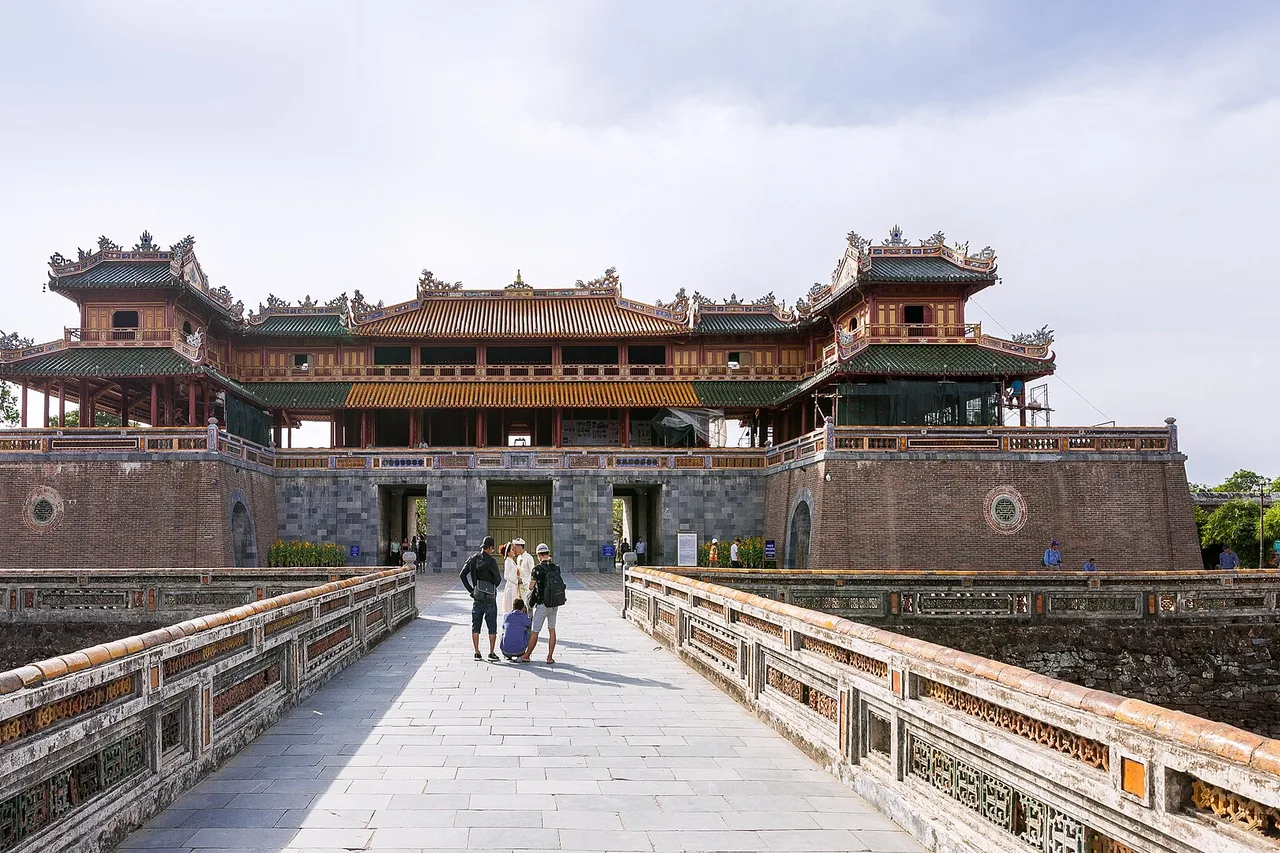
The Imperial City costs 200,000 dong, about €7, and the ticket is valid for two days. Come in the morning, before the heat. The next day, the royal tombs south of town, the finest being Tu Duc and Khai Dinh. Combined citadel-and-tomb tickets are available.
Day eight brings the best stretch by road: the Hai Van Pass between Hue and Hoi An. 130 to 140 km, three hours direct, four to five with stops at Lap An lagoon, the pass itself and the Marble Mountains. Best done with a private driver your Hue hotel can arrange. The train follows the coast too, but stops at Da Nang.

Hoi An is the pause in the trip: three nights. The old town is free to wander; the 120,000-dong ticket (about €4) covers the assembly halls, merchant houses and the Japanese Covered Bridge, five coupons for five sites. Go early in the morning before the groups, and in the evening when the lanterns are lit. By day, cycle through the paddies to An Bang beach. And if you want, a tailor will make you a suit in 24 hours.
Days 11–14: Saigon and the Mekong Delta
From Hoi An it is 30 km to Da Nang airport, then about an hour's flight to Saigon (Ho Chi Minh City). One evening in District 1 is enough for a first impression: Ben Thanh Market, Notre-Dame Cathedral, the Central Post Office, a rooftop bar.

On day twelve, head into the Mekong Delta, to Can Tho, about 170 km south-west. Sleep there: the Cai Rang floating market starts at sunrise and is over by late morning. Day trips from Saigon arrive too late. Afterwards, a boat ride through the side canals, orchards and a rice-noodle workshop.
Day thirteen, back to Saigon with a free afternoon for the War Remnants Museum, or simply an iced coffee with condensed milk. Fly out on day fourteen.
Three climates: when the route tips over
Vietnam does not have one rainy season, it has three. The north is cool and often grey from December to February, hot and humid in summer. The centre (Hue, Hoi An) has its rains from September to December, heaviest in October and November, with floods in Hoi An's old town. The south is dry from December to April, then come short, heavy afternoon showers.
In other words: from February to April the route works everywhere. In October and November, cut the centre to two nights and give the days to the north, which is then at its best. In July and August everything works, but the midday heat sets the pace: out early, a break at noon, back out late.
Practical: visa, internet, money
Visa. Travellers from the UK, Germany, France, Italy and Spain need no visa for up to 45 days: Resolution 44/NQ-CP applies from 15 March 2025 to 14 March 2028. Most other nationalities, including US, Australian and Irish travellers, apply online for an e-visa (25 US dollars, up to 90 days). Your passport must be valid for at least six more months.
Internet. Vietnam is a long way outside any home roaming deal, and roaming gets expensive. The simplest option is to install a Vietnam eSIM before you leave: it is live when you step off the plane, and you can call a Grab straight away, the app for drivers and motorbike taxis.
Money. One euro is roughly 30,000 dong. Cards work in hotels and many restaurants; street kitchens, markets and taxis want cash. Withdraw from big-bank ATMs and check the fee before you confirm.
With this plan, two weeks in Vietnam are not a race: two flights, one pass, one delta, and a different country on your plate every evening.