At Iceland’s latitude the aurora is overhead far more often than you get to see it. What is almost always missing is not solar activity: it is a clear sky. That single sentence changes how you plan the whole trip. It moves the question away from “when is there an aurora?” towards two others, both decided in advance and both entirely yours: can I move to the clear sky, and how many nights am I staying? Here is the method, the real calendar, and the calculation no guide ever does.
The method error: you are not looking for an aurora, you are looking for a gap in the clouds
Let us start with the thing that makes almost every aurora guide close to useless once applied to Iceland. They teach you to read solar activity: Kp index, solar wind, coronal mass ejections. It is fascinating, and at Icelandic latitudes it is not the deciding variable.
Iceland sits between 64 and 66 degrees north — that is, underneath the auroral oval, the permanent ring where the aurora happens. Elsewhere you need a magnetic storm to drag the oval down to you; here, you are already under it. The aurora is above the island far more often than you get to see it.
The clearest proof of that reversal is the official tool itself. The Icelandic Meteorological Office’s “aurora forecast” is, on screen, a cloud-cover map: green areas are cloudy, white areas are clear. The activity figure, on a 0-to-9 scale for midnight, sits beside it. Put plainly: the body that forecasts the aurora for an entire country shows you the sky first and the sun second. The page says as much in one line — the display needs skies that are dark and partly clear.
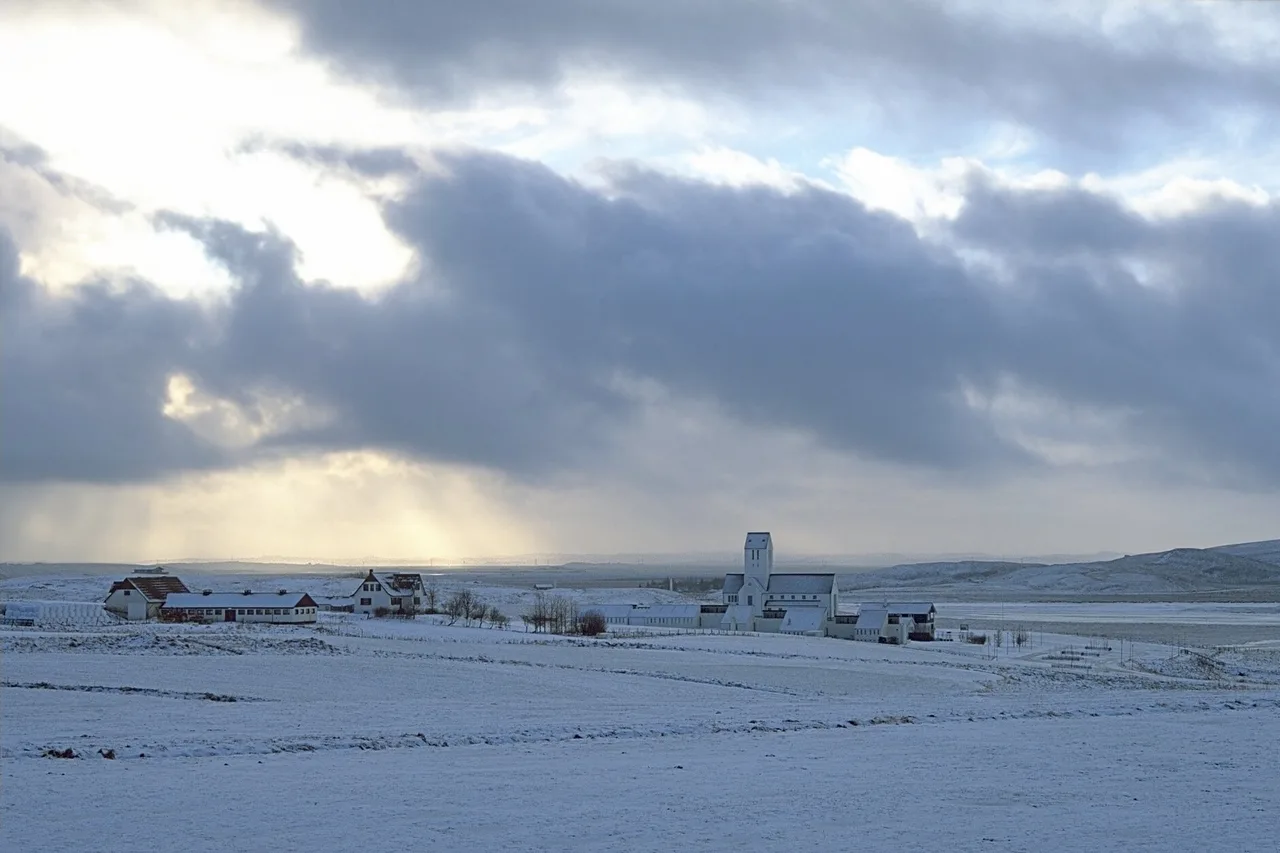
Here is the figure that explains all the rest: in Reykjavík, December is overcast or mostly cloudy about 73% of the time. In winter, three quarters of the hours are under cloud. The scarce resource in Iceland is not the aurora: it is the sky.
One qualification, so as not to swap one exaggeration for another: latitude does not excuse you from needing any activity at all. At an index of 0 or 1, little that is visible tends to happen, even in Iceland. The island sees at low indices; it does not see on nothing at all. But between a modest index and a solid cloud deck, it is the second that sends you home empty-handed, nine times out of ten.
So remember both the tool and how to use it: the forecast runs 6 days ahead with four points a day, and it should be read in the opposite order to the habit — the cloud map first, to know where to go; the activity figure only afterwards, to know whether it is worth the drive.
Consequence one: mobility beats location
If the constraint is cloud rather than aurora, then every list of “best places to see the Northern Lights in Iceland” is answering a question that does not arise. No spot on the island sees more auroras than another: the phenomenon covers the whole country at once. What separates a good night from a bad one is solely whether there is a hole in the deck — and that hole moves.
Tonight’s right place is whichever one is white on the map. Tomorrow it will be another. What you prepare is therefore not a destination but a capability: being able to drive fifty, sometimes a hundred and fifty kilometres early in the evening to reach the clear patch, getting away from town lights on the way.
Full guide: Car Rental in Iceland: Prices, Insurance and F-Roads
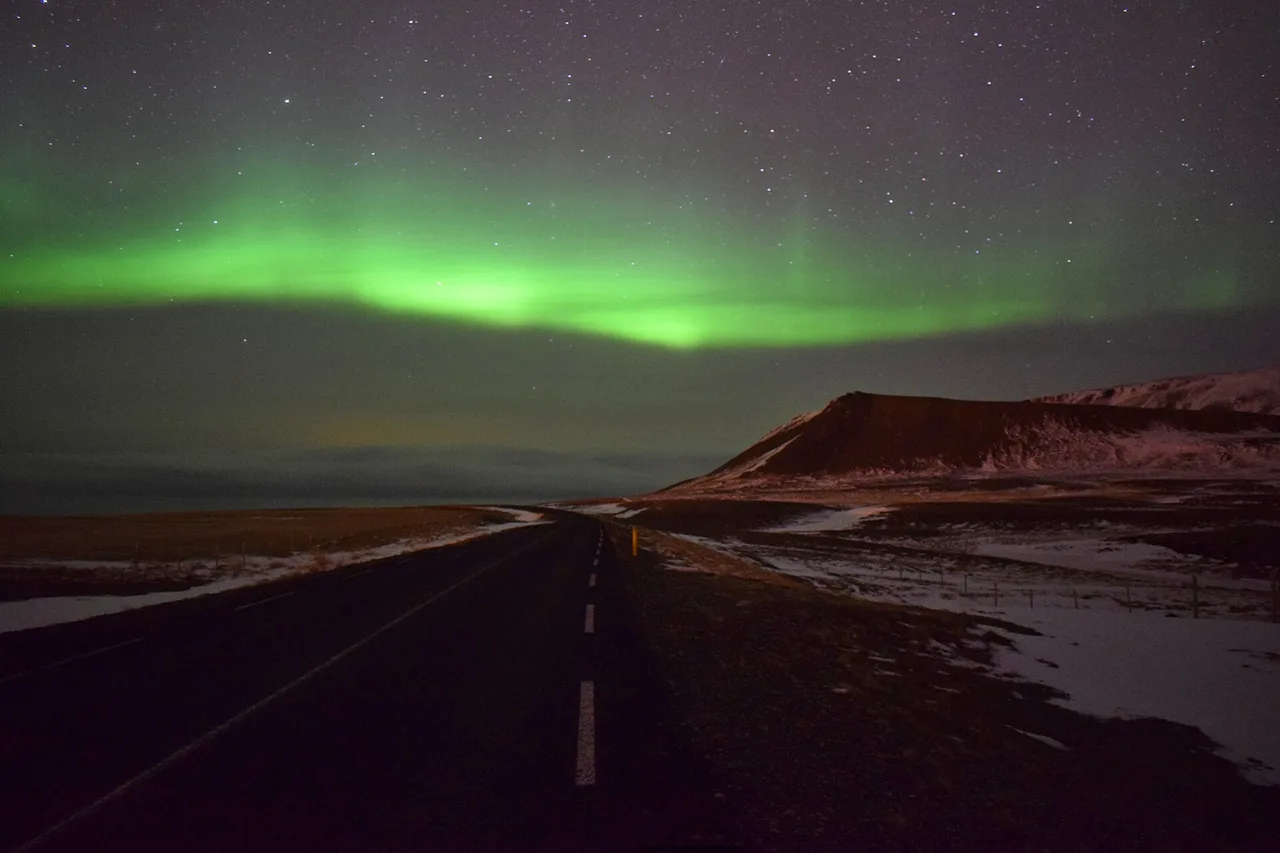
That has a concrete and slightly counter-intuitive consequence for planning. The line item that raises your odds most is not the accommodation, it is the vehicle — not for comfort, but because it is the only one that converts a weather forecast into an actual sighting. Seen that way, comparing rental companies on your exact dates is part of the aurora hunt as much as it is a budget line.
Two honest caveats, because they weigh heavily. First, driving at night in an Icelandic winter is not a trivial matter: ice, crosswinds, unlit roads and occasional closures. Second, a car only helps someone willing to take it out at 10 p.m. after a full day of sightseeing — that is a decision about the pace of the trip, not just about the rental.
For anyone who does not want that drive, a guided tour solves exactly the same problem by other means: the guide is the one watching the maps all day and choosing the direction. Tours leaving from Reykjavík run by coach, by boat from the Old Harbour or by super jeep, and many operators offer a free second attempt if the first tour ran without any aurora showing — valid for two to three years depending on the company, sometimes with no limit at all. ⚠️ That guarantee covers a tour that took place without result, not one cancelled for weather: those are not the same thing, and the distinction is in the small print everywhere.
Consequence two: you are not buying a night, you are buying a number of nights
Here is the calculation I have seen nowhere, and yet it is the one lever entirely in your hands.
Each night spent in Iceland is an independent attempt. If a given night has a probability p of being usable — sky clear enough, activity sufficient, and you outside at the right moment — then the probability of getting at least one over N nights is 1 − (1 − p)N. That is not an opinion about auroras: it is arithmetic, and it is brutal.
| Nights on the ground | Cautious case | Middle case | Favourable case |
|---|---|---|---|
| 1 night | 25 % | 35 % | 45 % |
| 2 nights | 44 % | 58 % | 70 % |
| 3 nights (a weekend) | 58 % | 73 % | 83 % |
| 4 nights | 68 % | 82 % | 91 % |
| 5 nights | 76 % | 88 % | 95 % |
| 7 nights (a week) | 87 % | 95 % | 98 % |
| 10 nights | 94 % | 99 % | > 99 % |
Assumptions are assumptions, and I would rather say so than hide it: nobody knows the p of your particular week. The three columns bracket a reasonable order of magnitude — the cautious one for someone staying put in Reykjavík, the favourable one for someone who moves and stays out for hours. The middle column, 35 % a night, is the reference used below.
Now read that middle column top to bottom. Three nights — the weekend format — give 73 %: barely better than a slightly loaded coin toss. Seven nights give 95 %. Going from one to the other does not cost seven times more, and it demands no skill whatsoever: it only demands having decided, at booking time, that duration was the point.
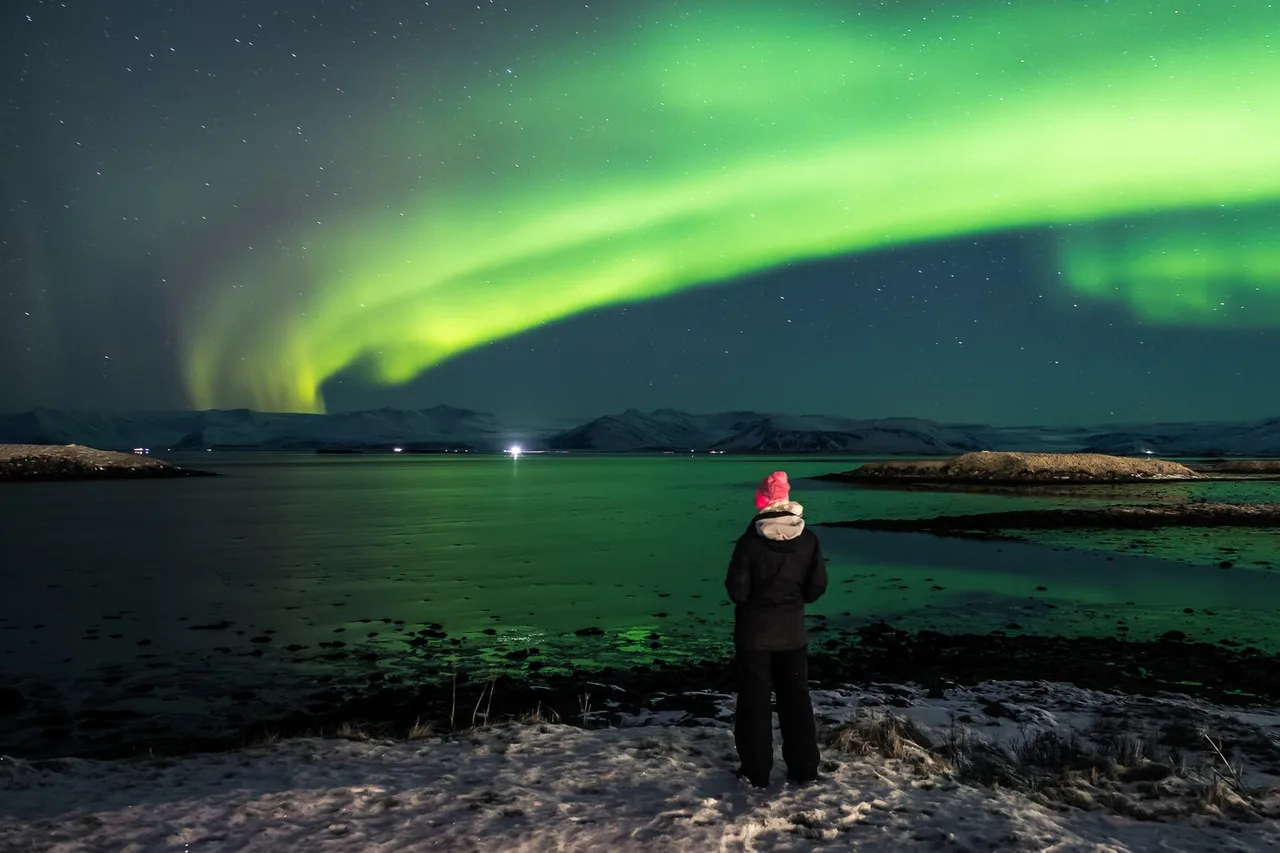
Two corollaries follow, and they contradict the way most trips are built. First: a short aurora-dedicated trip is a bad idea — not because it is impossible, but because the ratio between the hope being sold and the real probability is poor. Second, and more useful: make the aurora a bonus, never the goal. A trip built on waterfalls, hot springs and roads will be worth it even if the sky stays shut for seven nights running — and it will get you outdoors at night far more often than a stay organised around waiting.
A word on timing, since it feeds into p: the useful window runs roughly from 9 p.m. to 2 a.m., peaking around midnight. An aurora can rise and fade in twenty minutes. Stepping out for a quarter of an hour “to see if anything is happening” does not count as an attempt.
The real calendar: what you gain in darkness you lose in drivability
The usable season runs from late August or early September to mid-April. Outside it, luck has nothing to do with it: from late April to mid-August the midnight sun keeps the sky too bright, and no amount of solar activity will change that. May, June and July are a no — and if someone sells you an aurora hunt in June, that is not optimism.
| Period | Darkness per night | What it is worth |
|---|---|---|
| May → mid-August | next to none | The midnight sun keeps the sky too bright. No chance, and no serious operator sells one. |
| Late August → September | 5 to 8 h | Little darkness, but drivable roads, mild nights — and the equinox bonus. |
| October → November | 8 to 12 h | The best compromise: enough night, still enough road. |
| December → January | 14 to 20 h | Maximum darkness, only 4 to 5 hours of daylight — but weather and roads at their worst. |
| February → mid-April | 8 to 14 h | Night gives ground back as the roads open up again. March equinox. |
The table says the essential thing: what you gain in darkness you lose in drivability. December and January offer up to twenty hours of night, but they are also the months when roads close and the wind writes your itinerary — and mobility, as we have just seen, is your first resource. October–November and February–March give fewer dark hours but leave you able to go and find them.
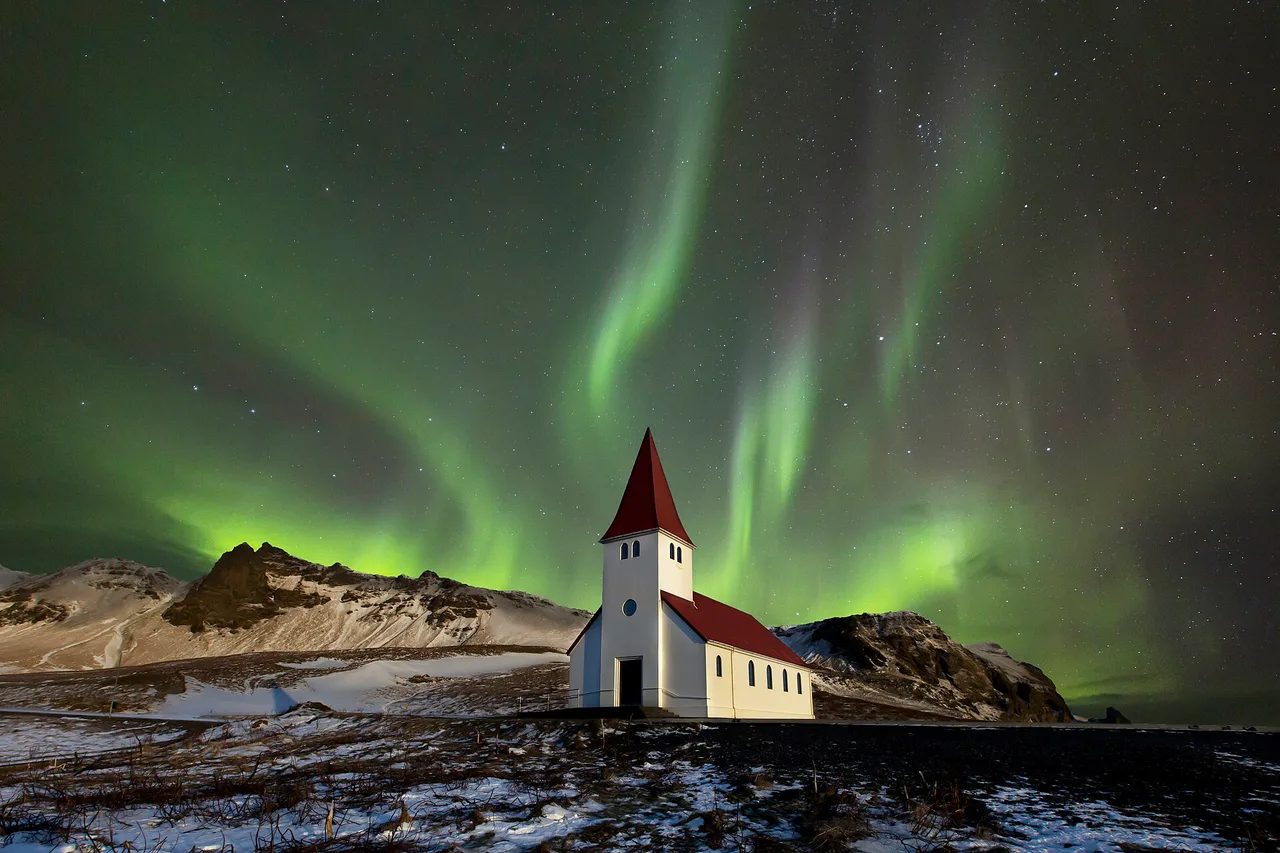
And there is a seasonal bonus which, unlike a good deal of travellers’ folklore, is not folklore at all. Around the equinoxes — 20 March and 22–23 September in 2026 — geomagnetic activity is statistically higher. The reason is geometric: the Earth’s tilt then places the interplanetary magnetic field and the Earth’s own field in opposition, which opens the coupling between them and lets more energy through. This is the Russell–McPherron effect, and it is measurable: according to British Geological Survey records, a sizeable magnetic storm occurs on average on nearly 2 times as many days in March as in June or July.
The practical consequence is a pleasant one, because it points the same way as everything else. Late September and March combine three advantages: the equinox bonus, roads still or already drivable, and nights far less punishing than midwinter. They have a single drawback, shorter darkness — which the table in the previous section lets you offset with the number of nights.
2026: the declining phase is not the end of the party
One question comes up everywhere: should you hurry, now that solar maximum has passed? The honest answer is no, but do not wait either.
The facts first. NASA and NOAA jointly announced in October 2024 that the Sun had reached maximum, with a smoothed sunspot number of about 161 — one of the strongest in decades, and well above the initial forecast, which had expected around 115. Cycle 25 therefore overshot what was announced. Since then we have been in the declining phase: fewer sunspots, fewer flares, and that continues through 2026.
But “declining” does not mean “over”, and this is where intuition misleads. Some of a cycle’s largest geomagnetic storms turn up one to two years after the sunspot peak, while the Sun’s magnetic field reorganises itself. Forecasters accordingly still treat 2026 as an above-average year compared with the quiet years early in the cycle.
What to do with that, concretely: do not build your trip on it, but do not postpone waiting for some hypothetical return to maximum either — the next one is about a decade away. And above all, never let an announced activity spike make you forget the cloud cover: a historic magnetic storm under a solid deck is not visible at all.
What you will actually see: grey to the eye, green to the sensor
There is one disappointment left to defuse before you go, because it is common and entirely avoidable: the aurora you see will not always look like the photographs that made you want to come.
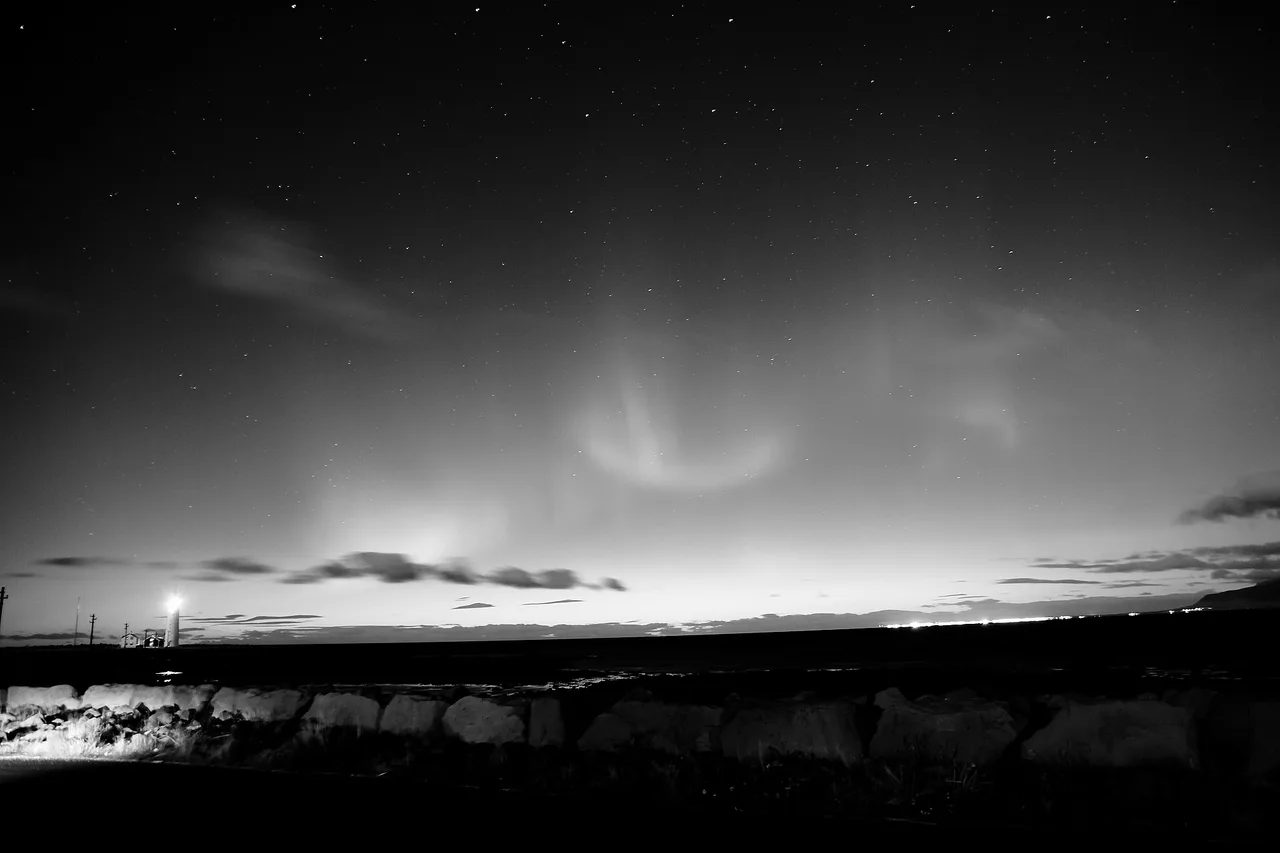
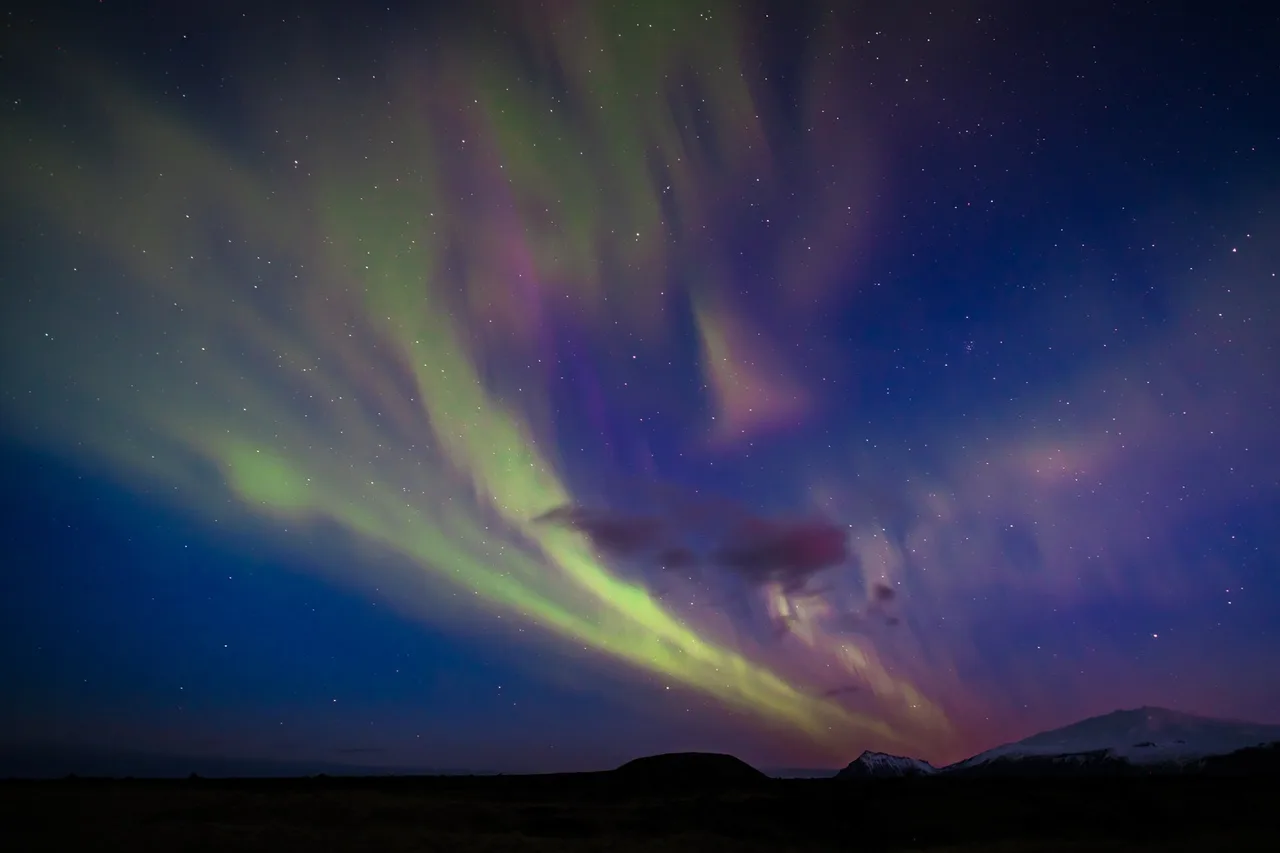
The explanation is not in the sky, it is in the eye. In low light the retina switches over to its rod cells, highly sensitive but unable to perceive colour; the cones, which do see colour, need far more light to work. A moderate aurora therefore appears grey, whitish, slightly milky — a moving veil of light. Strong auroras cross the threshold and do turn plainly green to the naked eye.
A camera has no such limit: it holds a long exposure and accumulates photons until it brings out a colour that is entirely real but too faint for your retina. That is why a phone in night mode shows vivid green where you can only make out a pale cloud. Nobody is cheating: both images are true, they are simply not taken by the same sensor.
Two practical consequences. First: photograph any moving grey veil immediately — it is the fastest way to tell an aurora from a cloud, and it is instant. Second: let your eyes adapt for at least twenty minutes, without looking at a screen. A phone’s light undoes that adaptation in seconds, and it is probably the most mundane cause of nights when “nothing was there”.
One night’s protocol, in five moves
Everything above reduces to a short routine, repeated every evening of your stay.
① In late afternoon, open the cloud map before anything else. Look for white, not for the number. Since the forecast runs 6 days ahead, you often know the day before which night will be the one — which is what lets you organise the rest of the trip around it.
② Decide on a fallback point and a departure time. A clear patch a hundred kilometres away is only useful if you decided before dinner that you were going. After 10 p.m., tiredness always votes the same way.
③ Get away from lights, but not to the point of putting yourself in danger. A few kilometres out of town is plenty. An open lay-by beats a narrow, windy verge: in an Icelandic winter, where you park is a safety question before it is a photography one.
④ Give it time. Count on the 9 p.m.–2 a.m. window, and at least an hour on site. Twenty minutes with nothing means nothing.
⑤ Take a test shot every ten minutes. It will tell you what your eyes cannot yet settle, and it will stop you driving home five minutes before the pale veil starts to move.
That is all, and it is deliberately little. Hunting the aurora in Iceland is not a matter of equipment or secret locations: it is a matter of nights accumulated and kilometres accepted. The island handles the rest.
Top-rated activities in Iceland, bookable online: