
Grand Baie, half past eight, the jetty is busy. I live in Mauritius, I built this app, and I still stood on that jetty and paid full price for a boat trip to the northern islands — with an operator we have been working with for weeks. The discount was in my pocket, two centimetres from the screen, and it simply did not cross my mind. That is the honest start of this story, and the reason I am writing it: a feature is only worth what you know about it. It lives inside the app, where places are sorted by what you feel like doing, and it does exactly one thing.
Budget tip: in Mauritius, part of what you do can cost you less. See how to save money with discounts on your activities.
Free guide: we put together a complete Mauritius guide — day-by-day itineraries, real budget and spots checked on the ground. Open the Mauritius guide (in French).
The problem is not the price, it is the moment
Booking activities on the spot in Mauritius rather than in advance is usually the right call: you see the boat, you meet the skipper, you push things back if the sea is wrong. The flaw shows up later. You are at the jetty or the counter, it goes quickly, you pay cash or card — and it is that evening you remember there was something.
That gap is where this started. The question was never « how do we make excursions cheaper », but « how do we make the discount visible at the right moment, which is before the money changes hands ». Everything else about this feature follows from that.
Which is why it is not filed away in a menu you have to go looking for. It shows up where your eye already is: in the list of operators, right next to the name. And partners move to the top of their category — not because they are better, but because an offer you cannot see is not an offer.
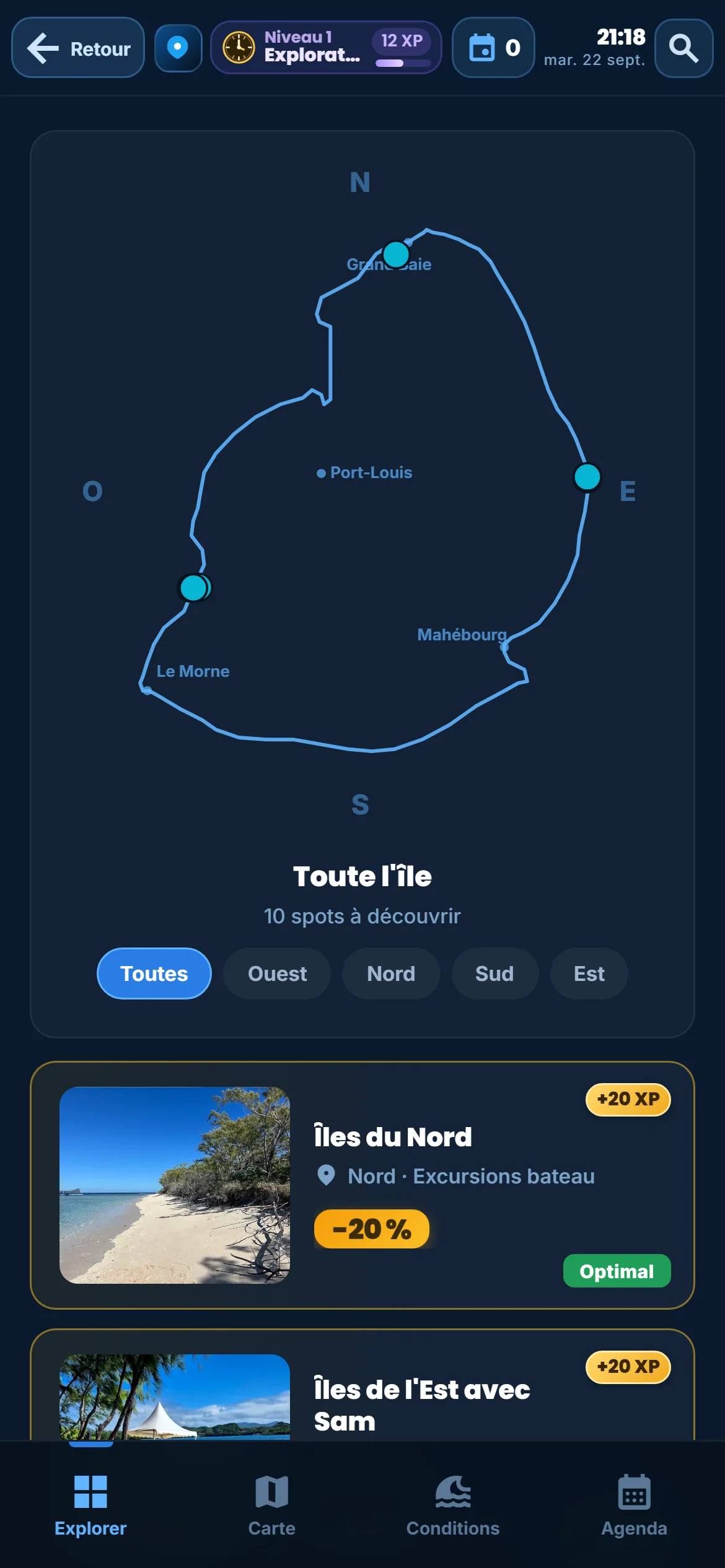
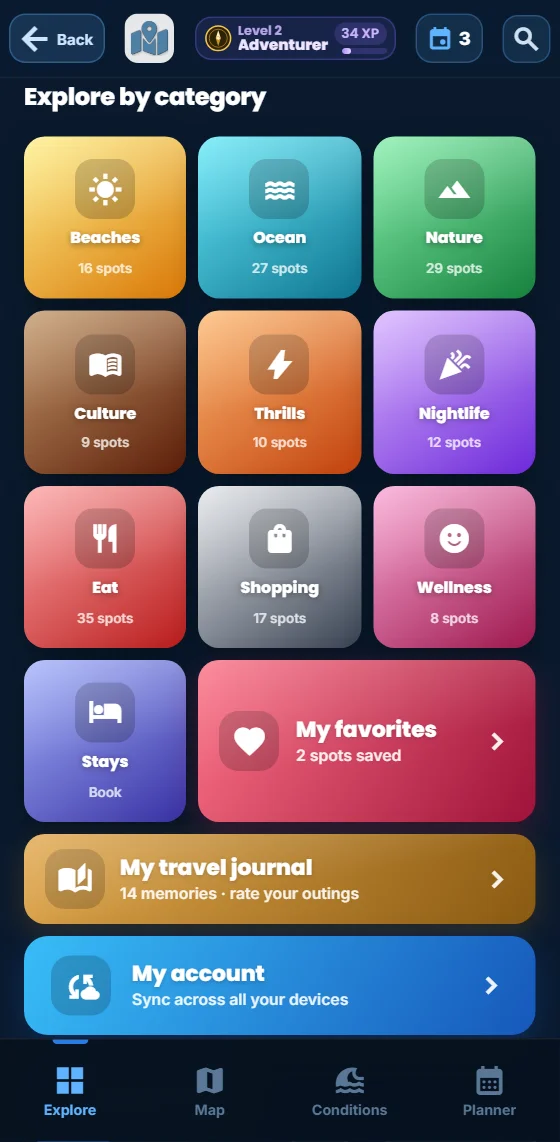
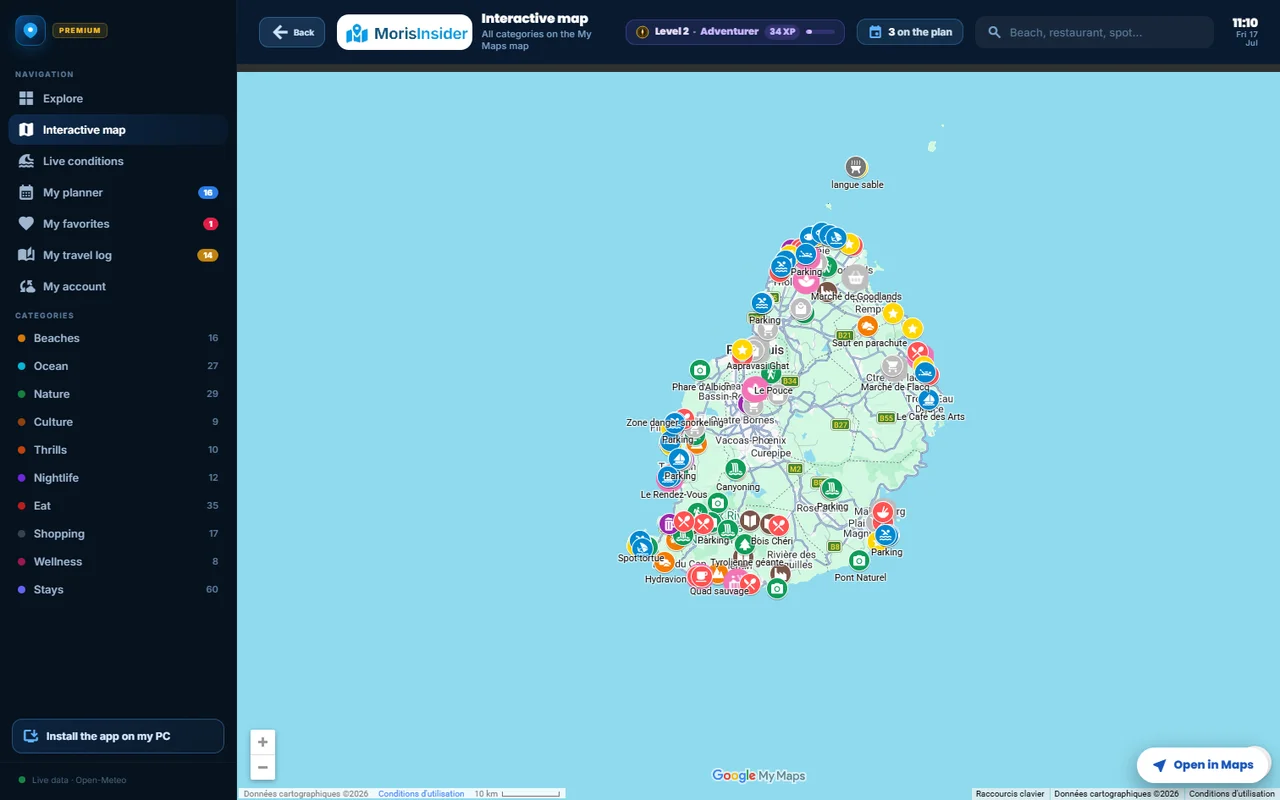
A word on proportion, so the picture stays honest: the app carries 225 entries for Mauritius — beaches, viewpoints, restaurants, hikes, places to stay. Four of them currently carry a discount badge. That is a small corner of the whole, and it replaces nothing: the rest of the island is described exactly as before, discount or no discount. Making the discount your selection criterion is using the app backwards.
What convinced me about this arrangement is a property you only notice on second look: it only holds if all three sides gain something. You pay less. The operator meets guests he would not otherwise have met, without handing over a commission. And we sell the app more easily, because it can pay for itself. Tip any one of the three and the whole thing stops working — which is why the percentage is deliberately high enough to be noticed.
What I did, screen by screen
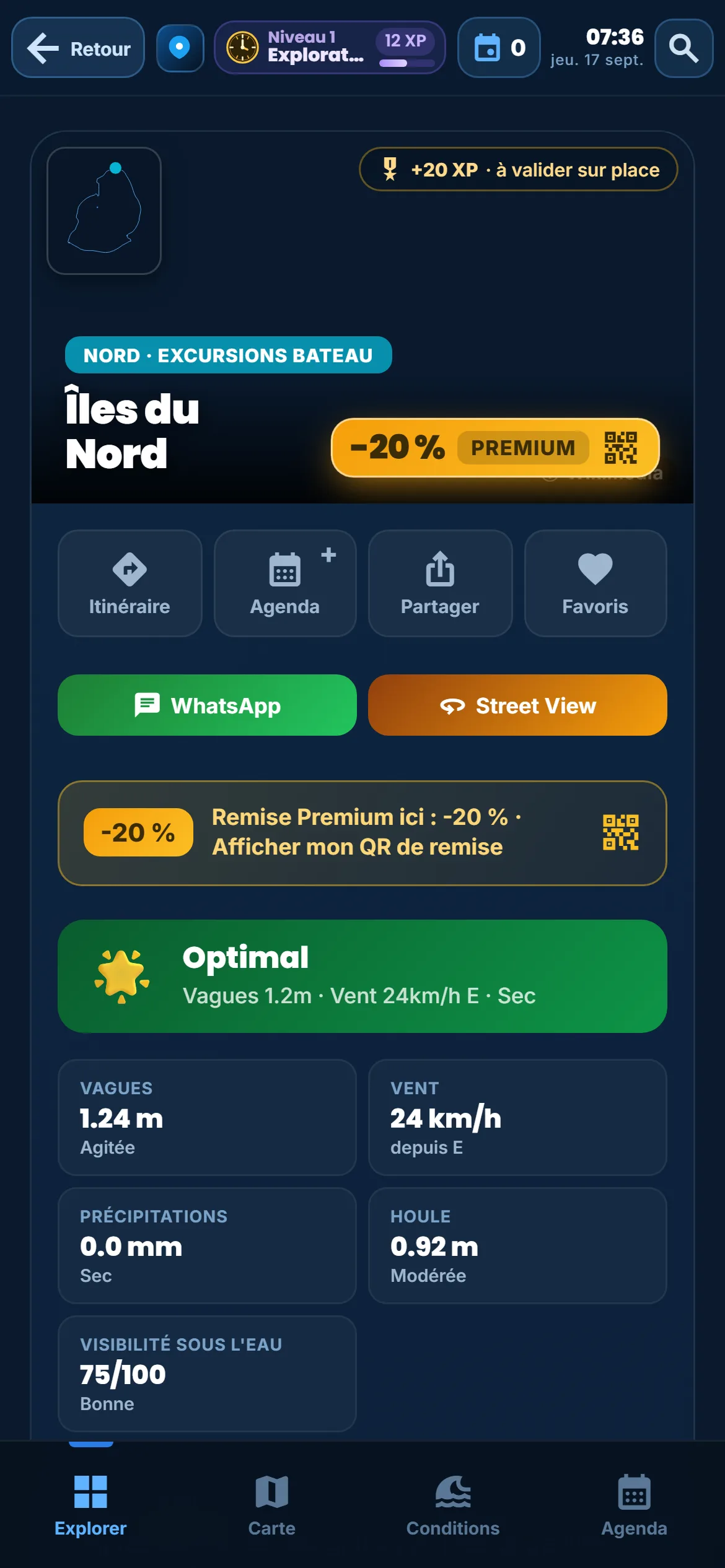
The second time I got it right, and it takes about twenty seconds. I open the operator’s page. Below the buttons sits a gold bar: « Premium discount here: −20 % · Show my discount QR ». One tap.
The app briefly asks the server and creates a code that belongs to me alone. A QR appears on a white background, with the line « Show this code to the partner to apply your discount » underneath, then a waiting note. Nothing else happens on my side: I just hold out the phone.
The operator scans with his own phone, any phone. He lands on a page telling him « Premium customer verified » and asking him for two things: his four-digit PIN and the amount I actually paid. He confirms — and my screen flips on its own, without me pressing anything: « Discount confirmed! You save X Rs ». The app checks every three seconds, which is why it feels instant.
That the operator types in the amount himself is not a detail: it is the single most important decision in the whole mechanism. It means the saving recorded in your account is not an estimate, but what actually crossed the counter. We could have assumed an average price — the app would then show prettier numbers and less true ones.
The four-digit PIN serves the same purpose. It proves the operator is the one confirming, not somebody who stumbled onto the link. Getting it wrong repeatedly blocks the code, which is then spent — annoying, but less annoying than a system where discounts could be passed around. If the PIN is not at hand, a phone call to the operator settles it better than guesswork.
And since the question always comes: the operator does not learn who you are. He sees that a verified customer is standing in front of him, and he enters an amount. No address, no number, no list that ends up somewhere. The code says exactly what it must, and not one sentence more.
What it is, what it allows, what it changes
What it is. A single-use code, one per person per partner, unlocked by the operator with his PIN and the amount paid. No coupon to print, no card, no commitment on your side. Four operators on the island take part today, between 10 and 20 %.
What it allows. The discount comes off at the till, at the moment you pay — not as a refund arriving later, not as points you have to build up first. No advance booking is needed: you can decide on the morning itself which trip suits you, and only open the code once you are on the jetty.
What it changes. This is the part most descriptions leave out. When a trip for two becomes noticeably cheaper at 20 % off, the balance of the whole day shifts: the boat becomes an option again instead of an expense you argue about. And because the discount only exists on the spot, it moves the money towards the people who work here, not towards a platform.
From the operator’s side the arithmetic is just as plain: no commission, no fee, no equipment. He needs a phone with a camera and his four-digit code. That is precisely what makes it workable for small outfits.
Who gives what, today
This list was read out of the app on 22 September 2026, not written from memory. It moves when an operator joins or stops: the app always shows the current state, this page shows that day’s.
- Îles du Nord (boat trip to the northern islets, with Arielle) — −20 %
- Îles de l’Est avec Sam (boat trip on the east coast) — −20 %
- Mayniko (restaurant) — −15 %
- Spot Kitesurf Bel Ombre (Kiteglobing) — −10 %
Four. That is few, and I would rather write it myself than let somebody discover it by counting. Each one was approached in person, visited, then put under contract, and that takes time. I would rather have one partner I know than twenty logos on a page.
What you have saved adds up under « My partner savings » in your account — the sum of the real amounts operators typed in. Next to the travel journal, where your stay gathers itself anyway, it is the second number that says something by the end of a trip.
What the discount does not do
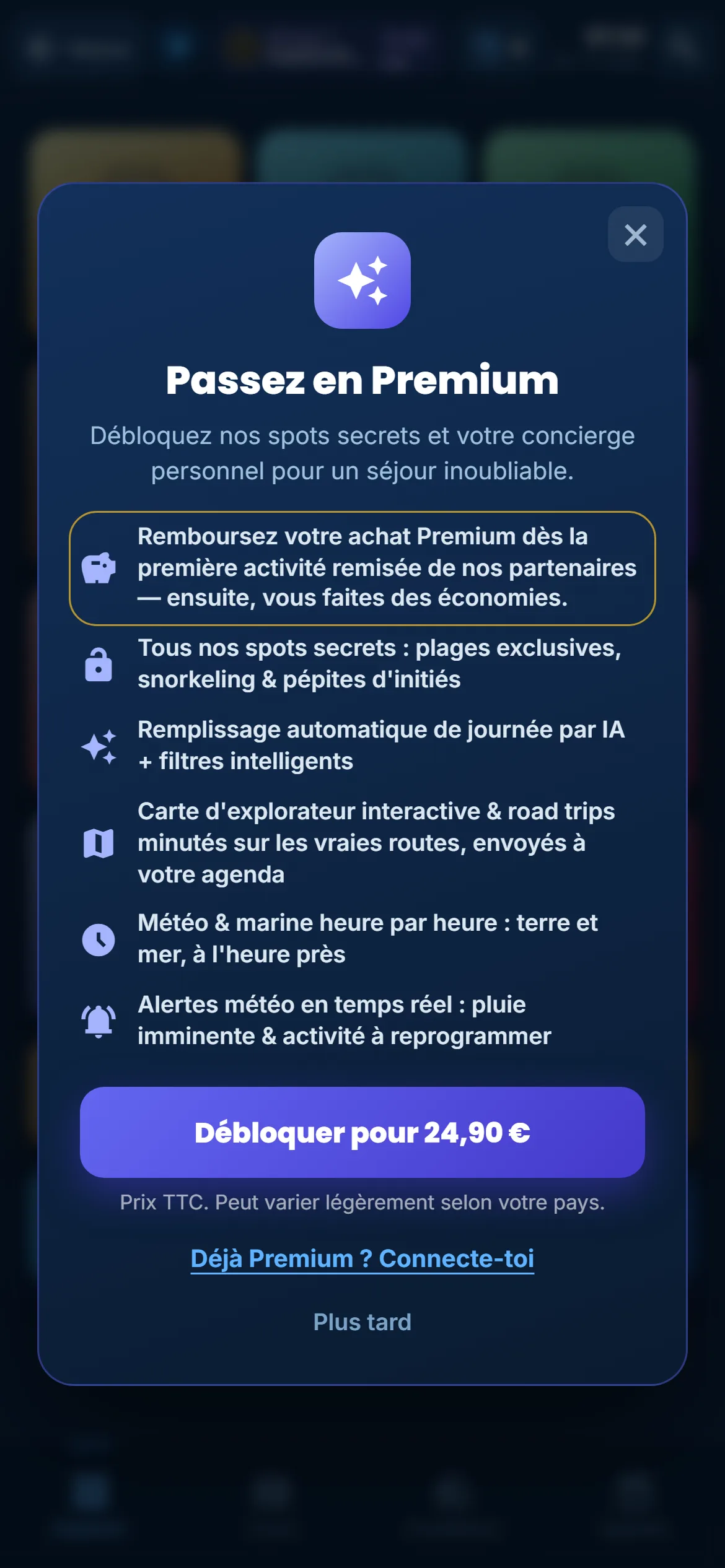
The honest part, and the most important. It is included in the app. Premium costs 24.90 € once, and it stays yours — no subscription, no renewal.
Once per operator. The code is spent on confirmation. Twice with the same partner is not possible: reopen it and the app says « Discount already used here », with the amount from that time. That is deliberate — operators give up 10 to 20 % to meet new customers, not to subsidise regulars.
It needs signal and an account. The code is created by the server at that precise moment: not in a dead zone, and not while signed out. At the Grand Baie jetty this is a non-issue; on a remote track in the south it would not be. Open it while you still have bars.
It is not retroactive and does not apply to anything booked elsewhere. Going through an agency or a platform means giving up the discount, even when the operator is the same. It is tied to booking directly, on the spot.
And it does not replace judgement. Whether the sea will behave that day is not something a discount can tell you — that is in the land and sea conditions, zone by zone, and on the map you can see where the wind is coming from that day. A cheap trip with the wind on the wrong side is still half a day lost.
All told: a small feature that does one thing and does not lie about it. If you are booking on the spot in Mauritius anyway, it costs you twenty seconds to open the code before you pay. Those twenty seconds are exactly what I did not take that morning in Grand Baie — and it is the only mistake this feature lets you make.