Le Morne, 11:30. It is 29 degrees, a light breeze is coming off the sea, and you do not feel the sun beating down. That is exactly the trap: in Mauritius the UV index climbs to 9 or 10 before noon, even under a half-cloudy sky. I live on the island and I built this app. Before going to the beach I look at one tile, then one row of numbers: they tell me when the sun burns, and when it becomes reasonable again. Here is what the app shows, screen by screen, with the real forecast for tomorrow.
The real problem: you cannot feel the Mauritius sun
In the tropics the sun rides very high in the sky. The trade wind cools your skin, so does the lagoon, and nothing warns you that the dose is rising. You settle in at 10 am, swim, have lunch on the sand, and the sunburn shows up in the evening.
Temperature tells you nothing about this: 29 degrees in the morning or the afternoon is the same to a thermometer. What changes from one hour to the next is the UV index. So you need it to the hour, and for the place you are going to.
What I did, screen by screen
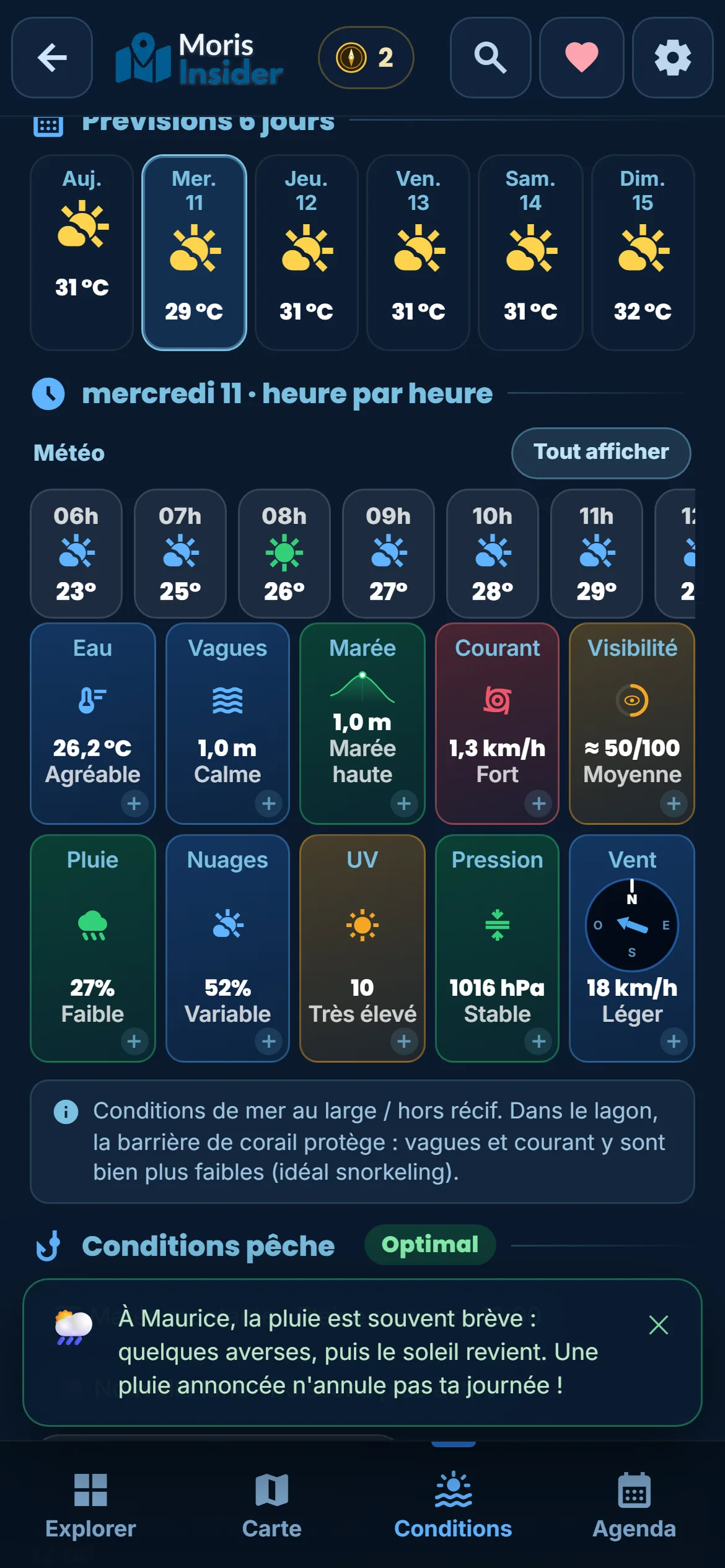
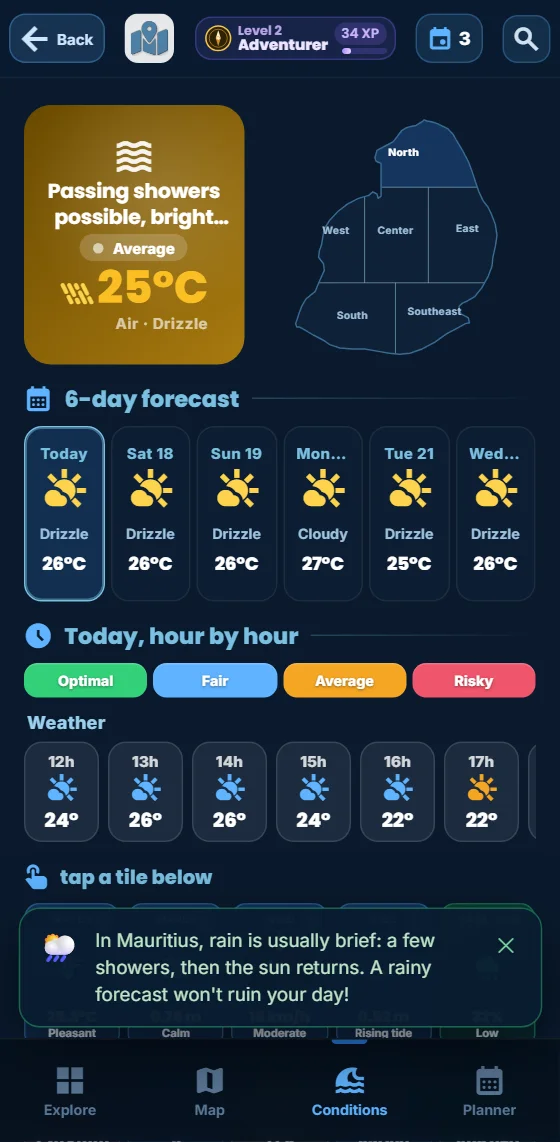
On the evening of Tuesday 10 November I prepared the next day. The screenshots come from the app itself, with the real forecast of the moment. The app was in French; in English the labels are translated.
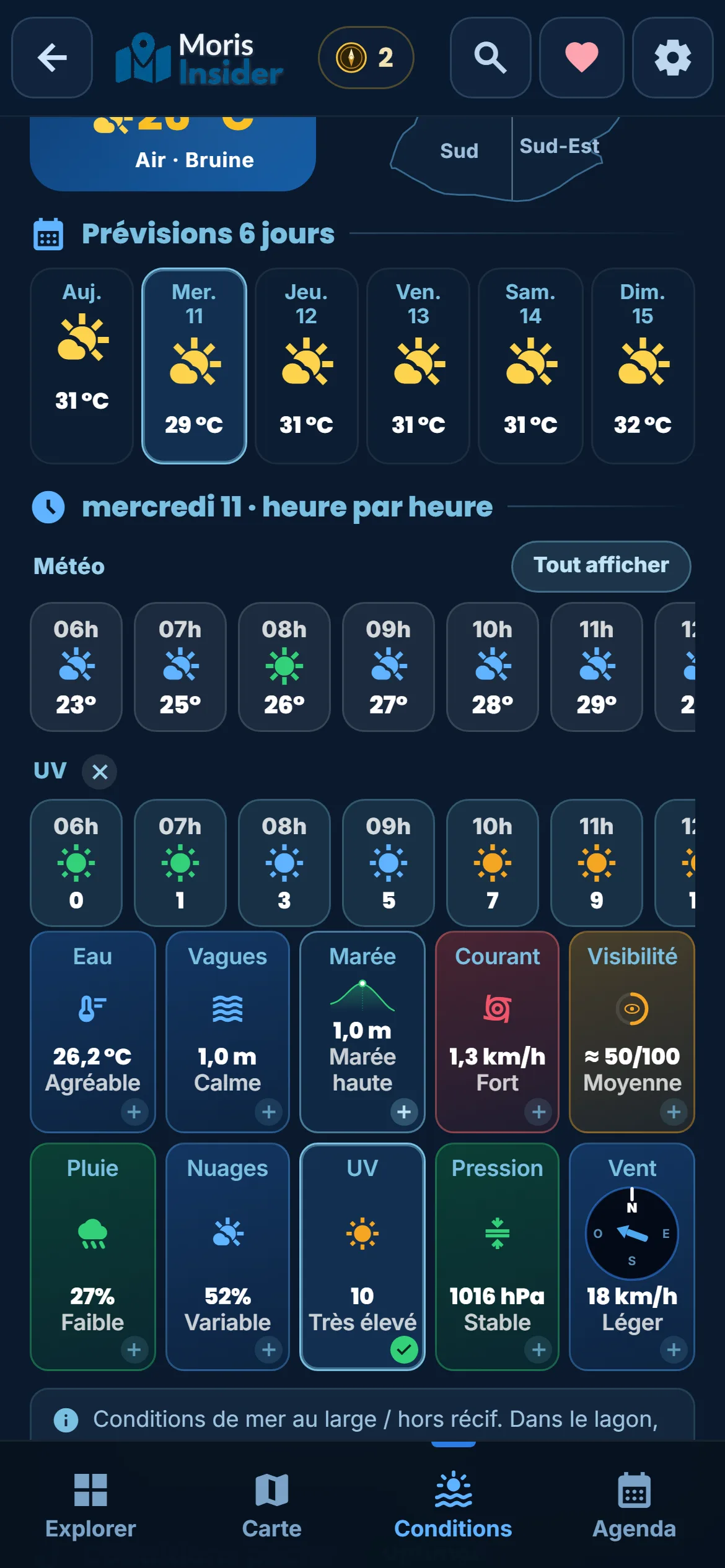
Pick the day. In the Conditions tab I first choose my region on the small map of the island, then the day under the six-day forecast. The tiles update: water, waves, wind, rain, and UV. For today the UV tile shows the value for the current hour (a moon at night); for another day it shows the maximum of the day.
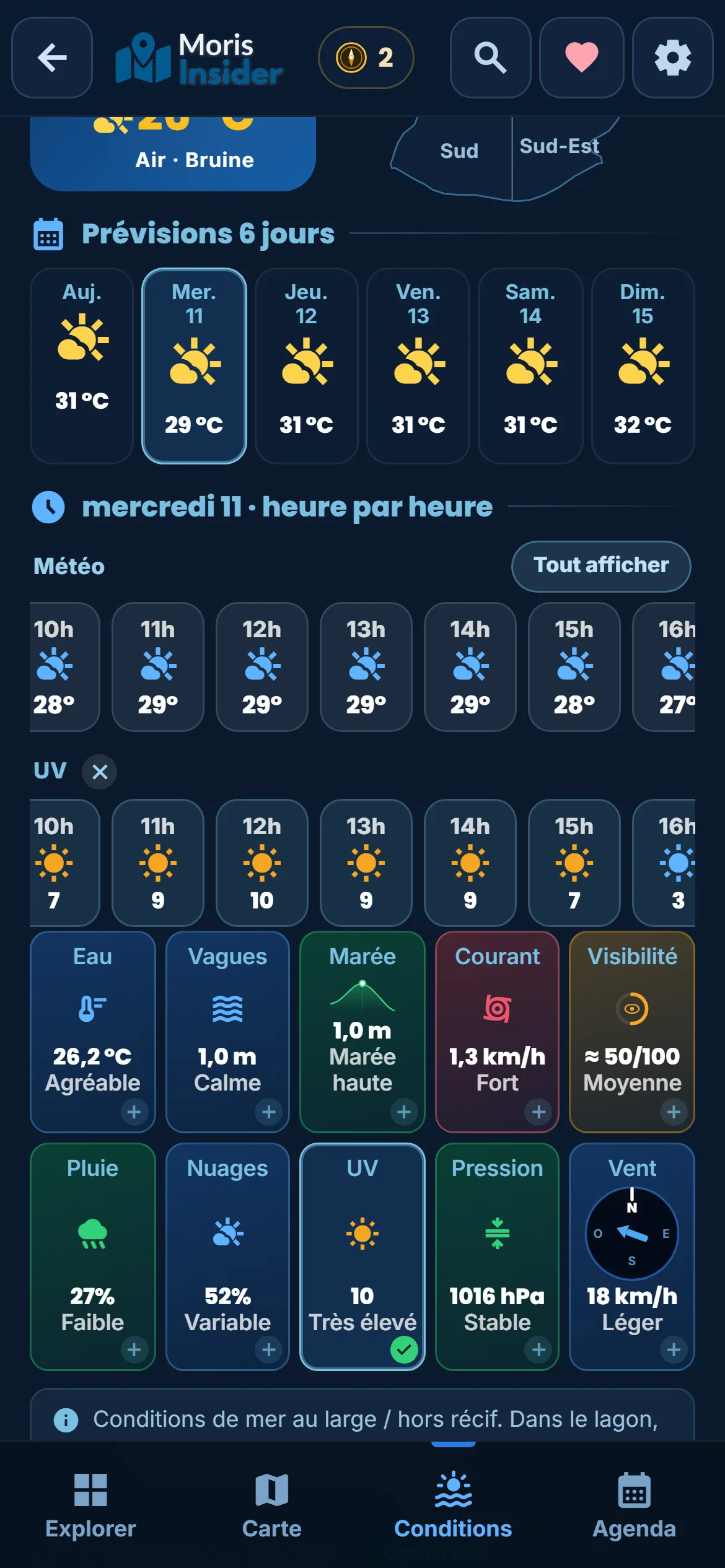
Tap the UV tile. One tap and a “UV” row appears under the hourly weather, hour by hour. That is where it all happens. For this Wednesday: 3 at 8 am, 5 at 9, 7 at 10, then 9, 10, 9 and 9 between 11 am and 2 pm, still 7 at 3 pm, and only 3 at 4 pm.
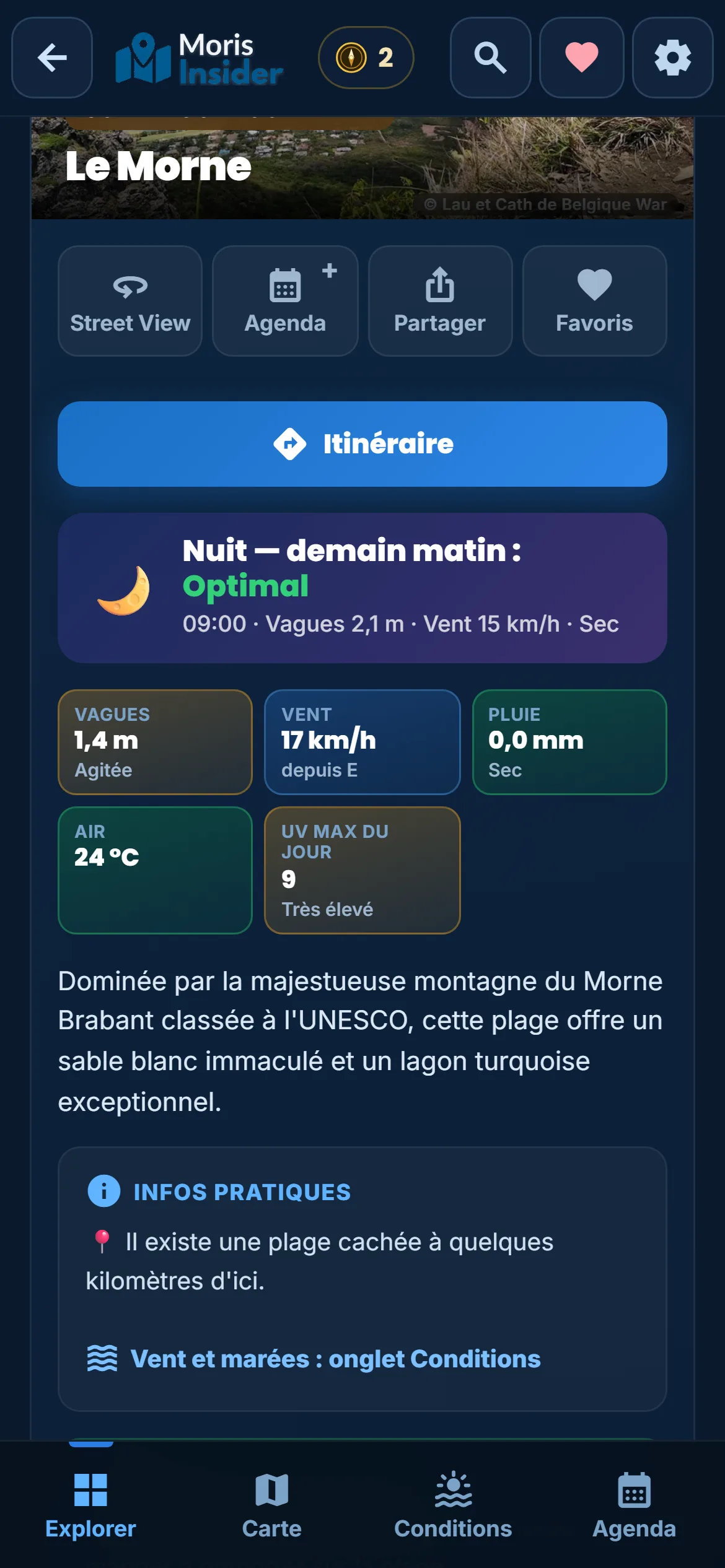
Check the beach page. On every beach page a “max UV of the day” box gives the value and its level. At Le Morne that evening: 9, “Very high”. No need to go back to Conditions to get the order of magnitude.
What it is, what it lets you do, what it changes
What it is. The forecast UV index for each region of the island, hour by hour and over six days, sorted into five levels: low (under 3), moderate (3 to 5), high (6 and 7), very high (8 to 10) and extreme (11 and above). The figures come from the ECMWF and GFS weather models, via Open-Meteo.
What it lets you do. See at a glance the window when the sun is strongest, and the one when it eases off. This Wednesday it was clear-cut: above 7 from 10 am to 3 pm, under 5 before 9 am and from 4 pm.
What it changes. You put the beach and the snorkelling early in the morning or late in the afternoon, and keep the middle of the day for shade, lunch or an indoor visit. With the weekly planner, the day is built around those hours, and you enjoy day two instead of spending it out of the sun.
What the app’s UV index does not do
It is a forecast, not a measurement. It applies to a region, not to your towel. A passing cloud lowers it for a while, and reflection from the water or white sand can add to what your skin receives: the value shown is an order of magnitude.
It barely affects a beach’s verdict. A beach’s verdict (“Optimal” and the levels below it) mostly looks at waves, wind and rain; UV counts for very little. So a beach can be “Optimal” with a UV of 10: reading the box is up to you.
It does not warn you. The app sends no reminder when the UV rises, and it does not replace sunscreen, a hat or shade. It only tells you when you will need them.
For the rest, one tile and one row of numbers are enough. Look at them the evening before, together with the beach map, and the Mauritius sun stays a pleasure.
One destination for life, a 3-day pass or an annual subscription