Bali has dozens of waterfalls, and the rankings doing the rounds tell you neither what they cost, nor how many steps they demand, nor at what hour they still look like the photograph. Yet that is exactly where a fine morning parts company with a disappointment: a famous waterfall visited at midday, in the middle of the wet season, looks nothing like its picture. Here are the seven worth the journey, with what each really asks of you.
There is no such thing as “the waterfalls of Bali” — there are two groups
This is the first thing to grasp, and it decides your day. Bali’s waterfalls fall into two distinct geographic clusters, and trying to string them together in one outing is the surest way to spend the day in a car.
First, the easy ones, around Ubud and the centre — Tegenungan, Kanto Lampo, Tukad Cepung, Tibumana. Short access, a few flights of steps, two of them fit into a morning. Then the north, the Buleleng regency — Sekumpul, Banyumala, Gitgit, Aling-Aling, Munduk — taller, greener, markedly quieter, but demanding a full day. Bali is counted in hours, not kilometres: the full reasoning is in our guide to getting around Bali.
Full guide: Flights to Bali: When to Book and Which Stopover
Here are the seven that justify the journey, with what each really asks.
| Waterfall | Entrance fee | Effort | What to know |
|---|---|---|---|
| Sekumpul | 20,000 (view) · 125,000 · 200,000 | Steep descent, 1 to 3 hrs | Guide compulsory beyond the viewpoints |
| Tukad Cepung | 25,000 to 30,000 | Short, along a river bed | The light beam: 9–10.30 am, clear sky |
| Banyumala | 50,000 | 15 min, easy | The only real swim · 8 am – 6 pm |
| Tegenungan | not verified on 16/08 | A few flights of steps | Packed 10 am–3 pm · brown water after rain |
| Nungnung | 10,000 to 20,000 | ~500 steps · 15 min / 45 min | 50 m tall · steps slippery after rain |
| Kanto Lampo | not verified on 16/08 | Short access, slick rock | People come for the photo, and they are not alone |
| Aling-Aling | not verified on 16/08 | Short, plus the jumps | Guide and vest required · jumps closed if water rises |
Sekumpul: the finest, and the only one you have to earn
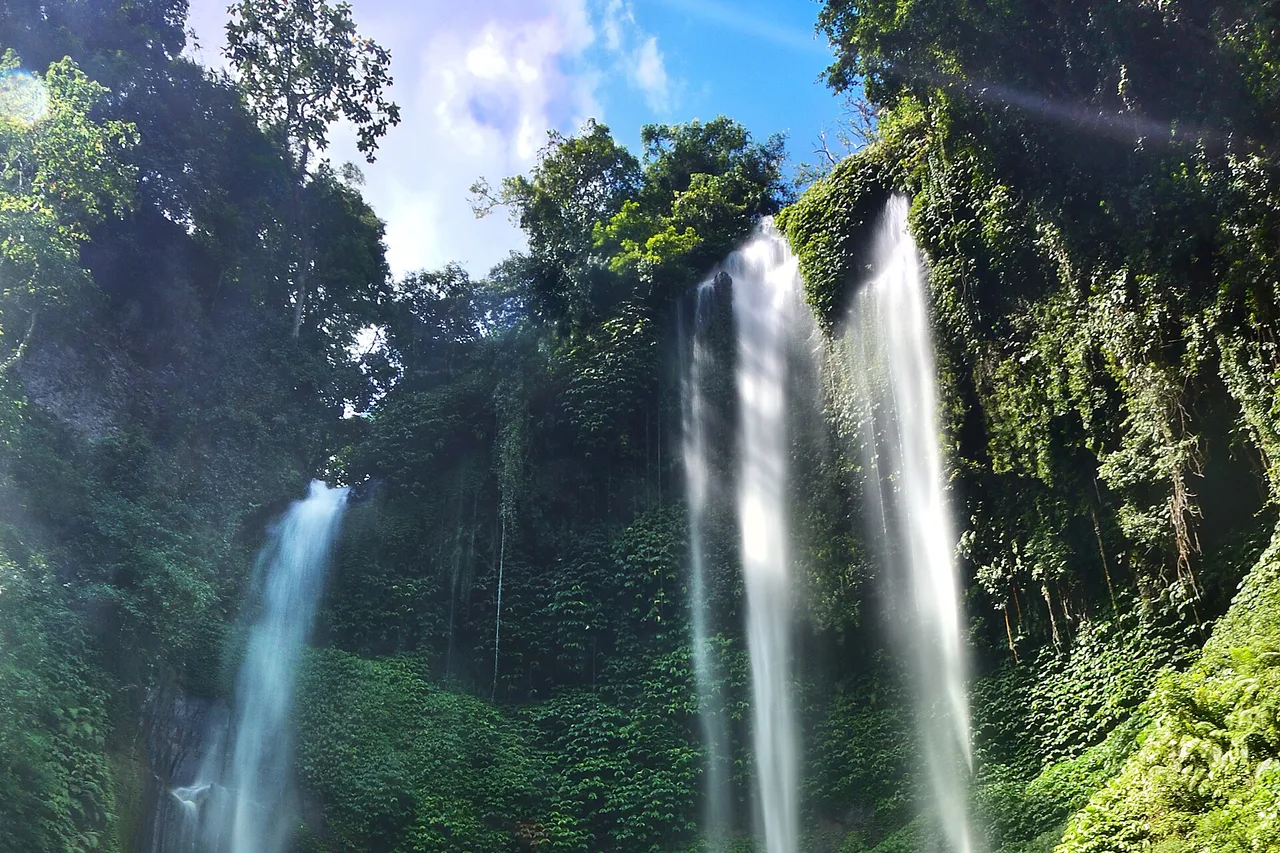
If you visit only one, make it this. Sekumpul is not a waterfall but an amphitheatre: several columns of water dropping side by side into a valley entirely closed off by jungle. No photograph conveys the scale, and that is rare.
Three options at the gate, and you should choose knowingly. View only: 20,000 rupiah, you stay at the viewpoints. Medium trek: 125,000 rupiah, one to two hours, down to the foot of the falls. Long trek: 200,000 rupiah, two to three hours, guide included, with a donation to the village and a visit to Hidden and Fiji, two neighbouring falls.
A guide is compulsory the moment you go beyond the viewpoints. This is not a hustle: it is a village rule, adopted for safety and so that the money stays local. The official guides at the entrance are therefore not touts, contrary to what you sometimes read — here, the instinct to refuse is the wrong instinct.
On the effort, let us be plain: the descent is steep and taxing. Once at the bottom, moving from one fall to the next is nearly flat but very slippery. Closed shoes with a gripping sole, no flip-flops, and expect the climb back to take longer than the way down.
Tukad Cepung: the one that has to be visited by the hour
Tukad Cepung resembles nothing else: the fall drops into an almost enclosed gorge, and light enters only through an opening above. When the sun reaches the right angle, a beam comes down onto the water. That image made the place famous — and it does not last all day.
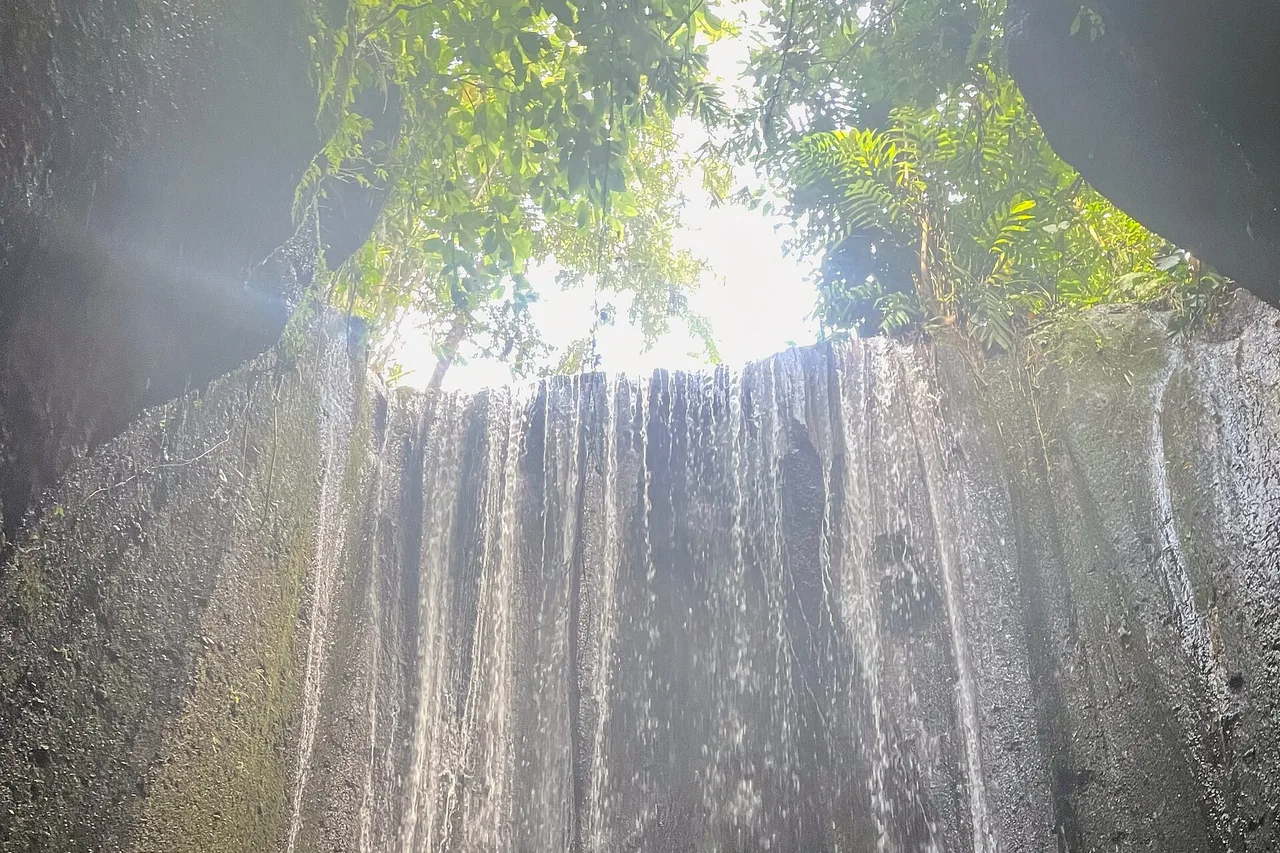
The useful window runs from 8 to 11 am, the best of it around 9 to 10.30, under a clear sky and preferably in the dry season. Outside that, you will see a pretty fall in a dark gorge, which is not the same thing. A second reason to be early: the crowds arrive after ten, and the floor of the gorge is narrow.
Entry sits at about 30,000 rupiah — one source recorded in January 2026 gives 25,000, and we would rather quote both than pick one at random. A local escort is generally imposed for the final stretch.
One serious seasonal caveat: the approach runs along a river bed. In the wet season the level can rise quickly and the path turns slippery. This is not a place to insist on when it is raining hard upstream.
Banyumala: the one you actually come to swim in
Many Balinese waterfalls are lovely to look at and unpleasant to swim in: narrow pools, current, rocks. Banyumala is the exception, and that is what justifies the detour north.
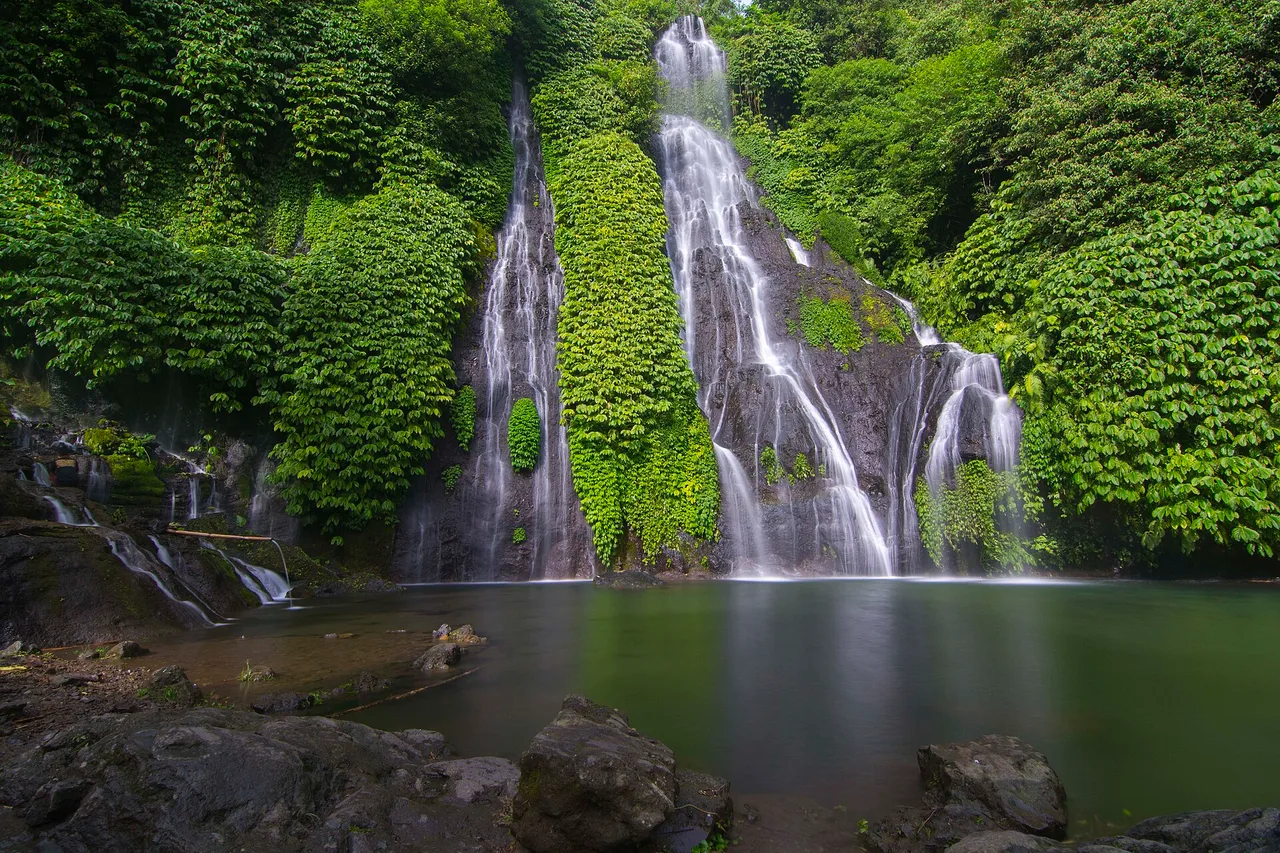
Twin falls slide down a wall of pure vegetation into a wide pool where the water reaches chest height. The fall is about 36 metres; the approach walk is fifteen minutes and nothing difficult. Entry 50,000 rupiah, open 8 am to 6 pm. The site is at Wanagiri, in Sukasada, Buleleng regency.
It is far quieter than the central waterfalls, simply because it lies beyond the reach of a day trip from the south. That is the best reason to go — and a good argument for sleeping a night in the north rather than driving there and back, as we suggest in our two-week itinerary.
Tegenungan and Kanto Lampo: the easy ones, and what they cost in peace
These two sit minutes from Ubud, ask only a few flights of steps, and can be seen in the same morning. That is their strength and their problem.
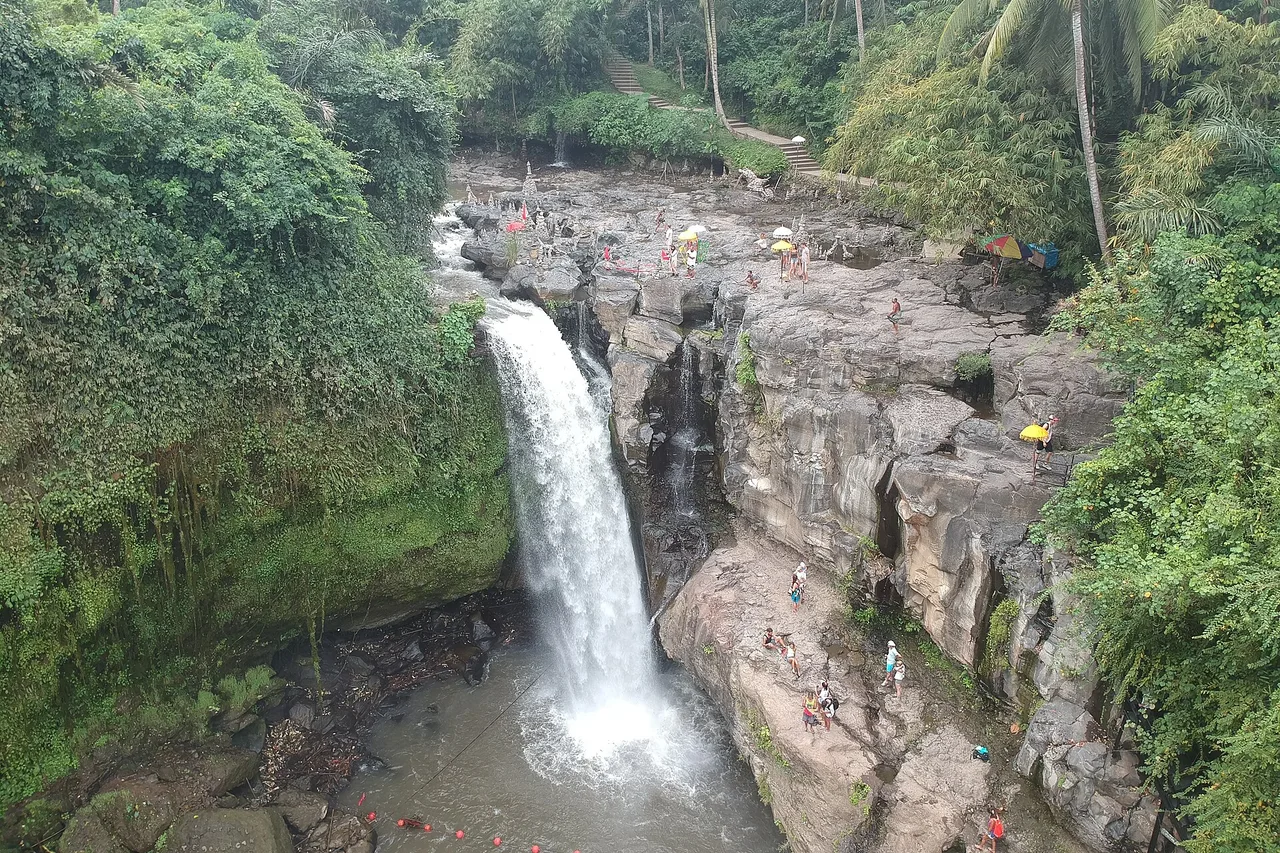
Tegenungan is the busiest on the island. It is packed from 10 am to 3 pm; the window that changes everything is 6.30 to 9 am. Swimming is allowed at the foot of the fall, with one qualification that matters: currents are strong in the immediate vicinity of the fall, and you must stay inside the marked area. Another point of honesty: the water turns brown during and after heavy rain; it is markedly clearer from April to October.
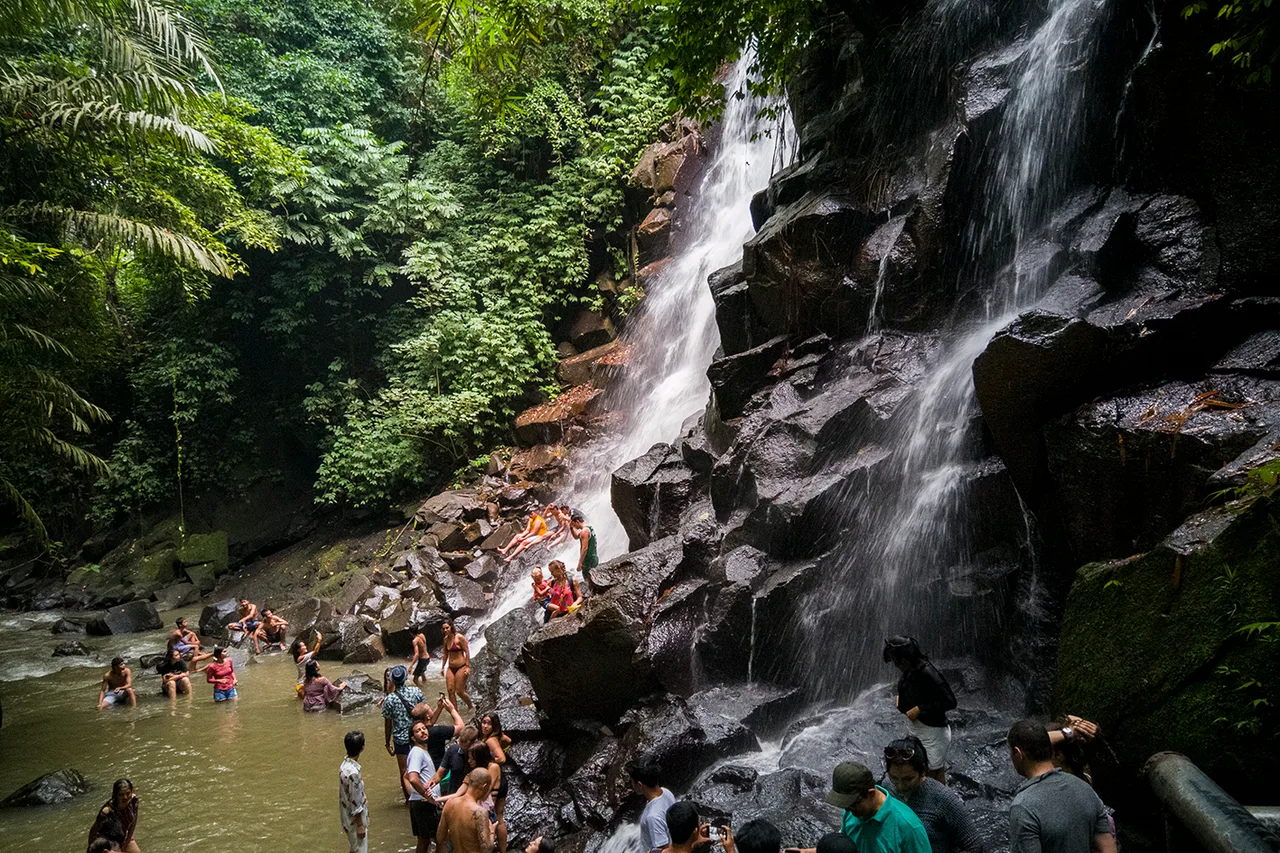
Kanto Lampo is not a single drop but a sheet of water sliding over stepped black rock — hence its popularity in photographs. On the ground, reality is the picture above: you are rarely alone, and the rock is frankly slippery. The entrance fee could not be verified on the day of this update; it sits within the general Balinese range, 20,000 to 200,000 rupiah depending on the site.
Nungnung and Gitgit: height, paid for in steps
Nungnung is among the tallest in Bali — roughly 50 metres — and it is paid for in stairs: about 500 steps. Reckon on fifteen minutes down and up to forty-five back up, which tells you all you need about the gradient. Entry is modest, 10,000 to 20,000 rupiah. After rain the steps turn slippery: this is the waterfall not to pick on a day of heavy showers.
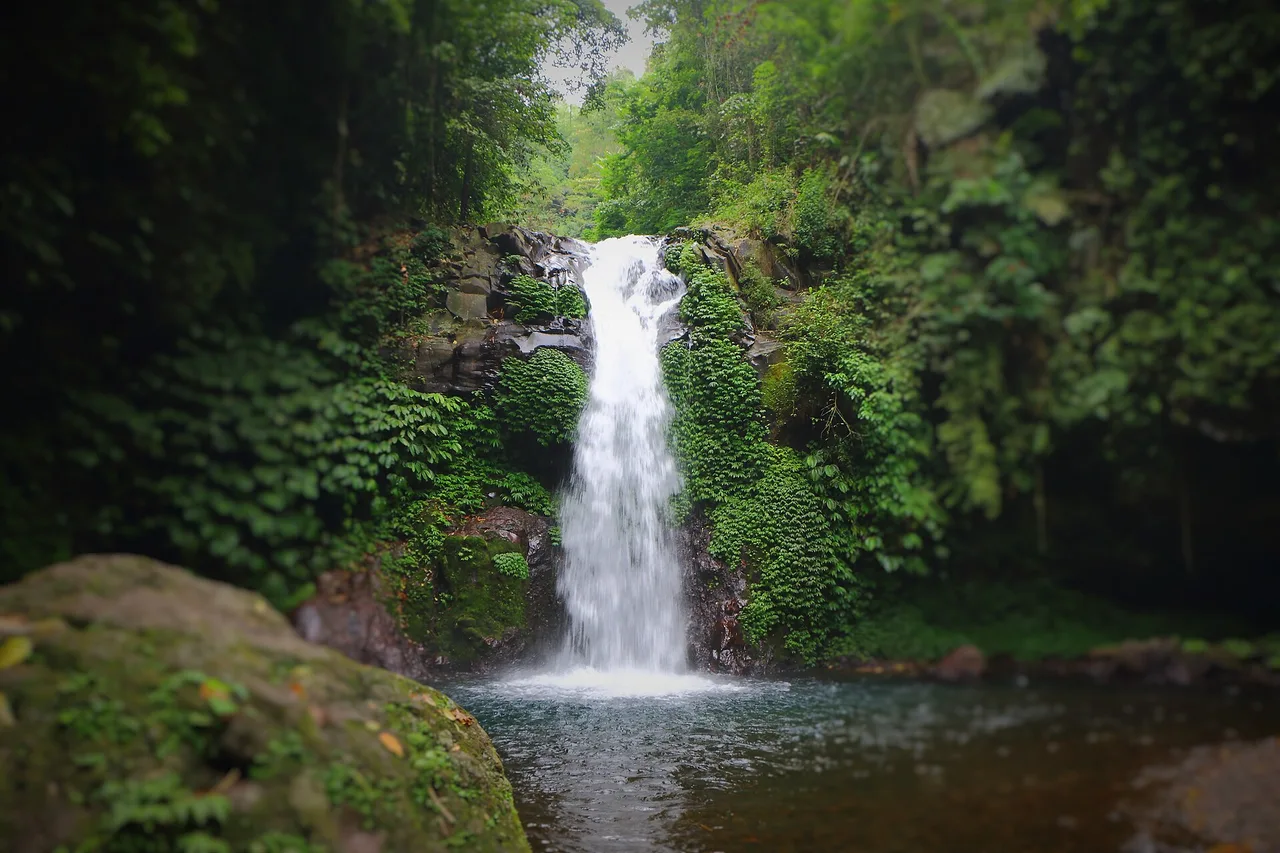
Gitgit is the northern compromise: a handsome fall into a green pool, easy access, no trek. It is the right call when you want to see a northern waterfall without Nungnung’s 500 steps or Sekumpul’s three hours — typically late in the day, or with children.
The jumps at Aling-Aling: what “supervised” means here
Aling-Aling is sold as an activity: cliff jumps and natural slides. It is real, it is supervised, and it is the one place on this list where a mistake cannot be undone.
A guide is compulsory, a life vest is provided for the slide, and in the wet season guides close the jumping spots when the level rises — pool depth becomes unpredictable after heavy rain, and the water turns light brown from rice-field run-off. A refusal on such a day is good news.
The rest has to be said, because it is documented: a fifteen-metre jump, made after cursory instructions, ended in a broken back and a medical evacuation to Singapore. That is not an argument for giving up — it is an argument for never jumping unless someone has checked the entry point that day, and for starting from the lower heights. Bear in mind too that travel insurance may contest a claim arising from an unsupervised activity.
What it costs, and why the guide is not a scam
Entrance fees run roughly from 20,000 to 200,000 rupiah depending on the site. They are collected by the villages and go towards maintaining paths, stairways and surroundings — that is, towards what makes the visit possible at all. Seen from Europe the sum is trivial; seen from the village, it is the income that keeps the site usable.
Two practical consequences. First, these fees are never included in a private driver’s rate — 700,000 to 900,000 rupiah for ten to twelve hours, fuel and parking included, but entrance tickets, toll and the driver’s lunch on top. A day taking in three or four waterfalls can therefore cost more in tickets than the driver himself. The detail is in our two-week budget.
Full guide: Car Rental in Bali: Prices, Licence and Pitfalls
Second, carry cash in small notes: cards are accepted almost nowhere at these sites. And if you are considering a scooter, the Indonesian rule applies here as everywhere: your home motorcycle licence and an international permit, with frequent checks since April 2026. On wet mountain roads, with a bag and soaked shoes, this is also the day when the driver makes the most sense.
Two ways to approach this spend, and they are not equivalent. Paying on site leaves the negotiation at the gate, with the gaps described above. Going through a guided outing fixes the price in advance but adds one more variable: checking what the outing includes — entry fees, village guide, transport — mainly tells you whether the posted rate is comparable to the next one, which it almost never is.
When to go, and in what order
The season. From April–May to September–October the water is clearer, paths less slippery and skies more often clear — which counts double for Tukad Cepung, which needs sun. In the wet season the falls are more powerful and often more spectacular, but the water clouds, steps become dangerous and some activities close. The month-by-month picture is in our guide to when to visit Bali.
The hour. This is the most underrated variable, and the only one entirely in your hands. Tegenungan before nine, Tukad Cepung between nine and half past ten, Kanto Lampo as early as you can. After ten, the question is no longer how beautiful the place is, it is how many people stand in front of you.
The order. Do not mix the two clusters. One morning for the centre — Tegenungan then Tukad Cepung — from a base in Ubud. A full day, or a night on site, for the north — Sekumpul and Banyumala, perhaps Gitgit on the way. It is another good reason to split the trip between two bases rather than one, as set out in our guide to where to stay in Bali.
And if water is your priority, Bali is not the only option: the choice between Nusa Penida’s cliffs and the flat lagoons of the Gilis poses itself in exactly the same terms, and we have set it out in our comparison, Nusa Penida or the Gilis.
Top-rated activities in Bali, bookable online: