Three sites, 235 kilometres, a closed loop: the Golden Circle is the one Icelandic itinerary where the content is not up to you. Everyone sees the same thing, in the same order, usually at the same hour. The only two variables left to you — when you leave and in which order you stop — are therefore the only ones that separate a memorable day from three full car parks. Here is the loop in numbers, what each stop really asks of you, and the moment to set off.
Half a day dressed up as a full one
Let us start with the figure guides rarely put up front: the whole loop is 3 hours 40 minutes of driving and about 3 hours of sightseeing. Six hours forty, in total, for a day that is sold to you as eight.
This is not a criticism of the Golden Circle, it is its exact description. Three sites, a closed 235-kilometre loop, fully paved on its main axis, starting from Reykjavík. Here is how it breaks down.
| Leg | Distance | Driving | On site |
|---|---|---|---|
| Reykjavík → Þingvellir | 45 km | 45 min | 1 h 30 |
| Þingvellir → Geysir | 60 km | 1 h | 45 min |
| Geysir → Gullfoss | 10 km | 10 min | 45 min |
| Gullfoss → Reykjavík | 120 km | 1 h 45 | — |
| Whole loop | 235 km | 3 h 40 | 3 h |
Read the last line as a constraint rather than a programme: you have one to two hours left to fill, and how you fill them decides your day far more than the order of the three big sites. Leave them empty and they will fill themselves — in queues, in hunting for a parking space, and in photographs taken over other people’s shoulders.
Full guide: Car Rental in Iceland: Prices, Insurance and F-Roads
Second figure, just as rarely highlighted: all three sites are free. Þingvellir, Geysir and Gullfoss cost nothing, paths included. What you pay for is two car parks — 1000 ISK at Þingvellir for a vehicle with up to five seats (1200 ISK for six to nine) and about 1000 ISK at Geysir. Parking at Gullfoss is free. The real cost of the Golden Circle is the car and the day, not the entrances — and our one-week budget breakdown gives the true order of magnitude.
The three stops, and what each really asks of you
The three sites carry the same name on every map, but they are not visited in remotely the same way. Two of them are widely misunderstood, and the third is shorter than people expect.
Þingvellir — allow 1 hour 30, and know that history comes before geology. Everyone arrives for the rift, and the rift is there: Almannagjá is the edge of the North American plate, a wall of lava the path follows for more than a kilometre. But that is not why Þingvellir has been a UNESCO World Heritage site since 2004. It is because the Alþingi, the Icelandic assembly, sat here from 930 until 1798 — nearly nine centuries — and because the republic was proclaimed here on 17 June 1944. The plain most visitors cross without looking at it is the oldest parliament in the world still in existence.
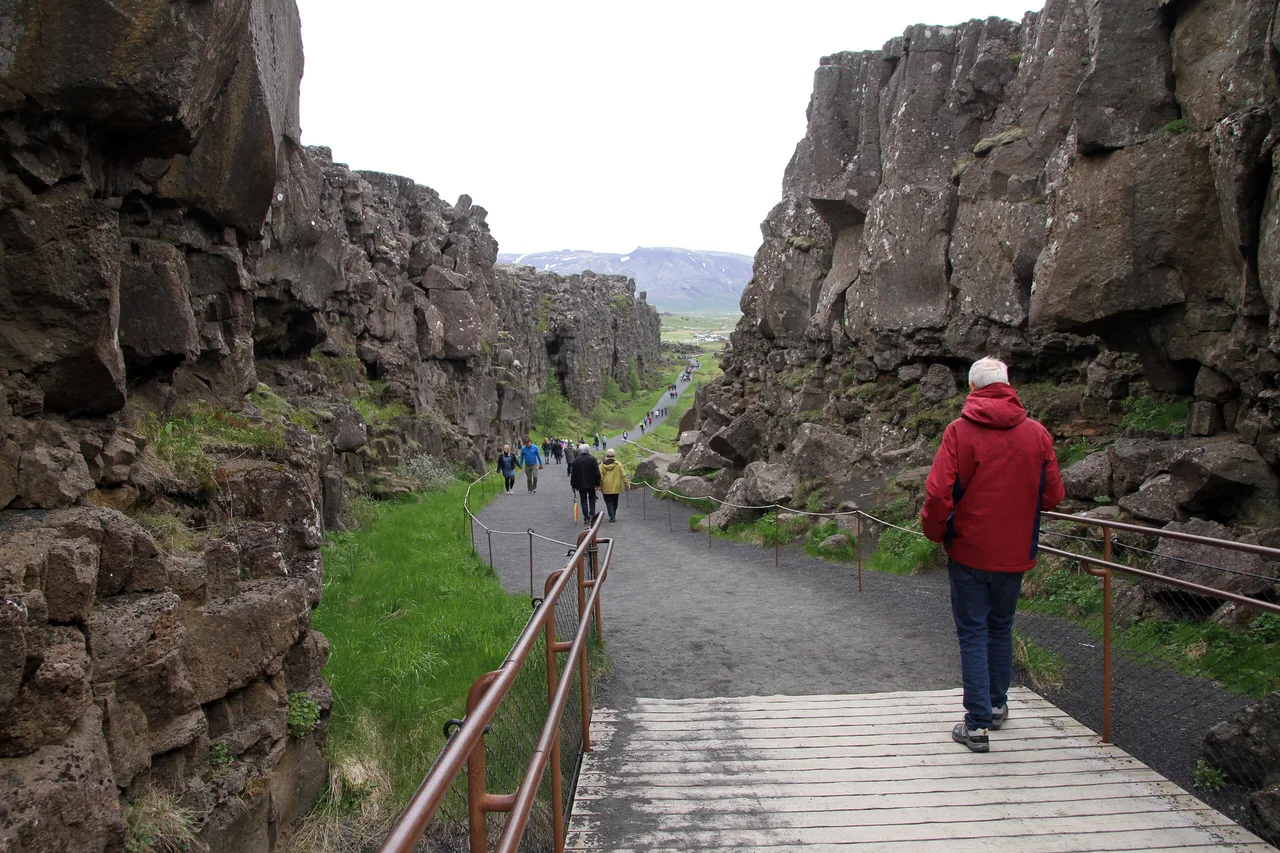
In practice: park at the upper car park, walk down Almannagjá to the Lögberg, and allow the ten-minute detour to Öxarárfoss at the far end of the rift. If you dive, Silfra — the fissure filled with meltwater filtered through lava, where you swim between two plates — must be booked ahead and takes half a day on its own: that is not a Golden Circle stop, it is a different programme.
Geysir — allow 45 minutes, and know that Geysir is not what you are photographing. The Great Geysir, the one that gave its name to every geyser on Earth, is now all but dormant. The column of water everyone waits for, camera raised, is Strokkur, its neighbour, which erupts every 5 to 10 minutes with metronomic reliability.
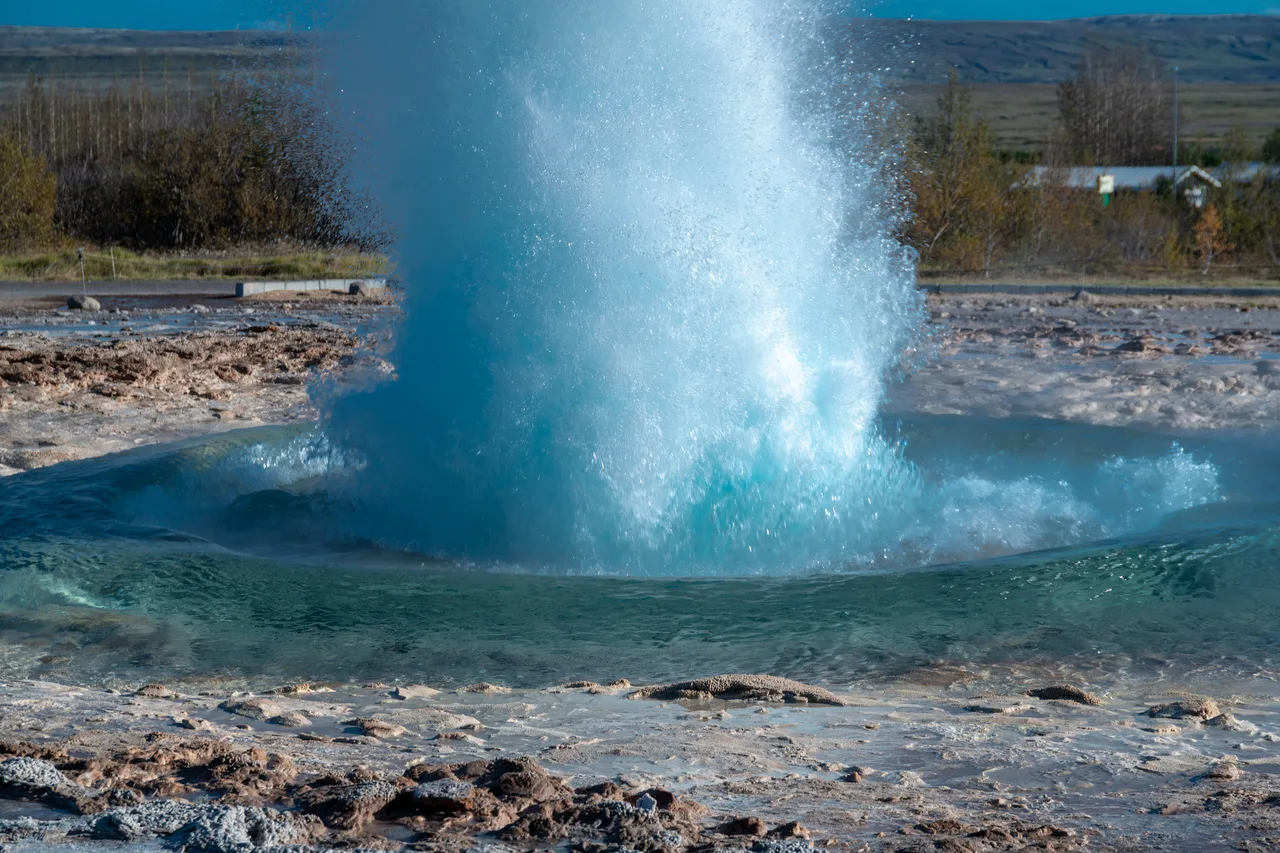
That reliability changes how you visit: nothing keeps you waiting long, and the good spot is not in front of the basin but slightly above it, with the wind at your back — the spray comes down, and it is scalding. The geothermal field around it, with its blue pools and mud pots, is worth the twenty minutes almost nobody gives it.
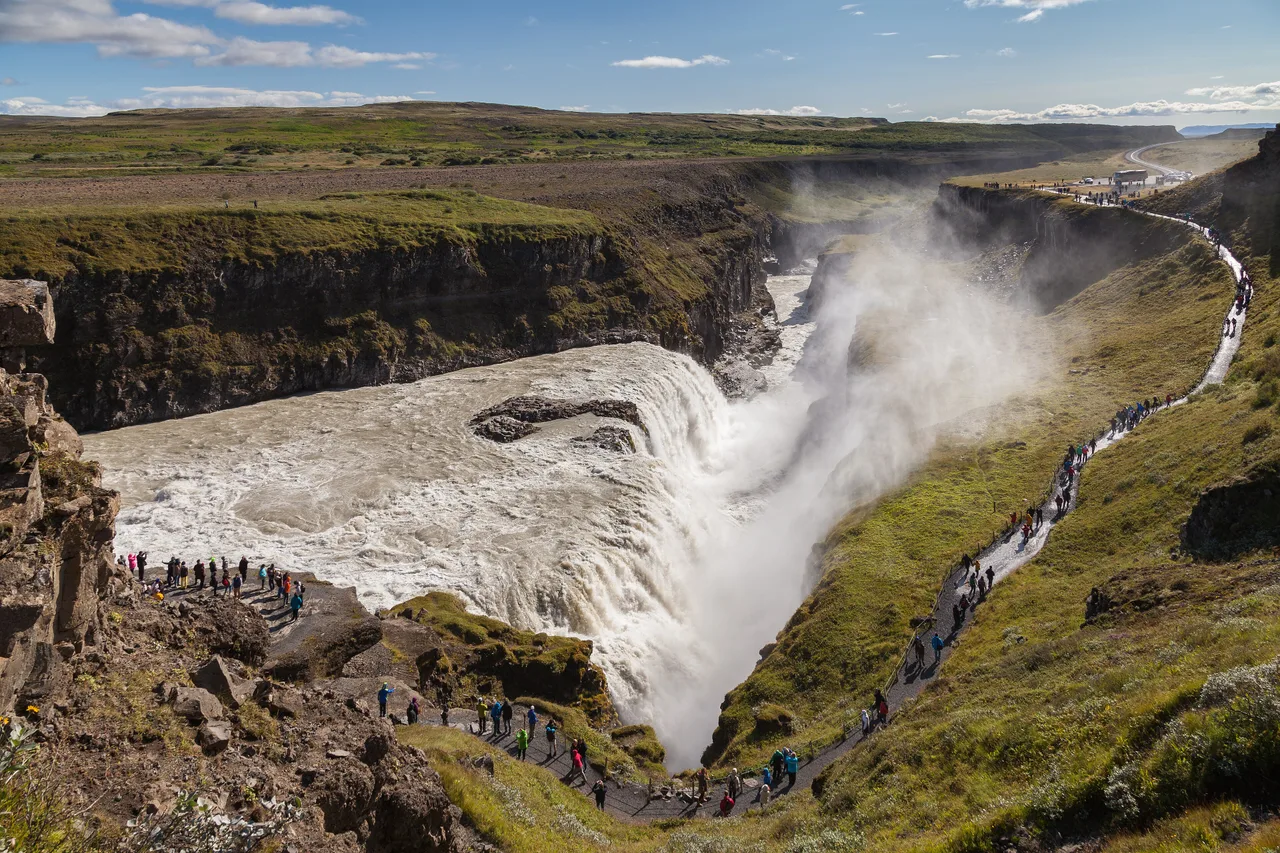
Gullfoss — allow 45 minutes, and walk down. The golden falls, the one that names the whole loop, drops in two successive steps of 11 then 21 metres before vanishing into a canyon so narrow that, from the upper viewpoint, the water seems to sink into the ground. The upper car park view is the most photographed; the lower one, at the end of the path, is the only place where you feel the real scale. A memorial stone recalls Sigríður Tómasdóttir, the owner’s daughter who fought a hydroelectric scheme in the early twentieth century that would have drowned the falls. Gullfoss is still here partly because of her.
The only real lever is the hour — the order comes second
Here is the point that decides your day, and it has nothing to do with the route.
Coaches leave Reykjavík between 8 and 9 a.m. and reach the sites from 10 a.m., almost all in the same order: Þingvellir, then Geysir, then Gullfoss. They head back in the late afternoon. Between 10 a.m. and 4 p.m., all three car parks are full and the paths are queues.
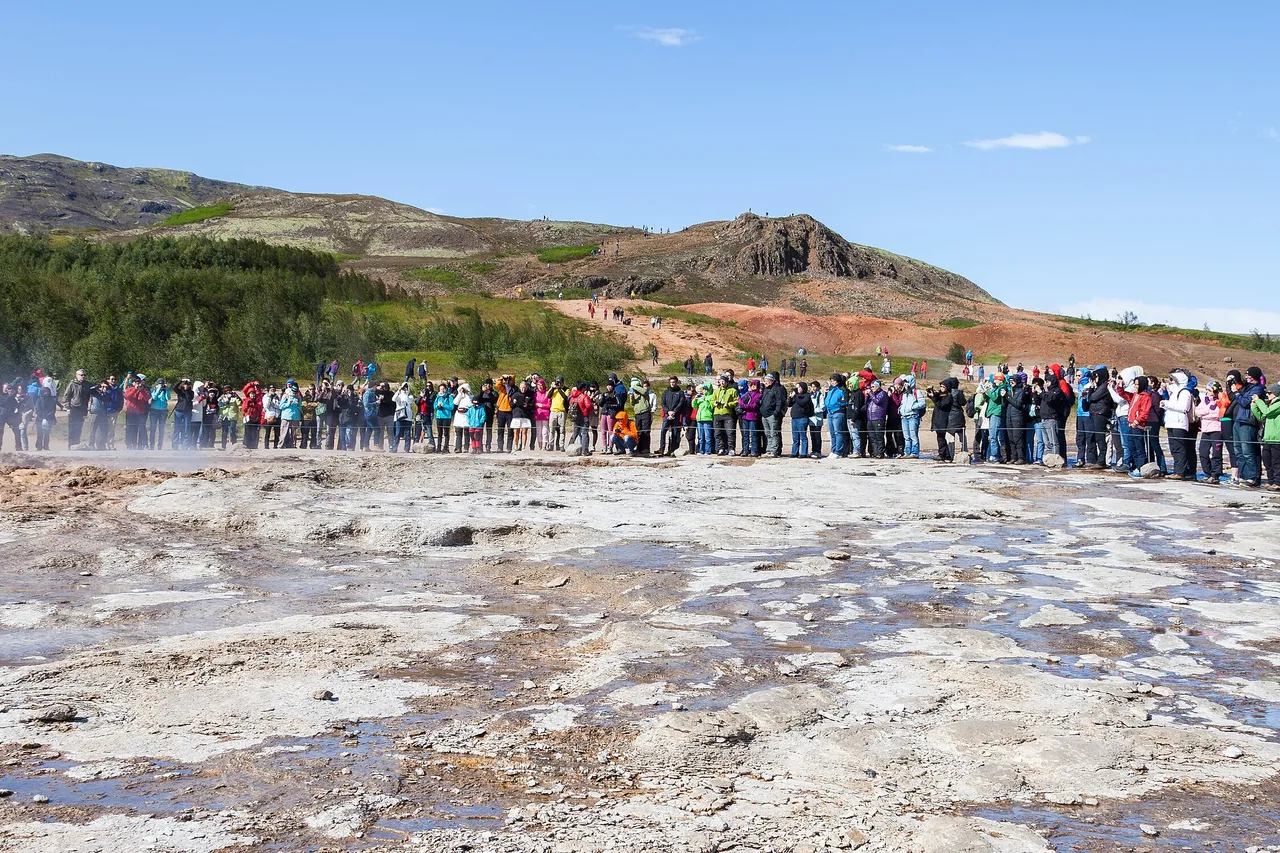
Look at this photograph: it has nothing to do with a bad itinerary. It is the same geyser as in the previous image, in the same place, at a different hour. No route makes that crowd disappear — only the clock does.
Two strategies work, and they are symmetrical.
① Stay in front. Leave Reykjavík around 7.30 a.m., keep the classic order — Þingvellir, Geysir, Gullfoss. You get Þingvellir almost to yourself, you cross the wave at Geysir, and you are at Gullfoss as it arrives. It is the simplest strategy, and the only one still available in winter.
② Stay behind. Leave around 2 or 3 p.m., reverse the order — Gullfoss first via Route 35 through Selfoss, then Geysir, then Þingvellir at the end of the day. You reach each site just as the coaches have left it. In summer, the midnight sun makes this evening loop not merely feasible but superb: the low light on Gullfoss at 9 p.m. bears no resemblance to midday.
⚠️ A word on vocabulary, because it makes the advice fail. Many guides recommend driving the loop “anticlockwise” — but sources do not agree on what “clockwise” and “anticlockwise” mean here, and you will find both words describing the same route. That is why this article names the stops rather than the direction: start at Þingvellir, or start at Gullfoss. Advice you can apply backwards without noticing is worth nothing.
Two details that cost little and pay well: avoid Saturdays in July and August, when the local crowd is added to the tourist one — a Tuesday is markedly calmer at the same season. And if you are driving, collect the car the evening before: that is what makes a 7.30 a.m. start genuinely possible, instead of spending it in a rental queue. Comparing totals on your real dates takes a few minutes and avoids the nasty surprise of options billed separately — the detail is in our guide to renting in Iceland.
The fourth stop is what makes your day
Back to the gap from the first section: one to two hours available. Here is what slots into them without breaking the loop, sorted by what it actually asks of you.
| Stop | Detour | What it costs | What it asks of you |
|---|---|---|---|
| Kerið | none, it sits on Route 35 | 600 ISK, parking free | 30 min |
| Brúarfoss | 10 min off Route 37 | 750 ISK parking | a 5-minute walk, and patience for the light |
| Friðheimar, the tomato greenhouses | none, it sits on Route 35 | a meal | a booking, compulsory — it sells out often |
| Secret Lagoon, in Flúðir | 25 min there and back | an entrance fee | 1 h 30 including changing |
| Laugarvatn Fontana | none, it sits on Route 37 | an entrance fee | 1 h 30 including changing |
A word on each, because the five are not equal depending on what you are after.
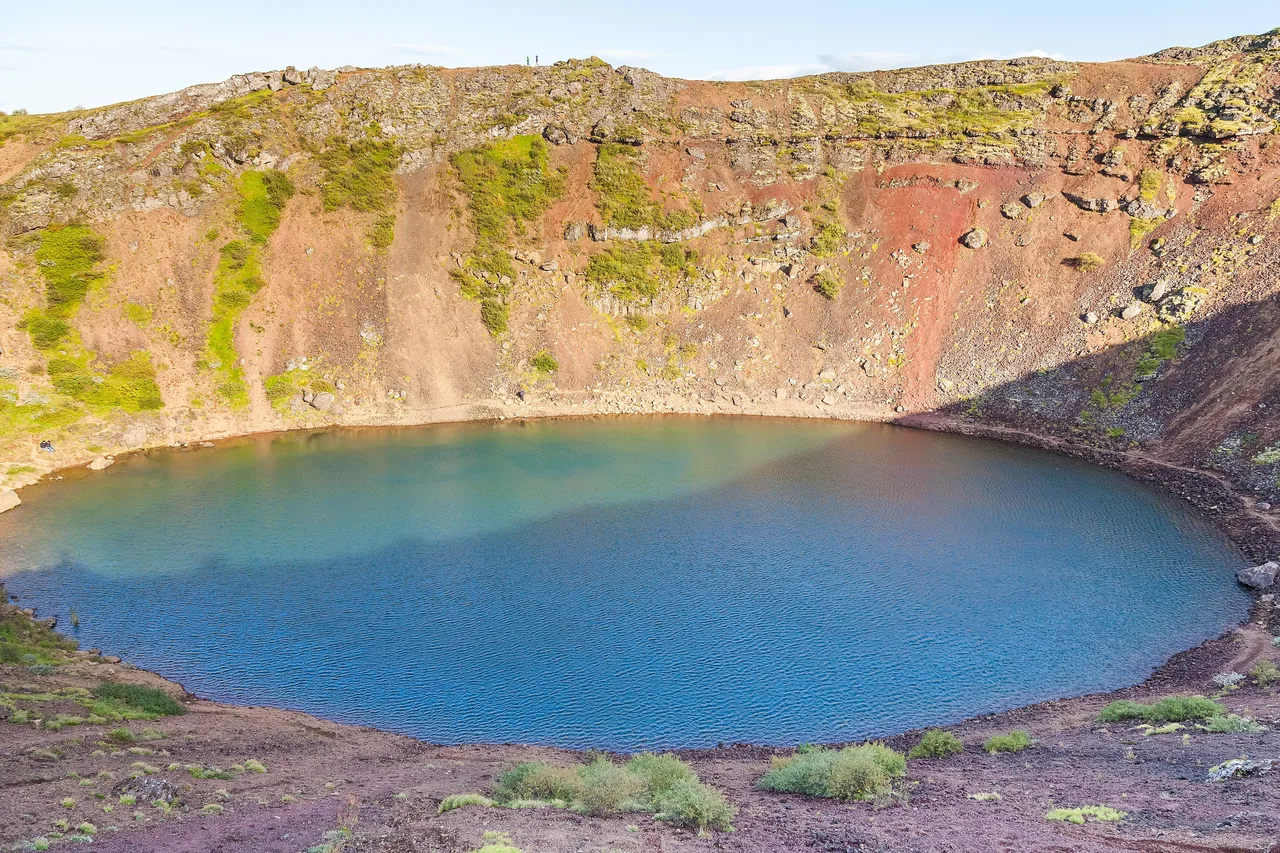
Kerið has the best time-to-effect ratio on the loop: a volcanic crater of red scoria filled with a turquoise lake, 600 krónur, thirty minutes, and it sits on Route 35 — meaning on your way home if you return via Selfoss, or on your way out if you run the loop the other way. No detour, a whole site.
Brúarfoss asks more commitment for a less certain reward: from the new car park (750 ISK), a five-minute walk is enough, but the waterfall only shows its extraordinary blue in good light. Under cloud, it is a pretty fall among a hundred others.
Friðheimar is the only stop on this list you must book, without exception: you eat lunch inside a geothermally heated tomato greenhouse, and places go a long way ahead. Turning up without a booking means turning around. It is also, incidentally, the best illustration of what geothermal energy does to this country.
Secret Lagoon, in Flúðir, and Laugarvatn Fontana are the loop’s two geothermal pools. Allow 1 hour 30 each, changing included — this is a real stop, not a pause. We do not quote their prices: they were not verified on the day of publication, and an approximate price is worse than no price.
The rule is simple: one of these five stops, not three. The Golden Circle with four stops is a good day; with seven, it is a day of car parks.
Winter does not change the road, it changes the time budget
Contrary to a widespread idea, winter does not close the Golden Circle. The main axis is paved and maintained all year, and the loop is one of the rare Icelandic itineraries that stays drivable in January without special equipment.
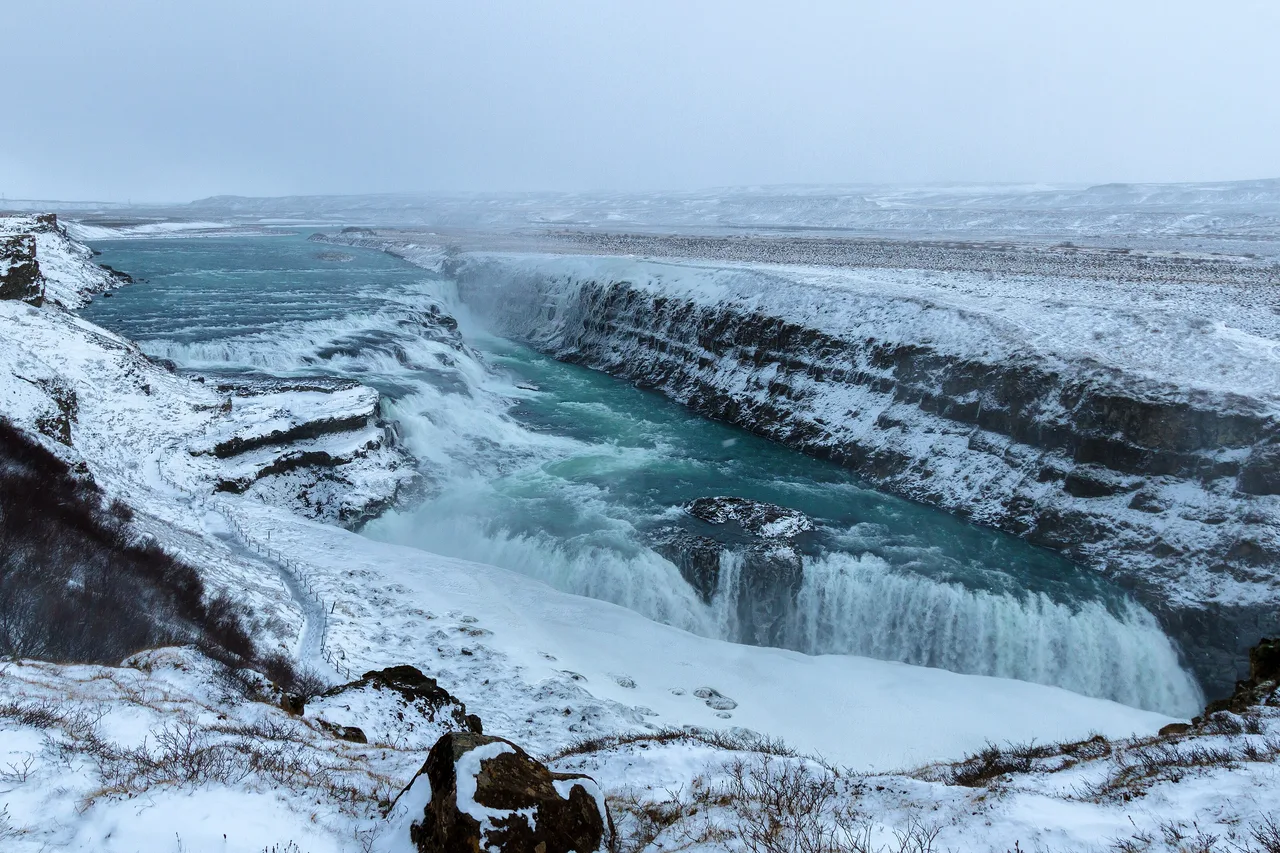
What changes is the one resource that cannot be negotiated: daylight. In December and January only four to five hours of usable light remain — sunrise around 11 a.m., sunset around 3.30 p.m. The loop needs 3 hours 40 of driving: in other words, your entire day fits inside a window of light barely longer than the time on the road. Any delay is paid for by visiting a site by head torch.
Three practical consequences, and they are enough.
Leave before sunrise, around 9 a.m.: the first hour is driven in the dark on a cleared road, and you reach Þingvellir with the light. Drop the fourth stop, or replace it with a geothermal pool at the end of the route, where darkness takes nothing away. And keep an eye on Route 365, between Þingvellir and Laugarvatn: it includes gravel and degrades faster than the rest; the route to Laugarvatn via the 36 then the 37 is the fallback.
Road conditions are read the same morning on road.is — never the evening before. No article can replace that, and our comparison of the seasons spells out what each period really demands of a driver.
If driving at night on a winter road does not appeal, the honest solution exists: a guided day trip from Reykjavík, preferably as an afternoon departure — which is exactly the “stay behind” strategy from the previous section, without the wheel. And since the Golden Circle then ends in darkness, it leads naturally into our northern lights guide, whose season this precisely is.
The method, in five lines
To recap, since the whole argument comes down to a few decisions taken before you set off.
① Choose your hour before your order. Leave at 7.30 a.m., or leave at 3 p.m. Anywhere in between and you are inside the wave, whatever the route.
② Keep the classic order if you leave early — Þingvellir, Geysir, Gullfoss — and reverse it if you leave late: Gullfoss, Geysir, Þingvellir, returning via the 35 and Selfoss.
③ Add one stop, exactly one. Kerið for spectacle without a detour, Friðheimar if you remembered to book, a geothermal pool if your day ends in the dark.
④ Budget for two car parks, not three entrance fees. The sites are free; 1000 ISK at Þingvellir, 1000 ISK at Geysir, nothing at Gullfoss. This is the one item that moves from year to year: check it on the spot.
⑤ In winter, count the daylight before the kilometres. Four hours of light and 3 hours 40 of road leave no margin: it is the fourth stop that goes, not the loop.
The Golden Circle is often described as the least original day in Iceland, and it is true that everyone sees the same thing. But it is also the only one where a choice as banal as what time you get up separates two entirely different days — and where a whole country, rift, geyser and waterfall, fits inside a hundred-kilometre radius. What remains is deciding whether you carry on east: the seven-day Ring Road itinerary starts exactly where this loop closes.
Top-rated activities in Iceland, bookable online: