Between a Reykjavík municipal pool and the Blue Lagoon, the price ratio is one to eight — for the same geothermal water. It is the only figure that matters here, and the one that lists of “Blue Lagoon alternatives” never give: they compare ten-thousand-króna lagoons with each other and miss what Icelanders actually do. Here are the country’s four families of hot bathing, what each really costs, and the changing-room rule that decides where you end up far more than price does.
The real gap is not between two lagoons: it is one to eight
Start with the figure that makes everything else readable: an Icelandic municipal pool costs about 1430 krónur to enter; the Blue Lagoon starts at 11990. A ratio of 8 to one, in the same country, with the same geothermal water out of the same ground.
That is not a scandal, it is information. You are not paying for the water — Iceland has it everywhere and heats itself with it. You are paying for a setting, a changing room, a bar in the pool and a photograph. On some days that is worth the money; you just need to know that is what you are buying.
Icelandic hot bathing falls into four families, and almost every “Blue Lagoon alternatives” article covers only one of them.
| Family | Examples | Adult price | What it asks of you |
|---|---|---|---|
| The neighbourhood pool | Laugardalslaug, one per municipality | 1430 ISK (~€10) | showering, naked, before you get in |
| The wild spring | Reykjadalur, Seljavallalaug | free (parking extra) | walking, and no comfort at all |
| The developed spring | Secret Lagoon, Hrunalaug, Fontana | 3000–4500 ISK | a car, and a detour |
| The showpiece lagoon | Blue Lagoon, Sky Lagoon | 11990–12990 ISK (€80+) | money, and a firm booking |
Read the last column: each family asks a different price, and it is not always money. The wild spring asks for walking, the developed spring asks for a car, the lagoon asks to be paid — and the neighbourhood pool, the cheapest of all, asks for the one thing foreign visitors refuse most often. That is where to start.
The rule that decides everything: shower, naked, before you get in
Here is the point that keeps most travellers away from the cheapest option in the country, and it has nothing to do with price.
In every public pool and bath in Iceland, you must shower completely naked, with soap, before entering the water. Swimsuits are banned in the showers. This is not a loose custom: attendants walk through the changing rooms, and illustrated signs mark the parts of the body to wash carefully.
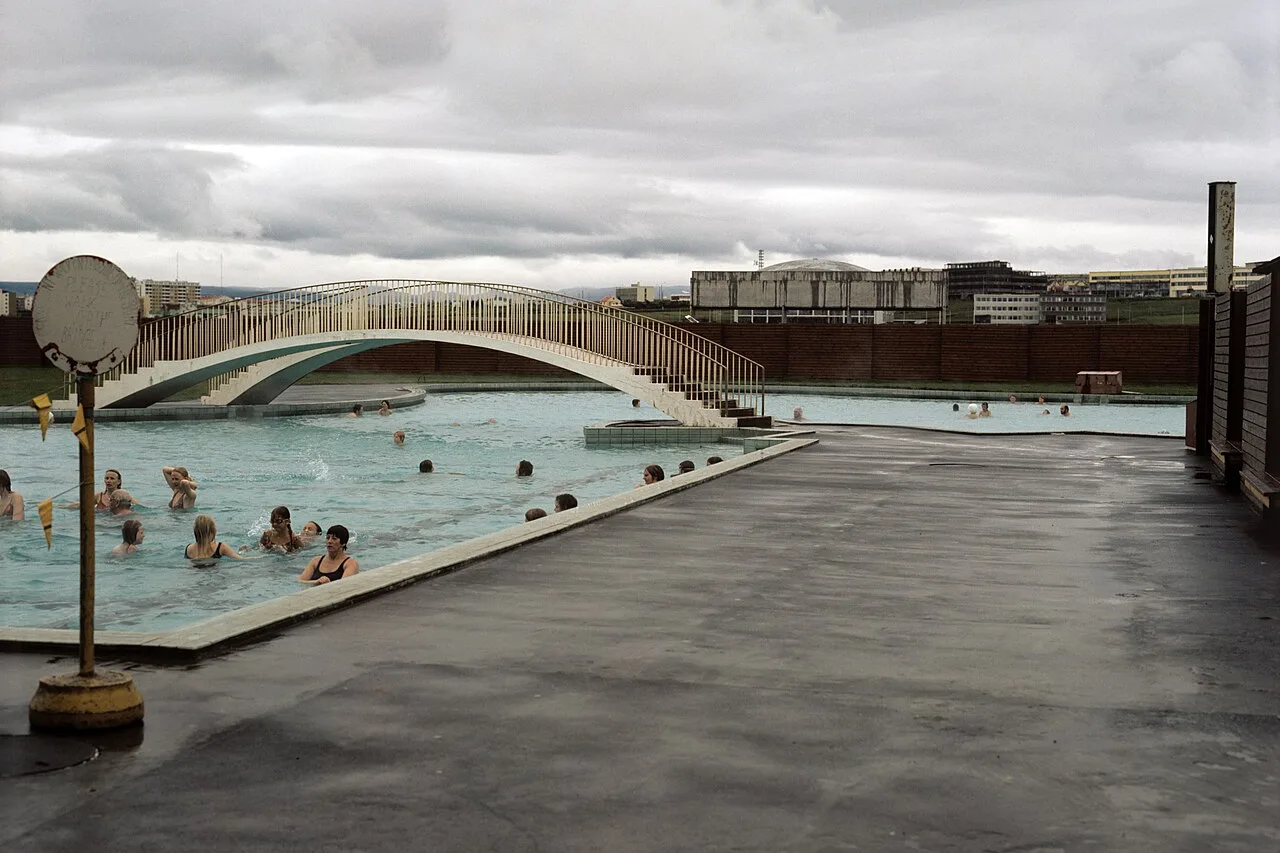
The reason is technical, not moral. Icelandic geothermal water contains very little chlorine — far less than in most countries. What keeps these pools clean is therefore not a chemical treatment but the cleanliness of the people who get in. A swimsuit stops soap reaching skin; a clothed shower washes nothing. That is the whole reason the rule exists.
Three things are worth saying plainly. Nobody is looking at you: Icelandic changing rooms are aggressively ordinary places, and the embarrassment is a visitor’s feeling, not a local one. It takes thirty seconds. And it opens the door to a network of heated pools in every town in the country, open from half past six in the morning until ten at night, for around ten euros.
At Laugardalslaug, Reykjavík’s big pool, that ticket buys an Olympic pool and a row of hot tubs running from 5 to 42 °C, one of them filled with seawater. It is also, very concretely, where Icelanders discuss the country: the neighbourhood hot tub does the job a café does elsewhere. No lagoon at 11990 krónur sells that, for the good reason that it is not for sale.
Wild springs: what they ask instead of money
On to the free ones, with the same honesty: “free” does not mean “without cost”. These places have no staff, no cleaning and no rescue nearby — which is exactly what makes them beautiful.
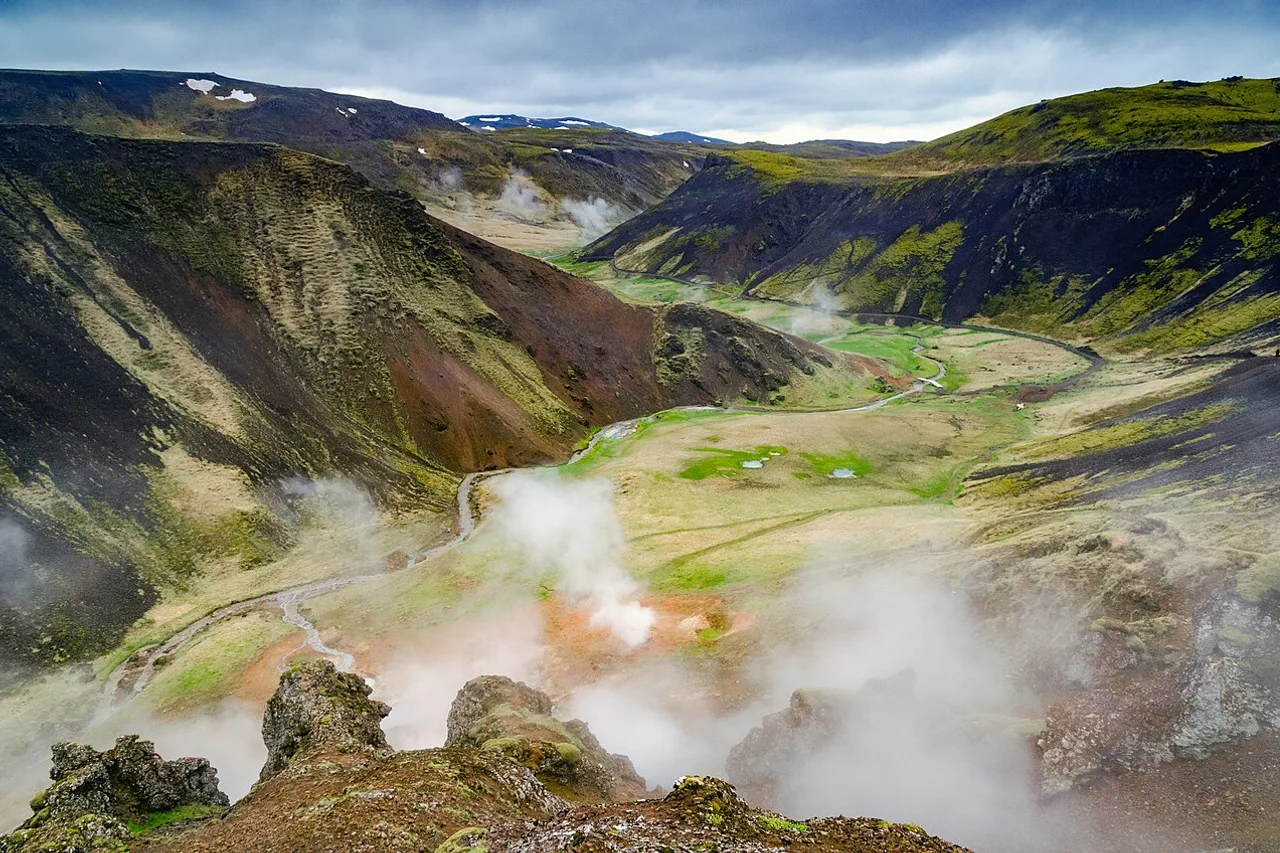
Reykjadalur, the river you bathe in. Forty minutes from Reykjavík, above Hveragerði, a whole valley steams. You walk up: about 3 kilometres each way for 340 to 380 metres of climb, three to three and a half hours there and back with a soak. At the top the river settles between 36 and 40 °C, with wooden walkways along the bathing stretch. Bathing is free, all year, at any hour; only parking is charged, roughly 1000 krónur for a five-hour pass through the local parking apps.
Three details the landscape does not mention. The “changing rooms” are wooden boards offering almost no privacy. There is not one bin on the trail: everything you carry up comes back down with you. And you must stay on the path — geothermal ground is a thin crust over scalding mud, and the vegetation here takes years to grow back.
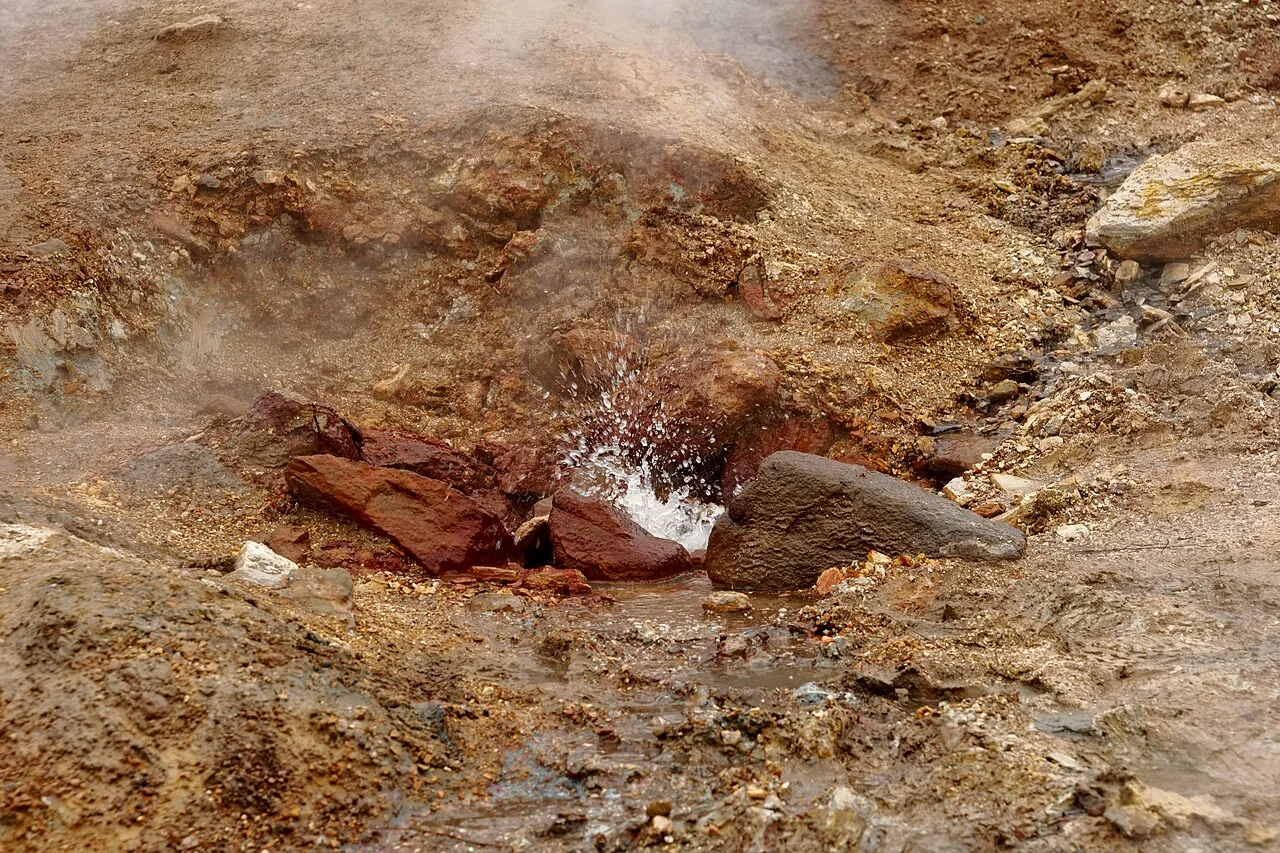
Look at this photograph, taken in that same valley: this one comes out hot enough to burn. Nothing about it looks different from the warm river people bathe in a few hundred metres away. Which is why you never test an Icelandic spring “just to see”: you bathe where others are bathing and where a sign allows it, and nowhere else.
Seljavallalaug, the pool against the mountain. Below Eyjafjallajökull, a 25-metre pool built against the rock face to teach fishermen’s children to swim. Free, 15 to 20 minutes’ flat walk from the car park, with a stream to cross — bring shoes that can get wet.
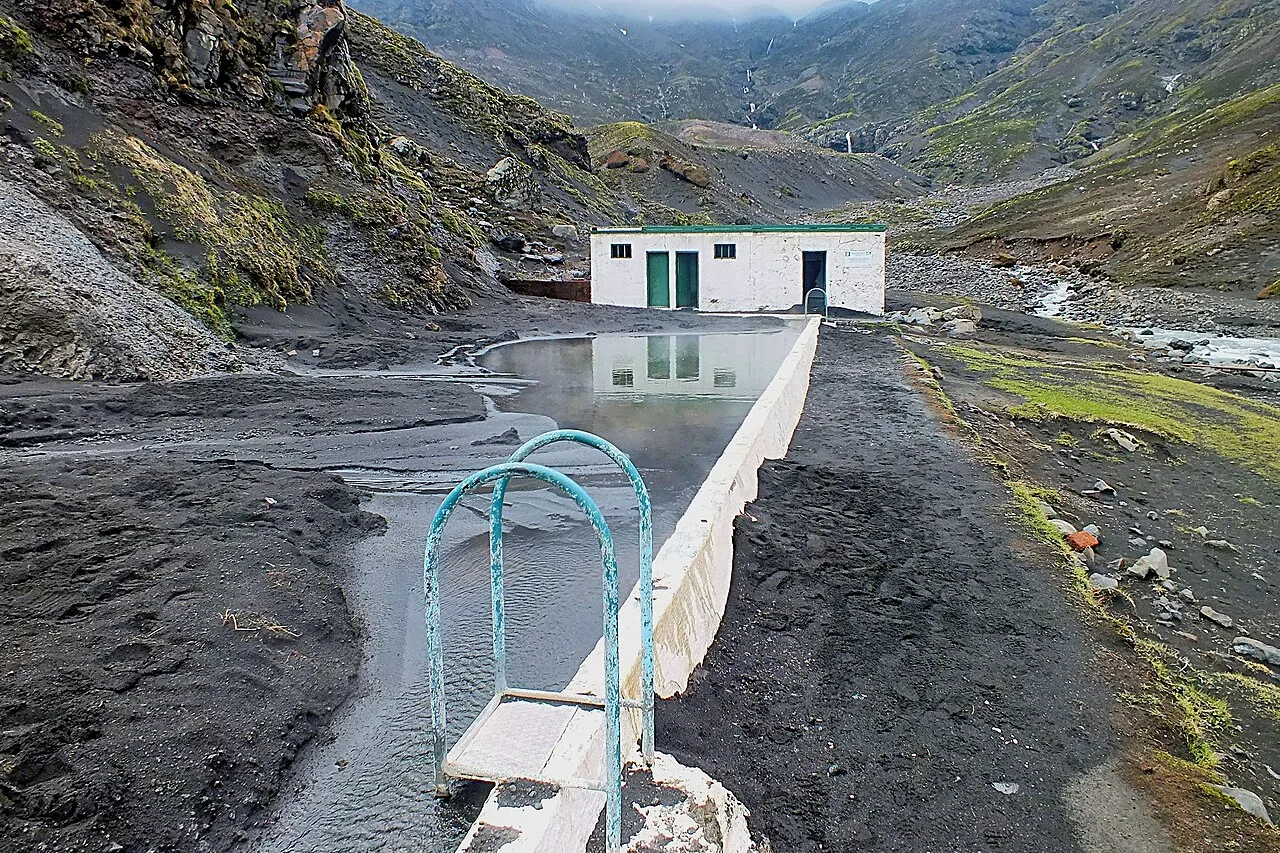
And here the truth serves better than the brochure: the water is lukewarm, not hot, and it is green. The pool is cleaned once a year, by local volunteers; algae return in spring and the bottom turns slippery by summer. There are no toilets, no showers, and the changing stalls have no doors. People who come for the photograph often leave disappointed; people who come for the place — a 1923 pool at the bottom of a black valley — find exactly what they were after.
One thing unites all these springs, and it is decisive: not one of them is served by public transport. Of the six places in this article, five require a car — that is the condition of entry, not a comfort. Compare rental totals on your real dates takes a few minutes and avoids the extras billed on arrival; we set out the traps in our guide to renting in Iceland, and what it really weighs in the budget for a week.
Developed springs: the best value in the country
Between the neighbourhood pool and the showpiece lagoon sits a middle family almost nobody mentions, and it is probably the best deal in Iceland: real springs, with changing rooms and genuinely hot water, at a third of the big lagoons’ price.
The Secret Lagoon, in Flúðir — 4500 krónur, around thirty euros. It is not a modern spa: it is the Gamla Laugin, “the old pool”, dug in 1891, the oldest swimming pool in Iceland. The water arrives naturally between 38 and 39 °C and renews itself at 10 litres a second, which is why it stays clear. A small geyser puffs at the edge every few minutes. It sits on the Golden Circle, which makes it the natural end to that loop.
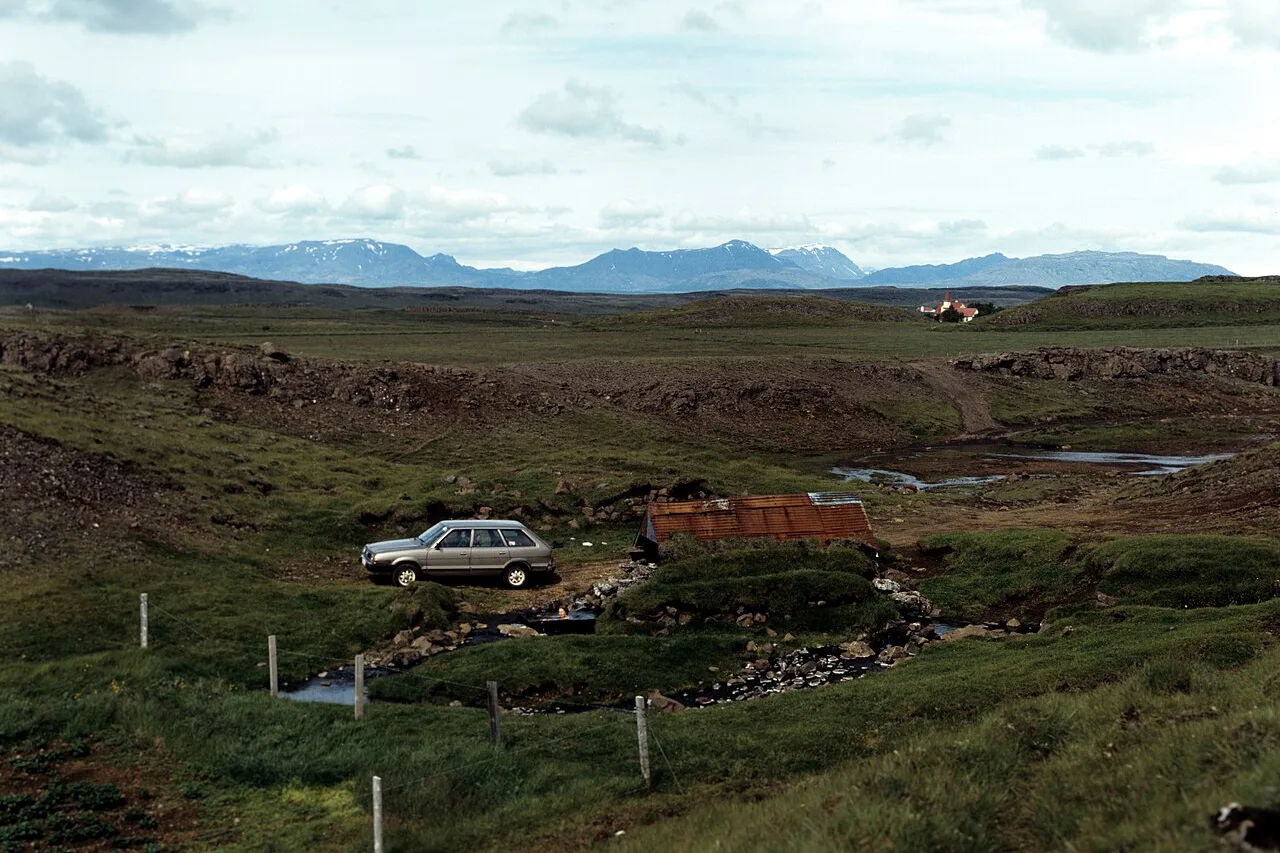
Hrunalaug, and a correction that needs making. This little spring near Flúðir still appears in dozens of guides as “free”. It is not any more. The owner’s posted rate is 3000 krónur before 2 pm and 3500 after for an adult, 2,000 to 2,500 for 11- to 15-year-olds, free under ten — and visits are capped at 90 minutes. Hours shift with the season: 9 am–10 pm at the height of summer, 10 am–8 pm in deep winter.
This is not bad news, it is useful news. Look at the photograph: you are walking onto someone’s land — a meadow, a fence, a tin shed and a farm behind. The entry fee pays for the upkeep of a place that visitor numbers were wearing out. Arriving convinced it is free means leaving without a bath, or making a scene over twenty euros.
Laugarvatn Fontana, also on the Golden Circle, completes the family: baths at the lake’s edge, a sauna set over a spring, and the option of plunging into cold water between sessions. We checked its hours — 10 am–9 pm from 1 June to 30 September, 11 am–9 pm the rest of the year — but we are not quoting its price: two public sources give very different figures and the official site does not display it. An approximate price is worse than no price.
Showpiece lagoons: what you are actually buying
That leaves the family everyone starts with, and there is no reason to sneer at it — provided you know what you are buying.
The Blue Lagoon starts at 11990 krónur, more than eighty euros, and rises beyond 14,990 for packages with a robe and a drink. Booking is compulsory: there is no walk-in entry, and turning up at the door achieves nothing. Parking, by contrast, is free. The Sky Lagoon, opened in 2021 in Kópavogur, runs between 9990 and 12990 krónur: an infinity edge facing the Atlantic, a seven-step ritual alternating hot, cold and steam, and fifteen minutes from central Reykjavík — the easiest to reach without a car.
The part the brochures do not lead with. The Blue Lagoon sits on the Reykjanes peninsula, which has erupted repeatedly since late 2023. The site has been evacuated several times, notably in February 2024 and July 2025, and one lava flow destroyed a hot-water pipeline serving the region. It was not damaged — barriers protect it — and in 2026 no eruption is under way: Grindavík has reopened and the Blue Lagoon is operating normally.
So the risk is not your safety, it is your schedule. Do not rest your only bathing day on a booking in that area, and remember that any spring from the sections above makes a perfectly good fallback. If you do choose a lagoon, book early: late-afternoon slots go first, summer and winter alike. Compare slots and packages shows availability for both major lagoons in one place, which saves opening two ticket sites at once.
One note for the north, and it calls for caution: the former Mývatn Nature Baths reopened in July 2026 as Earth Lagoon, fully rebuilt, with a steam cave and packages announced from 7,900 krónur. The reopening is too recent and too thinly documented for us to recommend it: we are flagging it, not vouching for it.
Choosing, in five lines
To sum up, because it all comes down to one question: what are you willing to give? Money, walking, or a little embarrassment.
| Place | Access | What it costs | What to know first |
|---|---|---|---|
| Laugardalslaug | bus, or on foot from the centre | 1430 ISK | tubs from 5 to 42 °C, one filled with seawater |
| Reykjadalur | 3 km walk, 340 m of climb | bathing free, 1000 ISK parking | no bins, no showers, never leave the path |
| Seljavallalaug | 15–20 min on the flat, one stream to cross | free | lukewarm and green in summer, no toilets, no doors on the changing stalls |
| Hrunalaug | car, near Flúðir | 3000 ISK before 2 pm, 3500 after | private land, visits capped at 90 minutes |
| Secret Lagoon | car, on the Golden Circle | 4500 ISK | dug in 1891, water at 38–39 °C |
| Blue Lagoon | car or shuttle, near the airport | from 11990 ISK | booking compulsory, active volcanic area |
① No car, based in Reykjavík: the neighbourhood pool. 1430 krónur, every day, and the most genuine experience in the country. The only obstacle is the shower, and it lasts thirty seconds.
② A car and half a day: Reykjadalur. Three kilometres uphill, a river at 36–40 °C, and nothing to pay but the parking.
Full guide: Car Rental in Iceland: Prices, Insurance and F-Roads
③ You want heat and comfort without the price: the Secret Lagoon at 4500 krónur, or Hrunalaug at 3000 — knowing that it now charges, and that you get an hour and a half.
④ You want the setting and you own it: book early, and keep a fallback if your lagoon is on the Reykjanes side.
⑤ In winter, reverse the reasoning. A hot bath outdoors at four in the afternoon, in the dark, is one of the great moments of an Icelandic trip — and a pool is often the best place from which to watch the northern lights. Our comparison of the seasons sets out what each one actually allows.
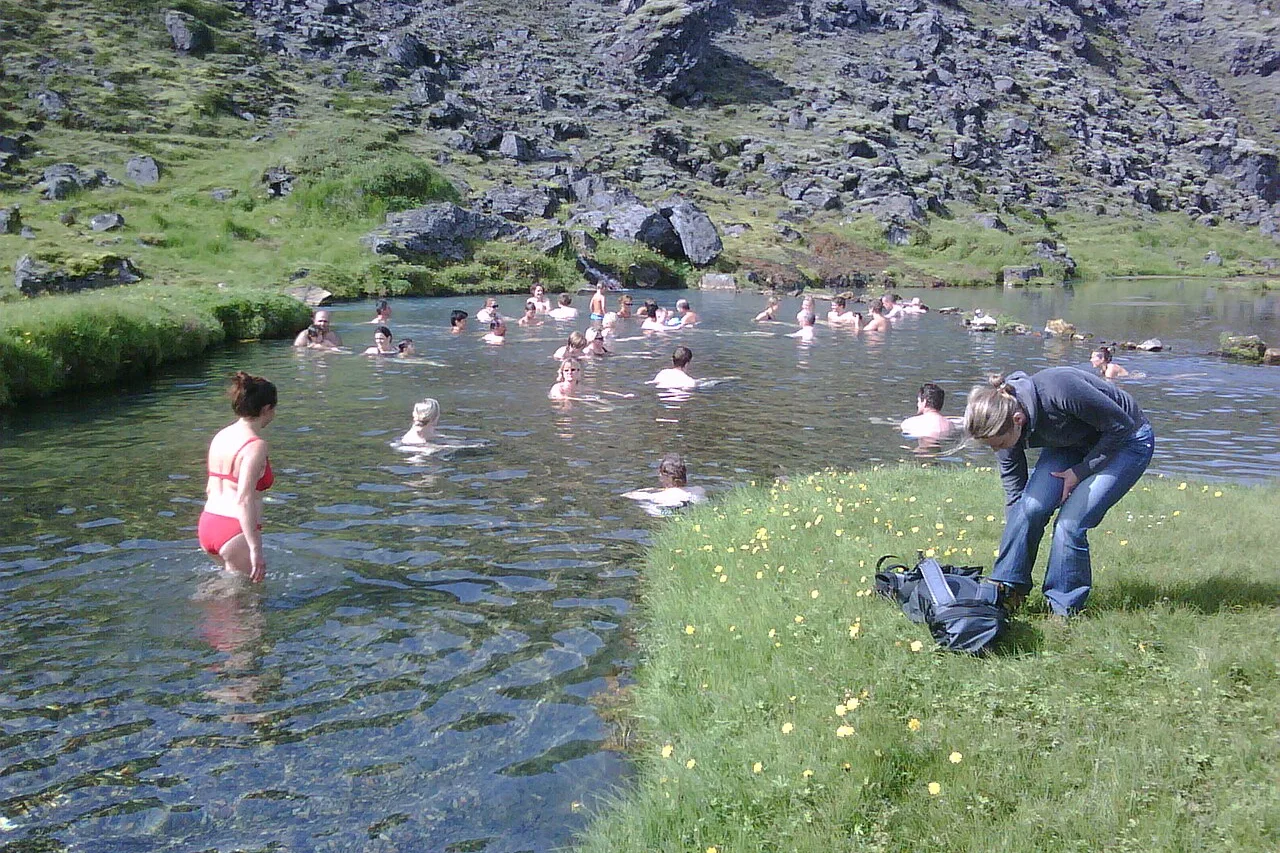
A last word, because it prevents a disappointment. “Free” and “wild” do not mean “empty”. Iceland’s open springs have been in every guidebook for twenty years, and you will share a river with thirty people on an August afternoon. What you are looking for is probably not solitude — that exists, but it is paid for in hours of gravel track — it is hot water, outdoors, in a landscape that exists nowhere else. Iceland gives you that for 1430 krónur, and the Ring Road in seven days takes you past it daily.
Top-rated activities in Iceland, bookable online: